
1
Career profile & lifetime achievement of UCA Werner Mauss, active since 1965
Mr. Werner Mauss has no criminal record anywhere in the world.
He rescued 122 hostages who were being held under threat of death.
Charges of tax evasion have been officially dropped!
werner-mauss.com/documents.html?documents
In July 2025, all proceedings against Mr. Werner Mauss were mutually terminated by
agreement with the Bochum Public Prosecutor’s Office, the Bochum Regional Court,
and the Düsseldorf Fiscal Court. All proceedings were thus irrevocably settled for tax
purposes. Furthermore, there are no outstanding tax liabilities to the German tax au-
thorities. The formal dismissal of the case took place in November 2025. The procee-
dings are therefore definitively closed without a conviction.
Mr. Werner Mauss is known in Germany and Europe as an undercover agent (UCA) for Ger-
man and Western security agencies. He was the first UCA of the Federal Republic of Germany
and was furthermore protected by a written contract with the Federal Criminal Police Office
(BKA) – werner-mauss.com/documents/Agreement_BKA_23_12_1976.pdf. Between 1965
and 1984 alone, in cooperation with law enforcement agencies, Mr. Werner Mauss infiltrated
approximately 15-25 different criminal organizations per year and tracked down and led to the
arrest of individual perpetrators, i.e., murderers and serious criminals. These included, for
example (as reported in the press), the police officer killer Alfred Lecki, who, after escaping
from the Essen correctional facility, committed serious bank robberies throughout Germany
together with the “escape specialist” Helmut Derks, much like Bonnie and Clyde. Mr. Werner
Mauss tracked down the aforementioned felons – first Helmut Derks in Alicante, then Alfred
Lecki in Marbella – and had them arrested in July 1970, acting as an undercover agent (UCA)
resp. civilian employee on behalf of the first investigative unit newly established at the BKA
after the war. Part of the stolen goods, a large amount of cash, was seized in Marbella.
During the aforementioned period (19 years), more than 300 criminal organizations were dis-
mantled from within by Mr. Werner Mauss as a UCA, under the leadership of government
agencies and primarily in cooperation with special task forces and special prosecutors’ offices,
pursuant to Section 129 of the German Criminal Code (formation of criminal organizations).
In the process, more than 2,200 individuals were arrested.
During his tenure, former BKA President Dr. Herold referred to Mr. Werner Mauss, in conver-
sations with experts, as his “secret weapon”. This is public knowledge. Throughout the entire
period up to 2017, Mr. Werner Mauss, at great personal risk, rescued numerous individuals
facing torture and death from captivity in Asia, South and Central America, and the Middle
East.

2
Mr. Werner Mauss is currently striving – and so far successfully – to save the life of one such
person, that is, someone who has been (politically motivated, unlawfully) sentenced to death.
Others belonging to that group of people have already been executed.
Throughout countless missions, including those in support of human rights, Mr. Werner Mauss
has always adhered to the principles of the rule of law, in close coordination with law enforce-
ment agencies resp. Western security authorities. Mr. Werner Mauss has always acted in the
interest of the internal security of the Federal Republic of Germany and its concerns.
From 1965 to the present, Mr. Werner Mauss has consistently distinguished himself through
intelligence integrity. He has no criminal record anywhere in the world. Furthermore, from 1979
to 1985, Mr. Werner Mauss flew 3,700 flight hours without a co-pilot, using the turboprop air-
craft provided to him and covered by the federal security authorities, subsequently under IFR
conditions, often in the most challenging weather conditions, accompanied by prosecutors,
investigating judges, officials from special commissions, state security, and intelligence ser-
vices across Europe to combat crime – all without a single accident – https://www.werner-
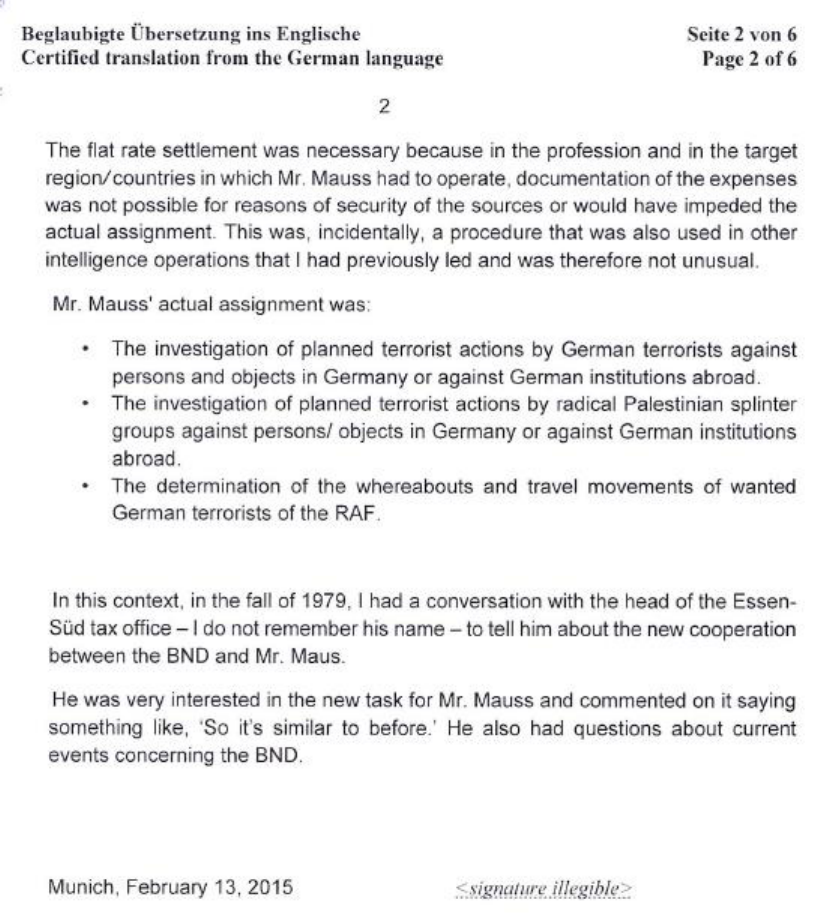
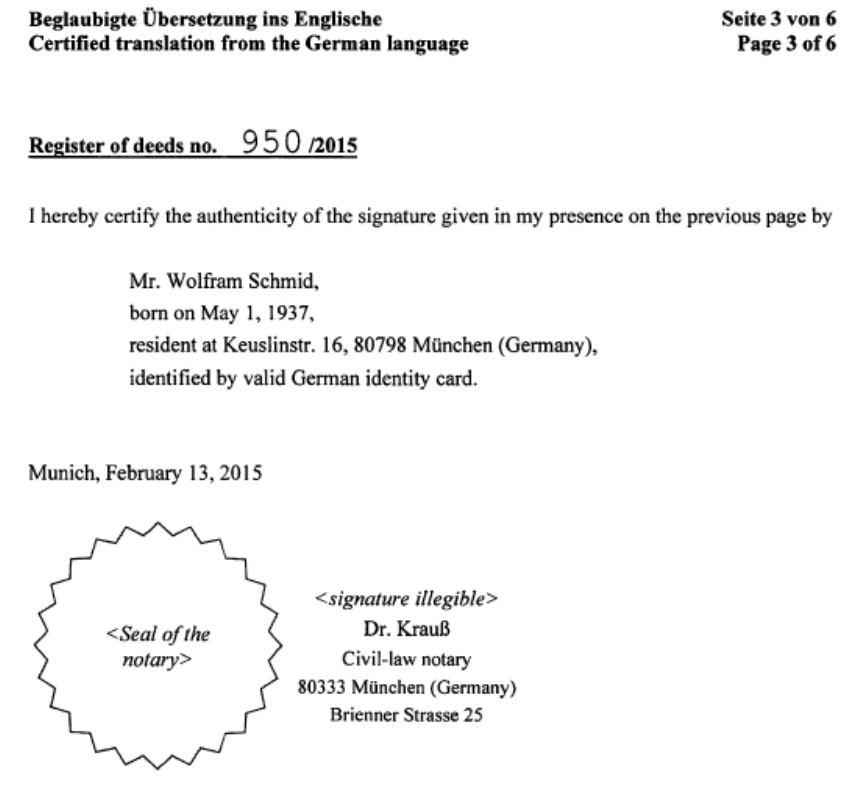
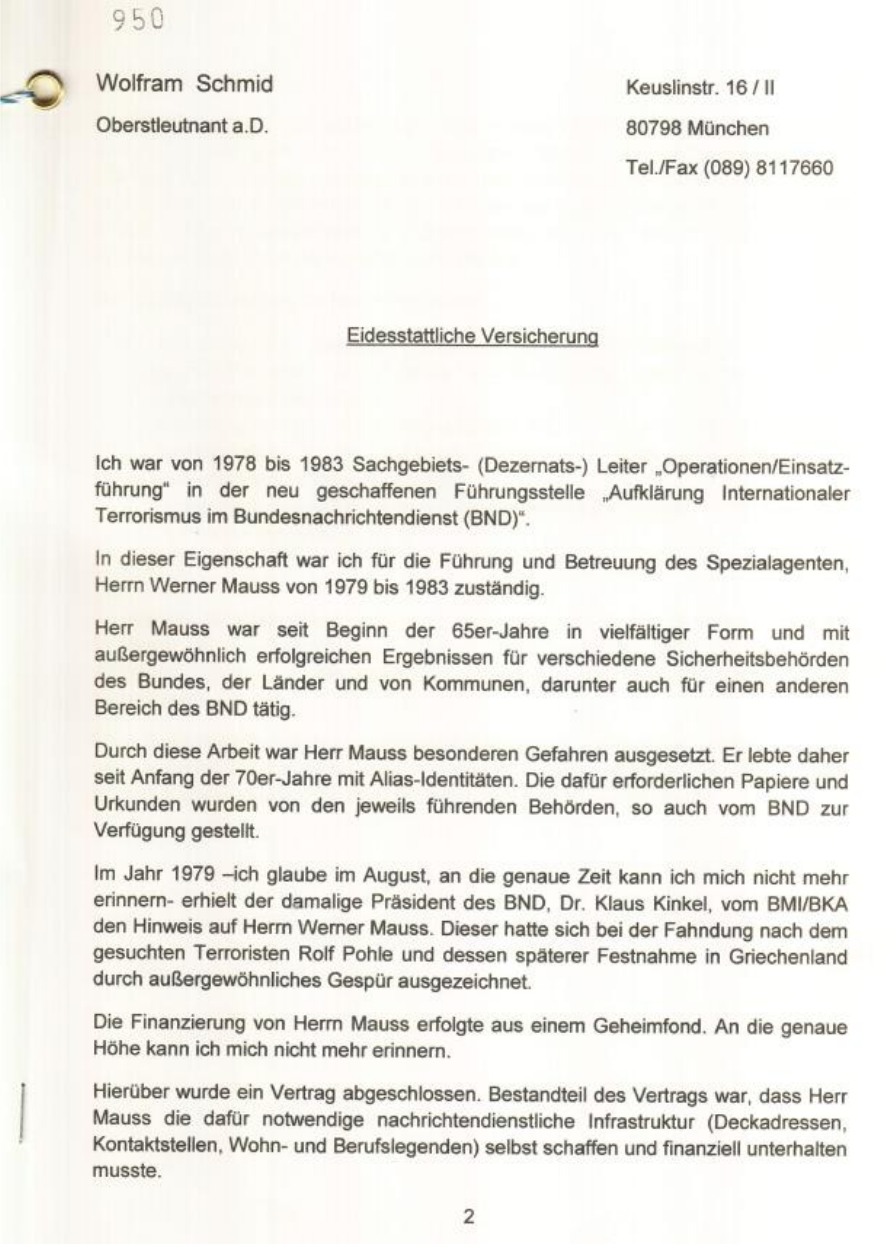
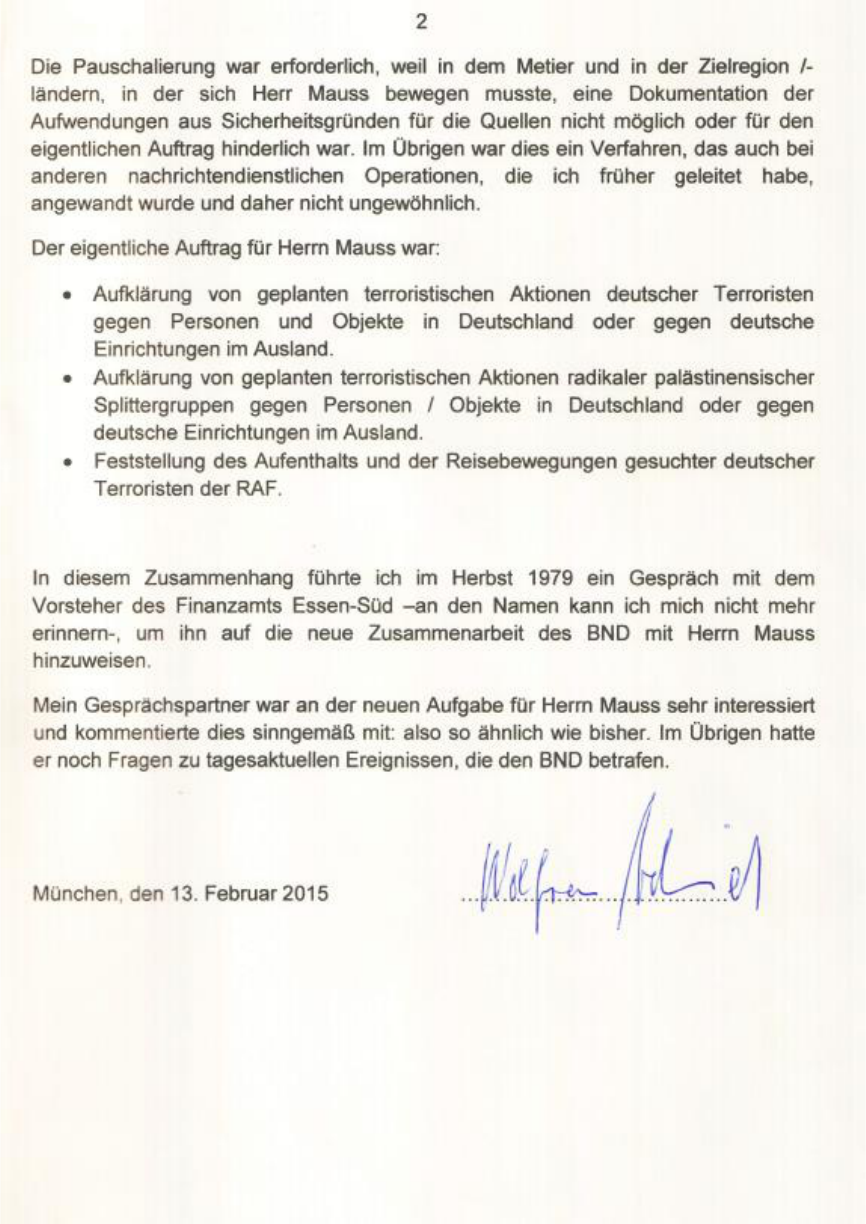
mauss.com/downloads/2-25/Pilotenscheine.pdf. In 1985, shots were fired multiple times at
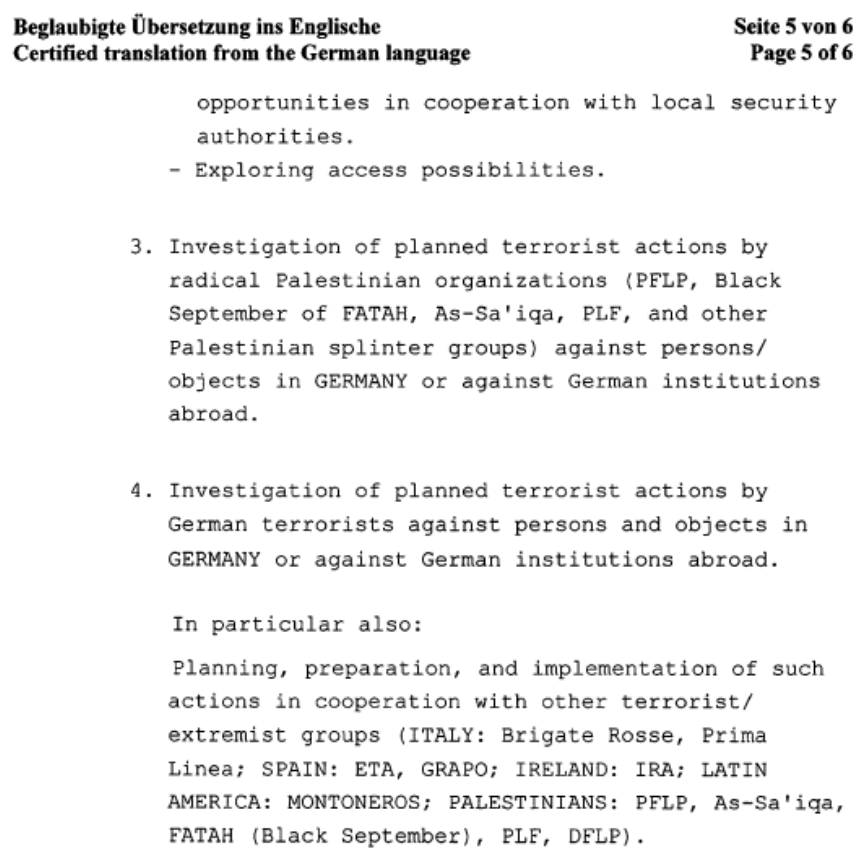
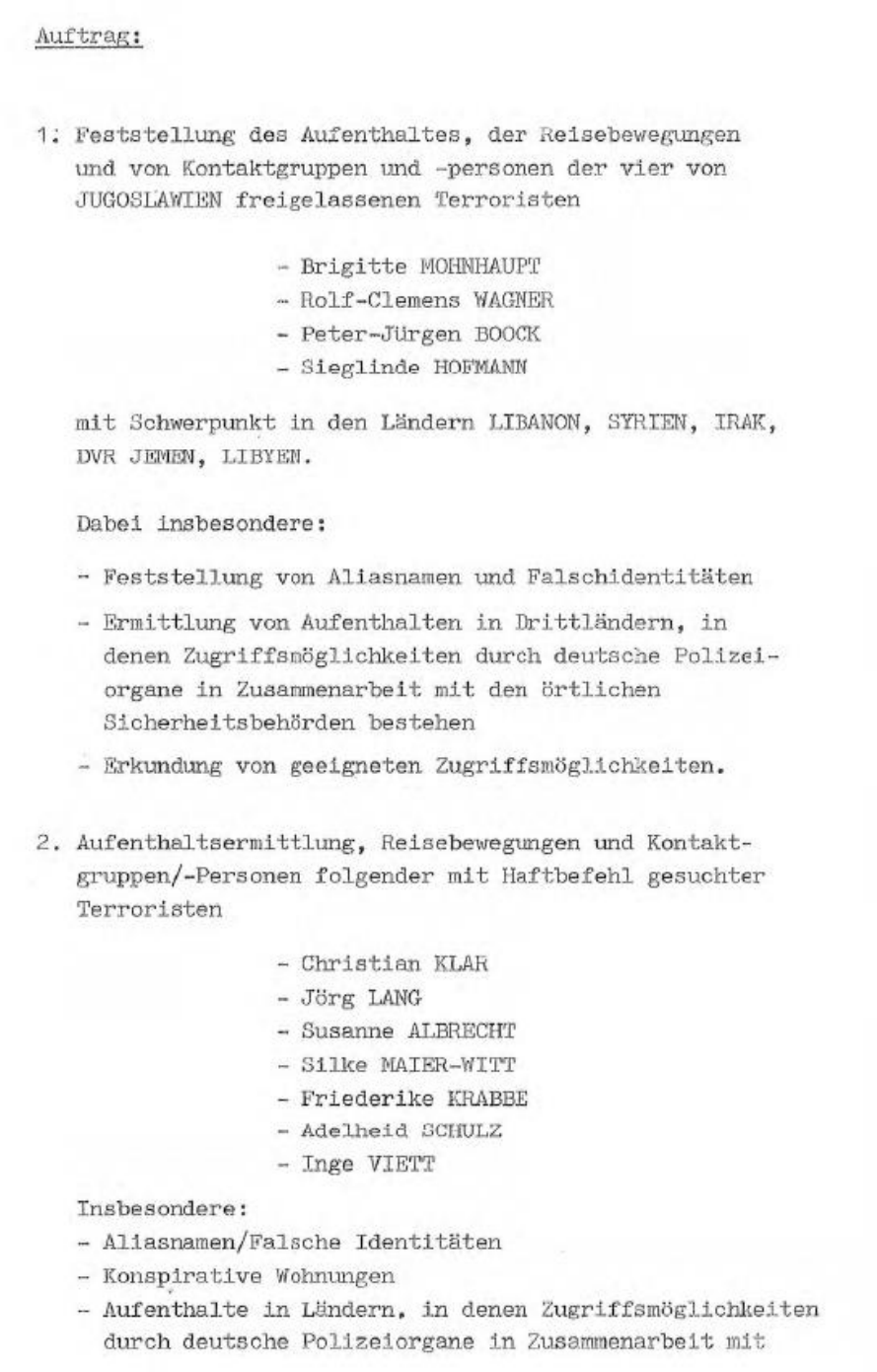
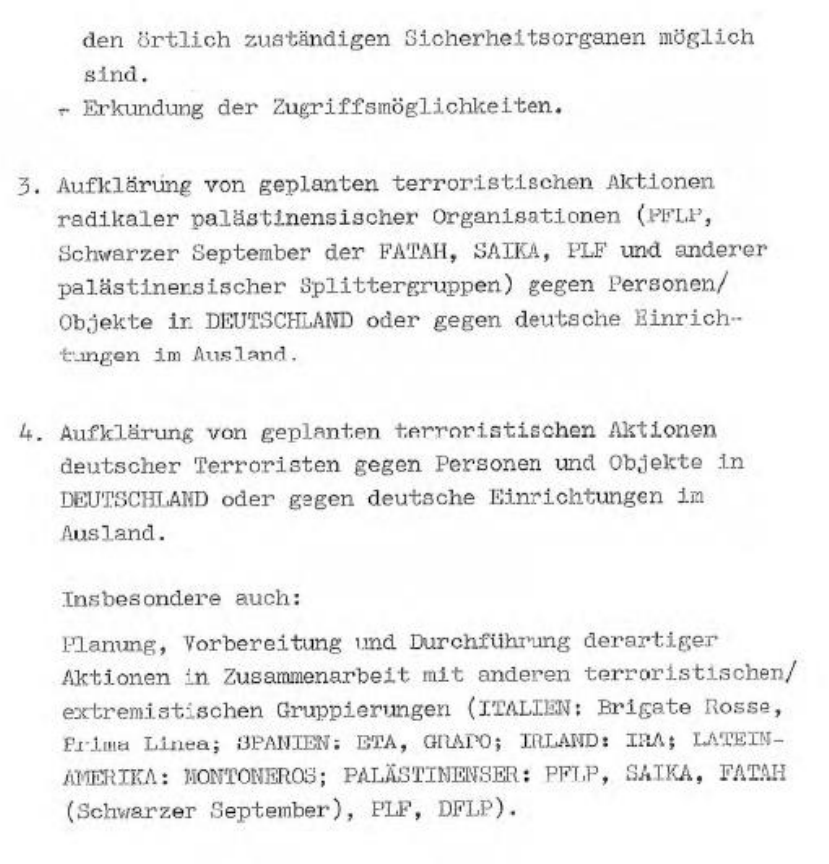
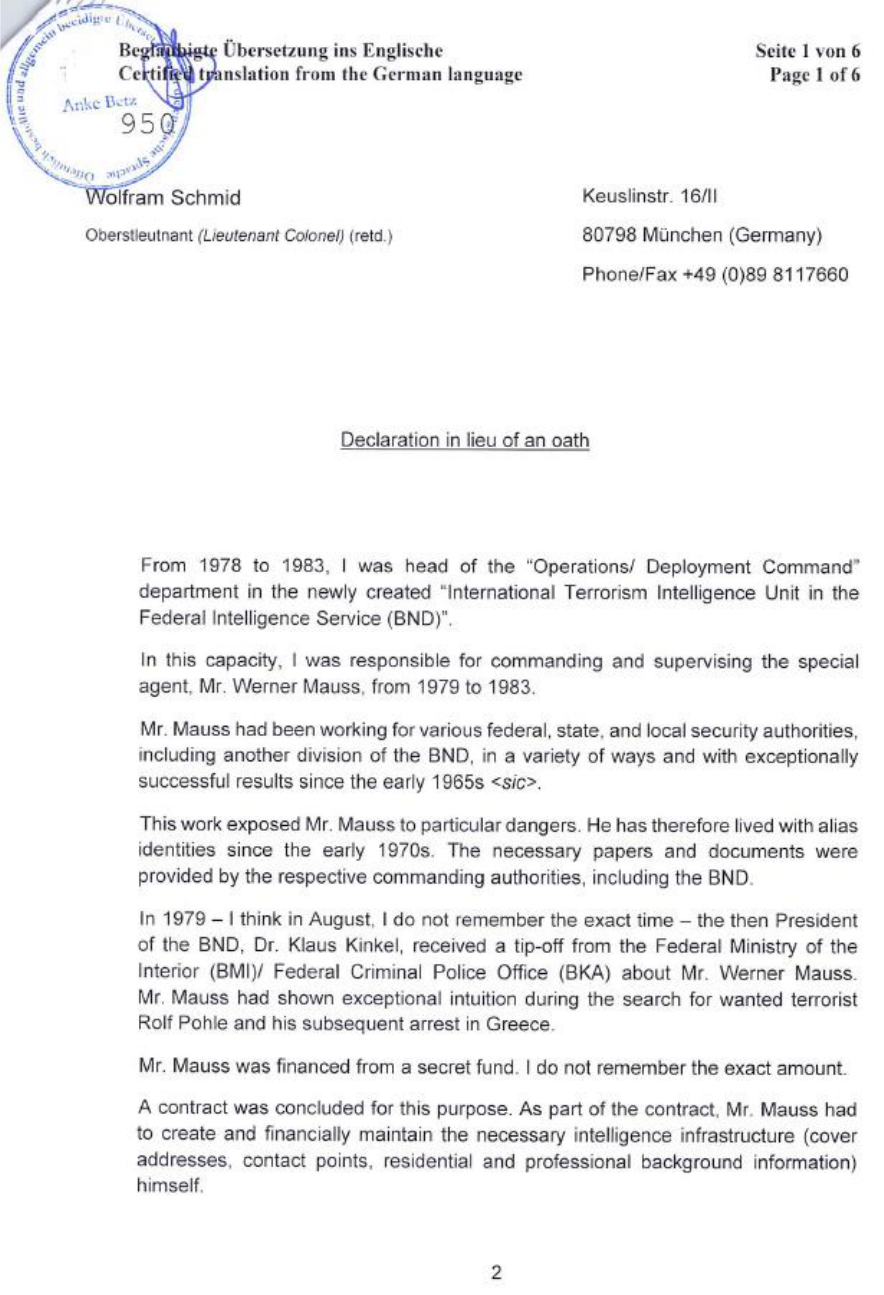
Mr. Werner Mauss’s aircraft as it was approaching for landing. Since the perpetrators could
not be identified, he gave up flying for safety reasons.
Mr. Werner Mauss has rescued hostages and helped solve major criminal cases; for example,
through UCA measures, he provided conclusive evidence against the thieves who stole the
Cologne Cathedral treasure in 1975. The perpetrators, Tunjic and Dalavale, were arrested in
Zurich on June 17, 1976, arranged by Mr. Werner Mauss, and the ringleader, Ernst, was ar-
rested in Milan on July 2, 1976, also arranged by Mr. Werner Mauss, who was assigned the
code “111” in all UCA operations conducted by the security authorities. The cathedral treasure,
which had been hidden in Yugoslavia, was recovered through covert operations by Mr. Werner
Mauss. It was superbly restored and is now back in the treasury of Cologne Cathedral. On
February 23, 2024, at 8:15 p.m., the public broadcaster WDR aired a documentary titled “The
Theft of the Cologne Cathedral Treasure”. This program is available in the ARD media library
or via the following link – Mr. Werner Mauss’s operation is documented starting at the 24:30
mark: https://www.werner-mauss.com/eh5v.files/html5video/Domschatz-EN.html
The documentary offers a glimpse into German criminal history as well as contemporary Ger-
man history. Numerous (former) police officers, as well as the senior public prosecutor in
charge at the time, Ms. Mösch, speak out and report on the success of Mr. Werner Mauss’s
investigation. The documentary gives an impression of the effort required and thus makes it
clear that substantial costs are involved, which – then as now – are financed by a fund such
as the one in question here.

3
The operations listed below represent only a small fraction of Mr. Werner Mauss’s operations
around the world.
1967/1970 – Subversive operation on behalf of the Federal Intelli-
gence Service (BND) against the former GDR resp. HVA (Foreign In-
telligence Agency, espionage division of the Ministry for State Secu-
rity - Stasi) within the area of interest of the Soviet Union at the time
The outcome of the operation, combined with the ongoing intelligence gathering, prevented
serious long-term threats to the internal security of the Federal Republic of Germany and Eu-
rope and their interests. Given the importance of the matter, then-Chancellor Kiesinger was
also informed about Mr. Werner Mauss’s mission. For security reasons, Mr. Werner Mauss
was provided with a basic cover identity for himself and his family under the name Nelson,
which, according to a BND commitment, he is permitted to use for the rest of his life. The
responsible BND department head, Folger (real name), later transferred to the BKA and be-
came department president. He stated after 1970 that this had been the BND’s most success-
ful operation. Parallel UCA operation by Mr. Werner Mauss on behalf of the BND against arms
and drug trafficking, target groups Beirut, Damascus, and Sofia. Operational confirmation by
the BND: werner-mauss.com/documents/Letter_Pres_BND-Praesident_Fed_Intel_Ser-
vice_Hans-Georg_Wieck_26-11-1987.pdf
Mr. Gerhard Folger, codename “Götz,” served as a department director at the BND beginning
in 1966 and headed a well-staffed BND branch office in Baden-Württemberg, where he was
responsible for a special operation targeting a senior cadre of the GDR’s foreign intelligence
service, the HVA. Around 1970, he transferred to the BKA to join the special department for
underground police investigations, which had been founded earlier by Chief Detective Dr.
Gemmer; this was the BKA’s first investigative unit with executive authority following World
War II. This department was responsible, among other things, for organized crime, kidnap-
pings, drug trafficking, international arms trafficking, and international vehicle smuggling. Ger-
hard Folger was appointed Director of Criminal Investigations for the Government by the Fed-
eral Criminal Police Office in Wiesbaden and later became Department President at the BKA.
1968/1969 – UCA operation pursuant to Section 129 of the German
Criminal Code against a European criminal organization
As part of a preliminary operation targeting a criminal organization operating in Belgium,
France, Italy, Germany, and Austria, Mr. Werner Mauss, in administrative assistance for the
BKA, received a cover identity from the Munich Police Headquarters, which included a fire-
arms permit, a driver’s license, etc. The target group, which was also under investigation for
various homicide offenses, was involved in organized burglaries, car theft, handling stolen
goods, as well as the production of counterfeit currency and forged vehicle documents.
4
For information-gathering purposes, while employing confidence-building measures, Mr. Wer-
ner Mauss met with the target persons, including a long-sought-after murderer of Austrian
nationality, in Brussels, Vienna, and Paris. At the end of a lavish dinner on March 26, 1969, at
a Parisian gourmet restaurant, the establishment was surrounded by spotlights from the
French Anti-Gang Brigade following a tip from Marseille. Mr. Werner Mauss’s companions,
who were wanted by Interpol, as well as Mr. Mauss himself, were arrested and placed in police
custody in a shared cell.
Unfortunately, the BKA coordination officer in charge of the operation was on vacation due to
the upcoming Easter holiday. His colleagues were not familiar with Mr. Werner Mauss’s code
name.
This was the reason why the BKA did not intervene, and Mr. Werner Mauss was transferred
to Santé Prison along with the other eight prisoners. In a side room, he saw the guillotine,
covered with black cloths, which was still in use at that time. During the search, the police had
overlooked a revolver that Mr. Werner Mauss was carrying, which he handed over to the sur-
prised officers before being transferred to Santé Prison. At Santé Prison, he was also placed
in a cell with his companions. This gave him the opportunity, over the course of nine days, to
question the individual target persons about the organization’s structures, supporters, and
leaders. One of the leaders was a member of the “Corsican Union” - an organization that was
very dangerous at the time. He remains significant to this day. This leader of the “Corsican
Union” happened to encounter Mr. Werner Mauss by chance and unexpectedly in the summer
of 2016 in southern France, along with other criminals. However, the aforementioned individ-
ual did not recognize Mr. Werner Mauss.
After nine days of “detention” at Santé Prison, Mr. Werner Mauss was informed over the loud-
speaker that a lawyer would be visiting him. However, waiting for him in the visiting room was
the BKA officer and then-head of Interpol Germany, Chief Detective Jürgen Jeschke. Under a
cover story, Mr. Werner Mauss said goodbye two days later at Santé Prison to the target
persos still detained there, who gave him a letter (secret message) to deliver to the organiza-
tion’s leader in Rome to inform him of their detention and further details.
A few days later, Mr. Werner Mauss received a new cover identity, which he used to travel to
Rome. However, for security reasons, Interpol Wiesbaden registered him with Interpol Rome
under a different alias. There he met one of the most important gang leaders, Dario de Cesare.
5
While Mr. Werner Mauss was still talking with the aforementioned individual at a street café
on the Piazza del Popolo, a police officer unexpectedly pulled up on a motorcycle and handed
de Cesare an official Interpol letter in which Mr. Werner Mauss, under his alias, was registered
by Interpol Wiesbaden for his UCA assignment in Rome. However, the identity Mr. Werner
Mauss used with de Cesare did not match the identity named in the Interpol letter, as de-
scribed above. This saved Mr. Werner Mauss’s life. That very same day, after consulting with
the BKA, he met with the then-head of Interpol Rome, Dr. Fariello, and his deputy. The sub-
sequent covert discussions with the criminal organization in Rome were accompanied by a
large special task force of selected Italian police officers conducting surveillance and wiretaps.
Mr. Werner Mauss's highly complex and life-threatening mission lasted another two months.
This was followed by arrests in Germany, Austria, Belgium, France, and Italy.
Dario de Cesare and the deputy police chief of Rome, Scire, were arrested in 1969 along with
26 other detectives from the Rome Police Headquarters, as well as officials from the Interpol
telex office and customs officers - a total of approximately 80 suspects. Several secret apart-
ments and two printing shops producing counterfeit money and forged documents were un-
covered and searched. Identification documents obtained through burglaries were also
seized.
1970 – Assignment as the first target investigator for the new BKA
investigative unit
In 1969, the Federal Criminal Police Office established the first new investigative unit since
the war, headed by Chief Detective Dr. Gemmer, who had previously led the HLKA investiga-
tive unit (Hessian State Criminal Police Office). Then-Interior Minister Genscher (FDP) placed
police killer Alfred Lecki and his accomplice Helmut Derks at the top of the most-wanted list
as enemies of the Federal Republic of Germany. The cop killer Lecki and the robber Derks
had, much like Bonnie and Clyde, committed a series of robberies in which people were also
seriously injured.
The first prison break by the violent criminal Lecki took place in August 1968; a year after his
escape, during a routine police patrol, he shot and killed one officer, seriously wounded an-
other, and was eventually recaptured shortly thereafter. By Christmas 1969, as the prison
choir sang “Macht hoch die Tür, die Tor macht weit (Open wide the door, throw open the
gate)”, Lecki had already staged his next escape: Using a homemade duplicate key and with
the help of Helmut Heinz Derks, who had been sentenced to seven years in prison for robbery,
he managed to escape from pretrial detention in Essen.
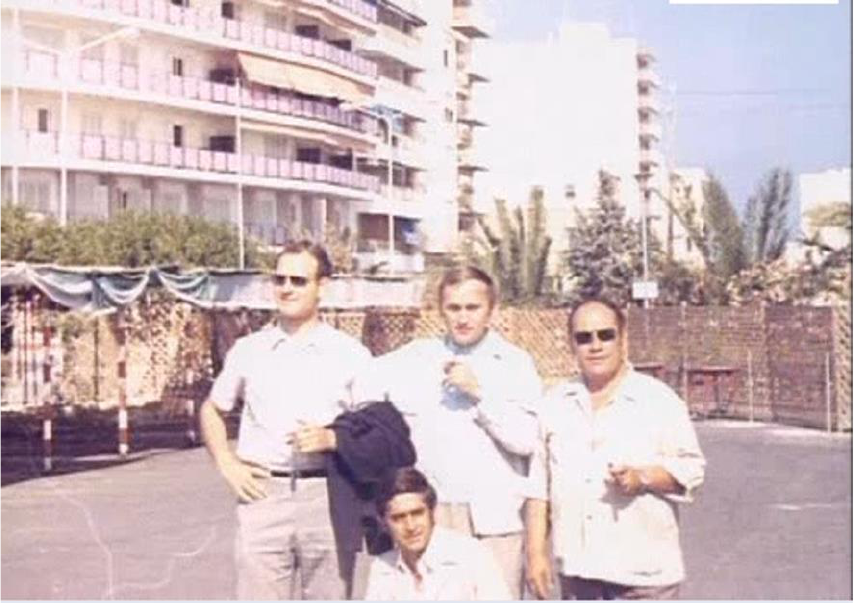
6
The two robbed banks together and managed to steal a total of five million marks. Chaos
ensued during the police investigation; a man who looked like Lecki was shot, and other inno-
cent people were taken into police custody. For the first time in legal history, then-Federal
Minister of the Interior Hans-Dietrich Genscher tasked the Federal Criminal Police Office with
the manhunt for the fugitive criminal.
The Federal Criminal Police Office appointed Mr. Werner Mauss as the first lead investigator
for the BKA’s new investigative unit. He succeeded in first luring one of the wanted felons,
Helmut Derks, into a trap in Alicante by employing intelligence resources. After obtaining per-
mission from the Director General of the Spanish Police and in close coordination with the
head of the BKA investigative unit, Dr. Gemmer, he had himself locked up in Derks’s cell for
one night under a cover story. There, Mr. Werner Mauss learned from Derks the exact where-
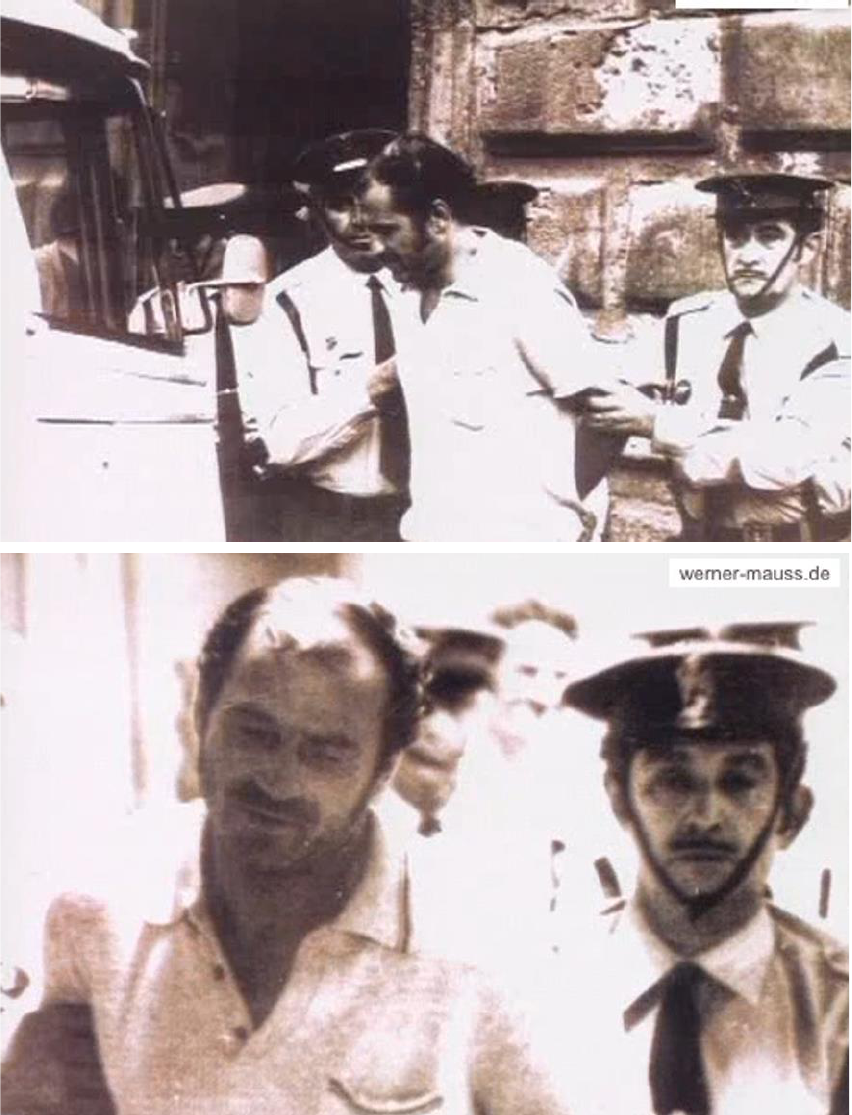
abouts of Alfred Lecki in Marbella. That very morning, Mr. Werner Mauss drove to Marbella
with a unit of the Spanish Criminal Police – see photo. Lecki was apprehended in his apart-
ment after he had entered his bathroom. Cash from robberies committed in Germany, various
identification documents, and other pieces of evidence were seized.
7
Following discussions in Madrid with the Director General of the Spanish security agencies
and on the recommendation of the then-head of Interpol Spain, Tomás Astilleros Domingo, a
unit of the Spanish Criminal Police was placed at Mr. Werner Mauss’s disposal for the entire
duration of his operation in Spain. This was done on the orders of Admiral Luis Carrero Blanco,
the right-hand man of Spanish Head of State Francisco Franco. Franco swore him in as head
of government in 1973. Six months later, Admiral Carrero Blanco was assassinated in an ETA
bomb attack.

8
News of the Federal Criminal Police Office’s successful investigation spread around the world.
Once again, Lecki and Derks were sentenced to long prison terms for the robberies they had
committed.
A lucky break in Werner Mauss’s investigation: While searching for Derks in Alicante, he no-
ticed that the doors of a suspicious car did not sound hollow - he reported his suspicions to
the BKA. As a result, the car’s owner, Reiner Curtius, was arrested in Kehl on July 2, 1970,
with 34.6 kg of hashish.
1971 – UCA operation - Seizure of 197 rifles - Arrest of perpetrators
On September 25/26, 1971, 197 rifles were stolen from a railcar on the Bundeswehr’s (Ger-
man Armed Forces) siding at the Bickenbach train station. The security authorities of the Fed-
eral Republic of Germany were extremely concerned, as it was feared that the theft might be
linked to the planning of a terrorist attack. The BKA was placed in charge of the investigation.
The BKA’s investigative division informed Mr. Werner Mauss about the aforementioned theft.
Within just 38 days, he succeeded in tracking down the perpetrators through his network in
Germany’s criminal underworld, which he had built up since 1965 with the approval of the
State Criminal Police Offices and since 1969 with the approval of the BKA. He made covert
contact with the target persons and learned that the group of perpetrators had sunk the rifles,
packed in plastic bags, into a branch of the Rhine. Since the water level of the Rhine had
risen, the criminals purchased diving equipment in Frankfurt to recover the stolen goods.
After days of targeted negotiations, Mr. Werner Mauss succeeded in luring the perpetrators
into a trap in cooperation with the BKA, head of special task force, Senior Detective Superin-
tendent Schröder, and Senior Detective Superintendent Breiter - Frankfurt Criminal Investiga-
tion Department, on November 9, 1971, at the forest parking lot in front of the restaurant “Un-
tere Schweinestiege,” near Frankfurt Airport Hotel, at around 11:00 p.m. The group of perpe-
trators, including Pöthig and others, was arrested. All stolen rifles, diving suits, vehicles, and
other evidence were seized by the BKA.
1972 – UCA operation against a Mafia organization acting in Europe
Due to his successful operation in 1968/1969, during which he was arrested along with the
target persons he had lured to Paris (including a murderer) and held with the perpetrators at
the Santé Prison, Mr. Werner Mauss, as a civilian employee of the BKA, was officially invited
to Paris by the French anti-gang brigade DCPJ-BCDRC on October 16, 1970, for an exchange
of information. The meeting was attended by Chief Detective Dr. Gemmer from the BKA, Chief
Detective Jeschke from Interpol Wiesbaden, and on the French side, Mr. Bellemin-Noel, head
of the Anti-Gang Brigade, Mr. Bourdeaux, then Mr. Bellemin-Noel’s deputy, and case officers.
9
At the request of the French authorities and intelligence network, Mr. Werner Mauss was as-
signed by the BKA as an undercover agent (UCA) against a criminal organization operating
throughout Europe. Under Special Prosecutor Heinrich of the Frankfurt Public Prosecutor’s
Office, the BKA established a special task force named “514” – Ref. 70 JF 217/71, known as
“Euro Gang,” led by then Chief Detective Strass, for which a villa was rented in Frankfurt to
serve as a covert headquarters, partly to safeguard Mr. Werner Mauss’s role as UCA and to
protect the various wiretapping operations. The special task force was also supported by se-
conded criminal investigators from France, Italy, Belgium, and the Netherlands. Mr. Werner
Mauss’s UCA operation targeted the entire group of perpetrators, extending all the way to the
headquarters of the mafia-like criminal organization.
Prior to Mr. Werner Mauss’s operation, the French Anti-Gang Brigade had unsuccessfully at-
tempted to infiltrate the group during a UCA operation. The officer who carried out this under-
cover operation was exposed after being tortured and was shot by gang member David Chris-
tian Jacques, born in 1931. Working closely with the head of the Anti-Gang Brigade, Mr. Bel-
lemin-Noel, and Dr. Gemmer of the BKA, Mr. Werner Mauss succeeded in his operations in
France and Italy in securing the arrest of this target individual in a non-European country.
Dr. Karlheinz Gemmer was a German lawyer and senior
criminal investigator who played a pivotal role in the
Federal Criminal Police Office (BKA) and the police
force, particularly in the 1970s and 1980s. He served as
head of the investigative unit at the Hessian State Crim-
inal Police Office (HLKA). He also served as Depart-
ment President the BKA, where his responsibilities in-
cluded leading the Institute of Criminalistics and the In-
vestigations Department. In addition, he headed the
BKA’s Intelligence Gathering and Investigation Unit. Af-
ter his tenure at the BKA and the Hessian State Criminal
Police Office, he moved to Frankfurt am Main to serve
as police chief. He was also a renowned author and
conference chair on topics related to criminalistics and
criminology.

10
1972 – UCA operation - Federal Criminal Police Office (BKA) and
State Criminal Police Offices (LKA) in Düsseldorf and Berlin
Dismantlement of a burglary and fence ring in Spain and Germany.
Mr. Werner Mauss exposed Dr. Scheuten, Chief Prosecutor and
Press Spokesperson in Krefeld, as a key accomplice and supporter
of the criminal organization. Suspension and arrest.
On behalf of the BKA, Mr. Werner Mauss spoke with Dr. Scheuten about initiating a prelimi-
nary investigation and wiretapping against the group of perpetrators that Mr. Werner Mauss
had infiltrated, based on Section 129 of the German Criminal Code (StGB). During the con-
versation, Mr. Werner Mauss noticed that Dr. Scheuten was acting suspiciously agitated and
exhibiting serious misconduct. After the conversation, Mr. Werner Mauss was warned by an
informant he had previously placed within the group of perpetrators that Dr. Scheuten was
one of the gang’s most important supporters. After the conversation, Dr. Scheuten exposed
Mr. Werner Mauss as a UCA to his accomplices. Consequently, the criminal organization de-
cided to shoot Mr. Werner Mauss. However, Mr. Werner Mauss was warned beforehand by
his informant and, from that point on, directed further covert measures against the criminals
through him. The Attorney General of Düsseldorf took over the investigation. All official and
private telephones of Prosecutor Dr. Scheuten as well as those of the gang members were
tapped. The entire group of perpetrators was arrested. On the matter: Excerpt from an article
published in the magazine “Der Spiegel” No. 20/1974 on May 13, 1974:
“A chief prosecutor from Krefeld is now being accused by colleagues
of bribery, aiding and abetting criminals, and other serious offenses.
The senior official came from the Krefeld judiciary - Chief Prosecutor Dr.
Ernst Josef Scheuten, 46. Sometimes by phone, sometimes in person at the
bar, the file expert, according to his own statement out of sympathy for a
fence, brought members of the dealer ring into the police investigation: An
undercover agent using the alias “Mirko” had participated in the Berlin art
discussion as a prospective buyer; the Federal Criminal Police Office was
investigating the case, and the telephones of those involved were presuma-
bly being tapped.”
11
From 1972 onward – Covert subversive operation against the RAF –
Arrest of Baader
Starting in 1972, Mr. Werner Mauss worked on behalf of the BKA under the supervision of the
head of the Security Unit, Mr. Römelt, and the department head, Mr. Ruckmich, in a covert
subversive operation against the RAF, based on an extra-legal emergency. As part of a con-
fidence-building measure, in coordination with the public prosecutor’s office responsible at the
time, Mr. Werner Mauss purchased a Ford stolen by another criminal organization from Por-
tugal at the price paid by a fence.
Using this vehicle, which had not yet been officially seized, he provoked a head-on collision
with the car of a couple supporting the RAF who were under surveillance by the Berlin State
Office for the Protection of the Constitution (LfV). In keeping with his cover story, Mr. Werner
Mauss was carrying a submachine gun and instantly conveyed to the RAF supporters his
background as a weapons procurer wanted by the police. One of his conversation partners
immediately agreed to help the alleged arms procurer. Mr. Werner Mauss fled with him from
the scene of the accident to a secret RAF apartment. A few days later, he was taken by the
aforementioned target persons to a commune in Strasbourg.
As part of this dangerous operation, Andreas Baader’s whereabouts were later identified. He
was then arrested in Frankfurt on June 1, 1972, and the RAF’s lawyer at the time, Hans-
Christian Ströbele, was convicted of aiding the terrorists. During the operation, Mr. Werner
Mauss observed a lawyer bringing secret messages from RAF terrorists from the prison in
Amsterdam to the Strasbourg commune and handing these documents over to another lawyer
to smuggle them into the Stammheim Prison.
1973 – UCA operation against serious criminals - Protection of the
Volkswagen plant
In 1973, Mr. Werner Mauss was requested by the Lower Saxony State Office for the Protection
of the Constitution (LfV), in consultation with the Braunschweig Public Prosecutor’s Office, as
a civilian employee of the Federal Criminal Police Office. The goal was to infiltrate a criminal
organization through an undercover operation; the group was suspected of supporting the
RAF by manufacturing silencers for pistols with technicians from the VW plant and of being
involved in robberies, burglaries, a series of safecrackings, and acts of sabotage against the
VW plant. The group was also suspected of having carried out contract killings.
12
During his life-threatening mission, Mr. Werner Mauss succeeded in exposing a specialist
from the Computer Center of the State Criminal Police Office in Kiel as an accomplice of the
criminals. He also witnessed shooting practice conducted by the group of perpetrators in a
forest near Wolfsburg using a rapid-fire rifle and pistols fitted with silencers. As described
earlier, these silencers had been manufactured for the group by technicians of the VW plant
within the VW plant itself. The contents of a wiretapping order were unlawfully revealed to the
perpetrators by a supporter of the group working in the judiciary. Mr. Werner Mauss was sus-
pected by the perpetrators of being this traitor. He was threatened by the perpetrators during
a shooting exercise staged as a ruse in a forest. He managed to convince the group’s leader
that he could not be the informant.
The target persons possessed the master key to the VW plant in Wolfsburg, which allowed
them to access the general manager’s office via cable shafts. In consultation with RAF sup-
porters, the criminals intended to extort exorbitant sums of money by threatening to blow up
the VW plant’s power station or sabotage the plant’s power supply. In addition, the criminal
organization intended to destroy the magnetic tapes of the VW plant in the computer center.
On September 27, 1973, at six o’clock in the morning, 19 arrests were made and 31 searches
were conducted.
1973/1974 – UCA operation against an Italian robber, shot and killed
by Italian police on December 2, 1974, at Milan’s Duomo Square, sub-
way entrance - BKA - Zurich and Geneva cantonal police, and the
police departments of Rome and Milan
Aldo Galeno, a robber originally from Naples, born on October 8, 1932, was arrested in Paris.
Through contacts with Galeno’s accomplices, Mr. Werner Mauss managed to locate Galeno’s
hideout in a safe deposit box at Dresdner Bank in Frankfurt. The loot was seized by the police.
The courts released Galeno from pretrial detention. He went into hiding again and committed
further robberies, most recently at a jewelry store in Zurich. Mr. Werner Mauss was once again
deployed as a UCA against Galeno.
After successfully establishing his cover, he arranged a secret meeting with Galeno at Milan’s
Duomo Square. During the arrest, Galeno fired two revolvers from his coat pocket at Mr. Wer-
ner Mauss, who dropped to the ground between his car and the curb in a flash. Instead of him,
two Italian detectives were seriously injured by Galeno. Immediately afterwards, Galeno was
shot and killed by other Italian detectives, as he attempted to flee, at the entrance to the Milan
subway.

13
The grid information gathered from the covert contacts with Galeno enabled Mr. Werner
Mauss to piece together the location of the loot from the most recent robberies. He had pri-
marily noticed Galeno’s Oedipus complex regarding his deceased mother, as well as his pen-
chant for constantly watching vampire films. By court order at the request of the Italian police,
the coffin of his mother, located in a crypt at the main cemetery in Naples, was therefore
opened. As Mr. Werner Mauss had suspected, Galeno had hidden the loot obtained during
his raids across Europe in the coffin. Valuable diamonds, emeralds, watches, etc., were
seized.
During the aforementioned shooting, one of the police officers was struck in the sciatic nerve
and the femoral artery in his leg, resulting in paralysis. Mr. Werner Mauss arranged for the
Italian officer to receive highly expensive treatment from the specialist Prof. Dr. Hanno Millesi
of Vienna - who was, at the time, the only doctor in the world capable of performing surgery
on the nerve - and covered the costs out of his own pocket.
1974 – Special task force BKA - Case Leader Chief Detective Klaus
Becker - Successful UCA operation against a Yugoslav criminal or-
ganization operating throughout Europe - Focus on robbery, drug
trafficking, burglary, and handling stolen goods
The organization was infiltrated, exposed, and dismantled from within by Mr. Werner Mauss.
As part of a major enforcement operation by the BKA on June 20, 1974, a total of 40 arrest
warrants were executed. Thirty-four individuals were arrested and 50 different locations were
searched. In addition to stolen goods, heroin and various other drugs were also seized. In the
run-up to this undercover operation, Mr. Werner Mauss had arranged in October 1973 to be
incarcerated for several days in the cell of a Yugoslav suspect resp. accomplice of the afore-
mentioned organization at the Hamburg Correctional Facility, posing as a fellow inmate. After
several days, he succeeded in persuading the target person to cooperate covertly by offering
the prospect of avoiding imprisonment. With the support of the aforementioned inmate and a
cover story coordinated with the BKA, Mr. Werner Mauss managed, at the risk of his own life,
to infiltrate the entire criminal network.
1976 – Operation against an Italian criminal organization - extortion,
robberies, and homicides
In 1976, Mr. Werner Mauss was assigned by the Frankfurt Criminal Investigation Division -
led by Chief Inspector Falk and Senior Inspector Kalk - and the Duisburg Criminal Investigation
Division to investigate a criminal Italian organization whose ringleaders were orchestrating
robberies, burglaries, and arson attacks in Germany and Italy.
14
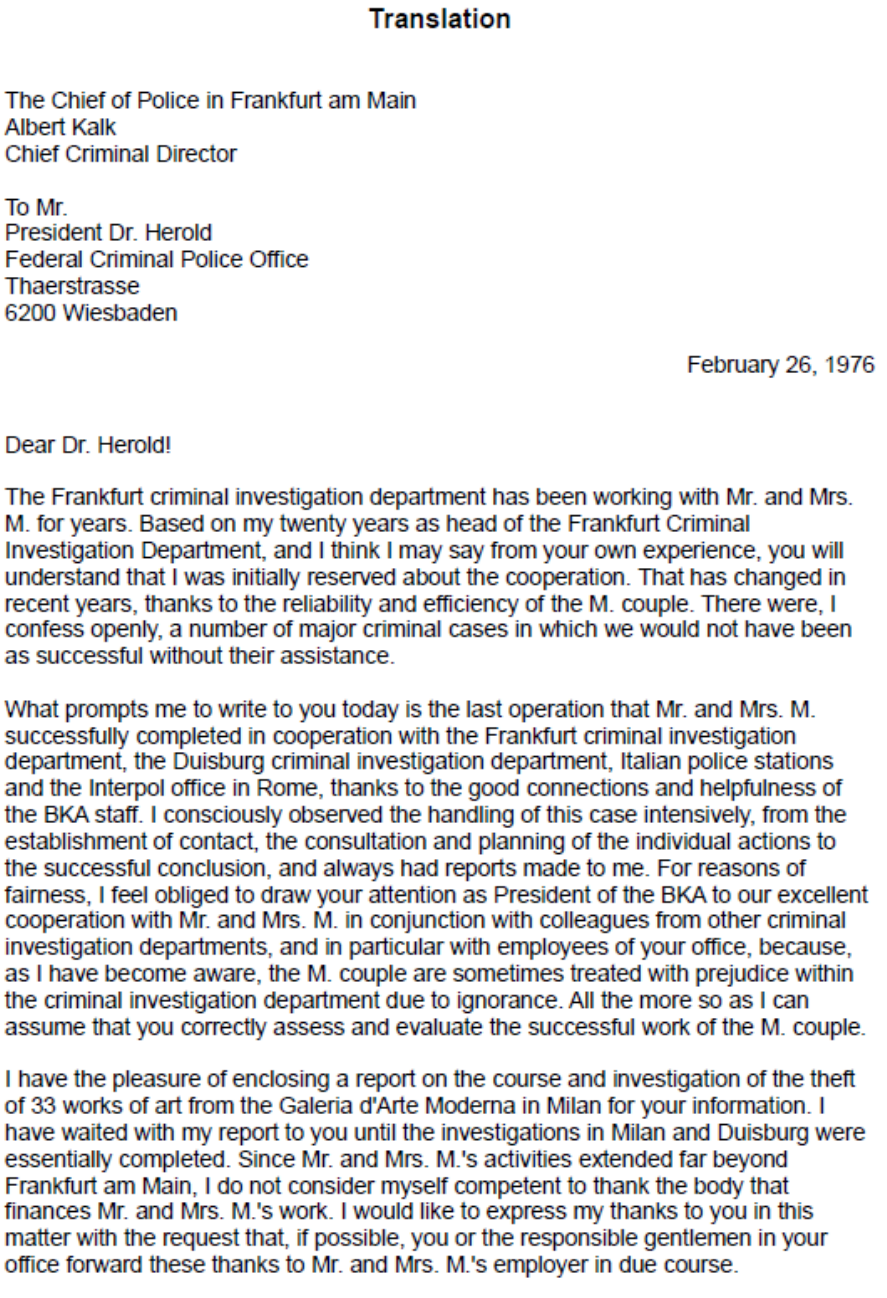
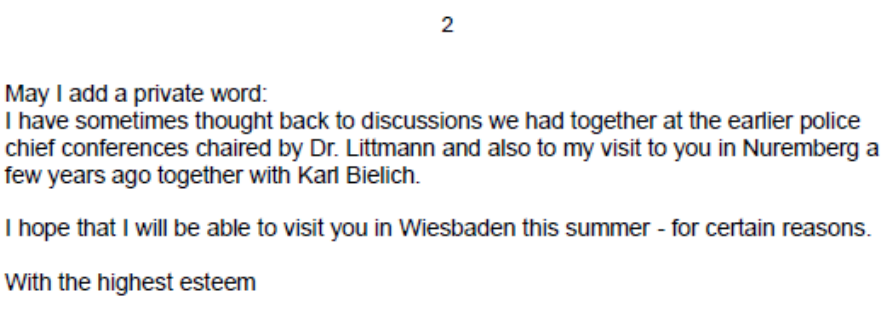
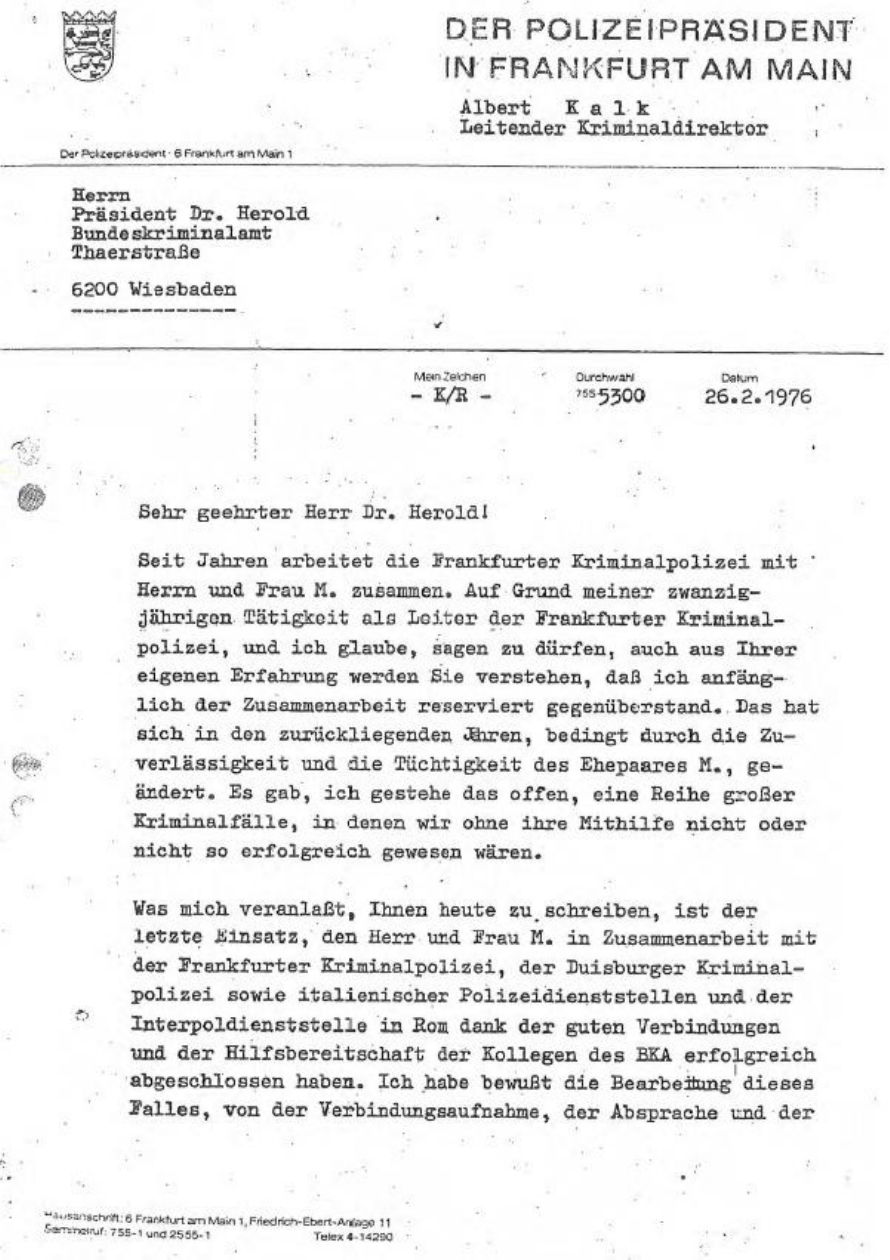
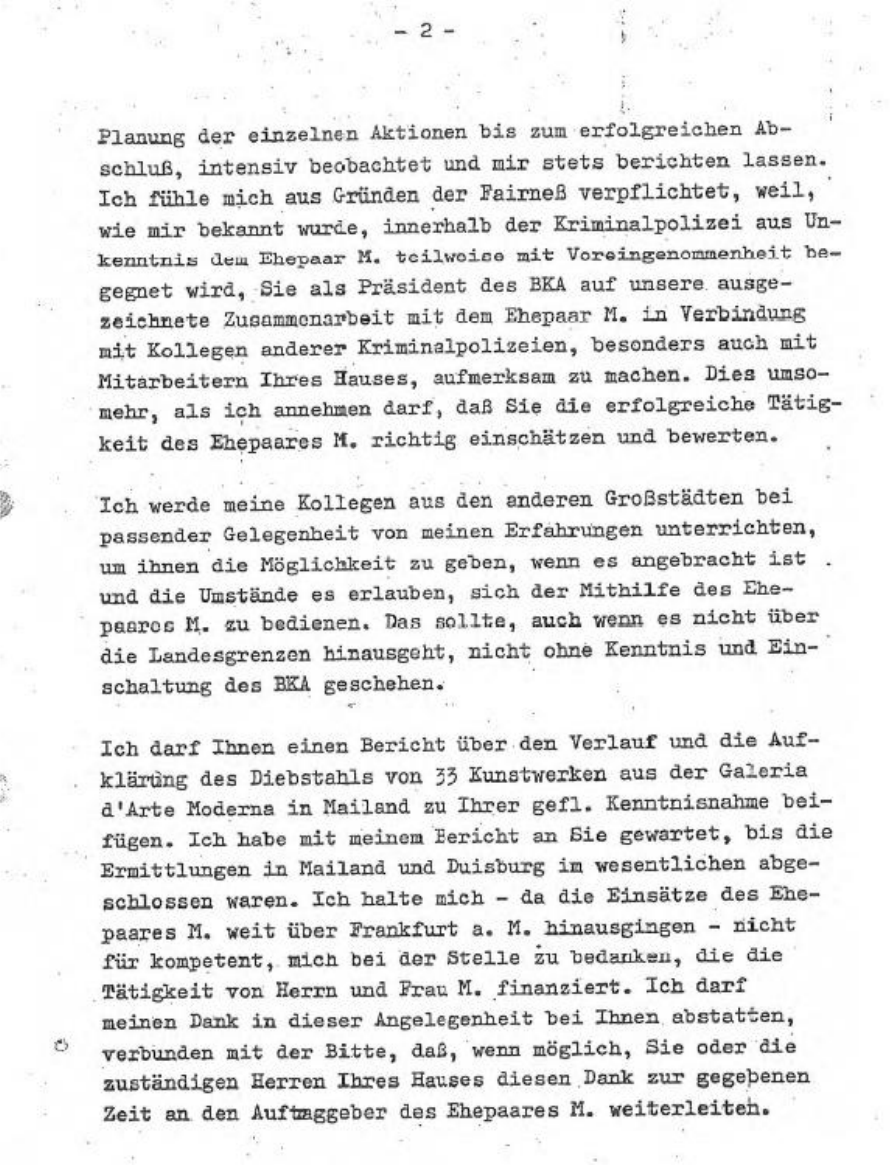
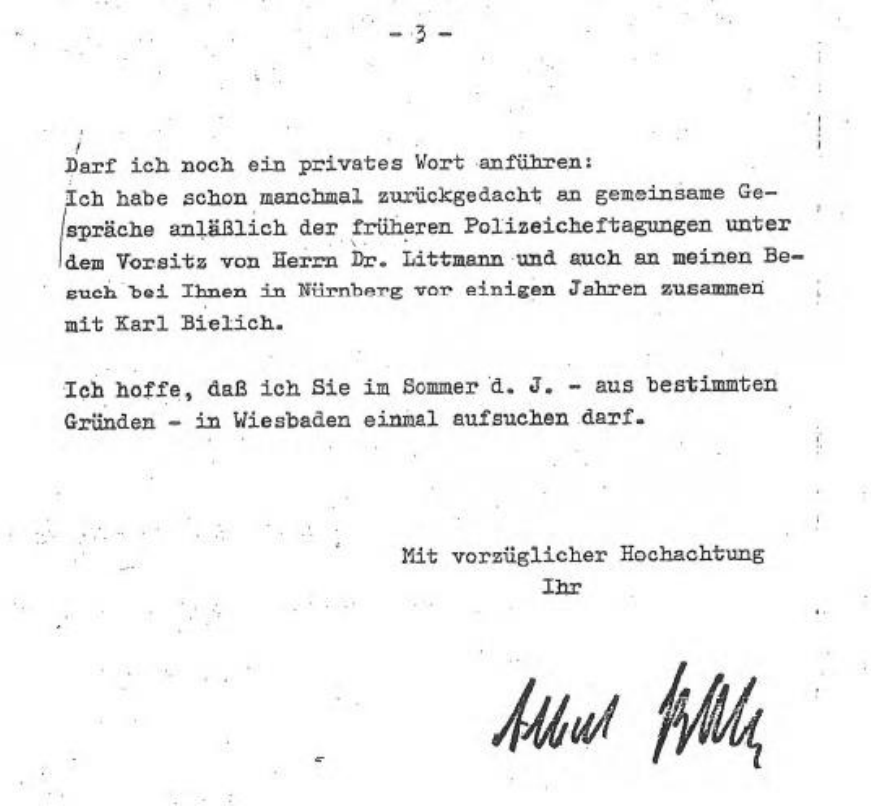
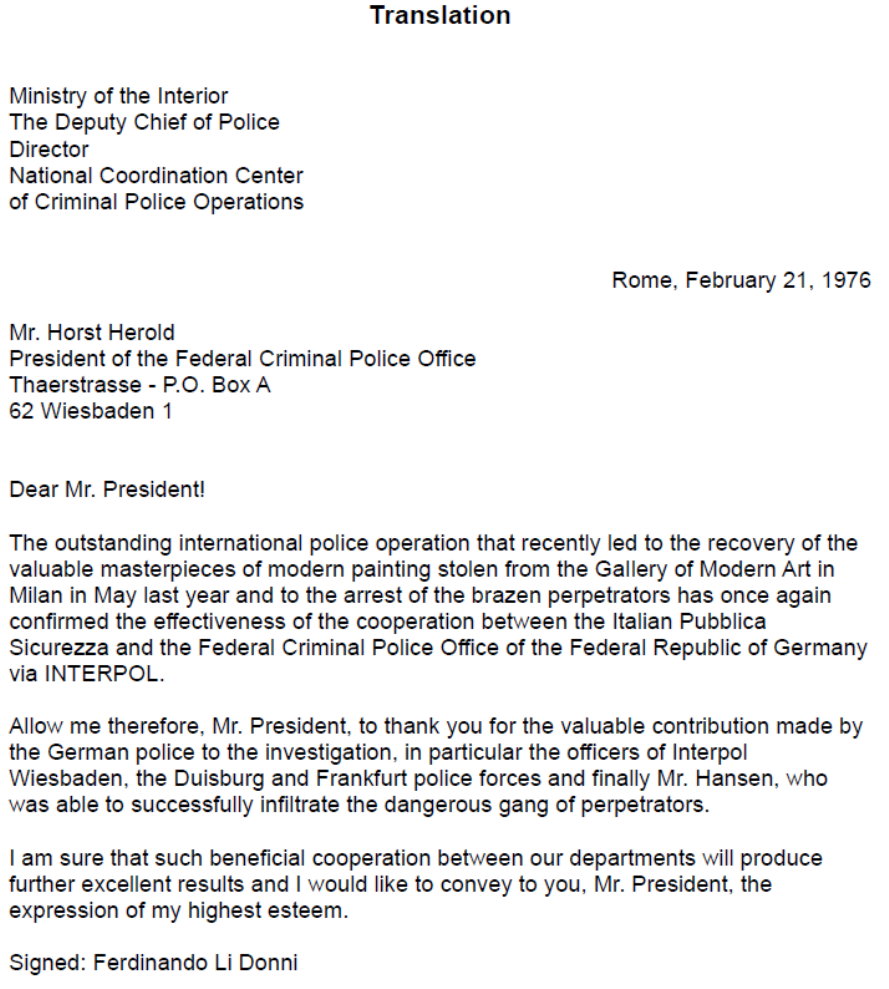
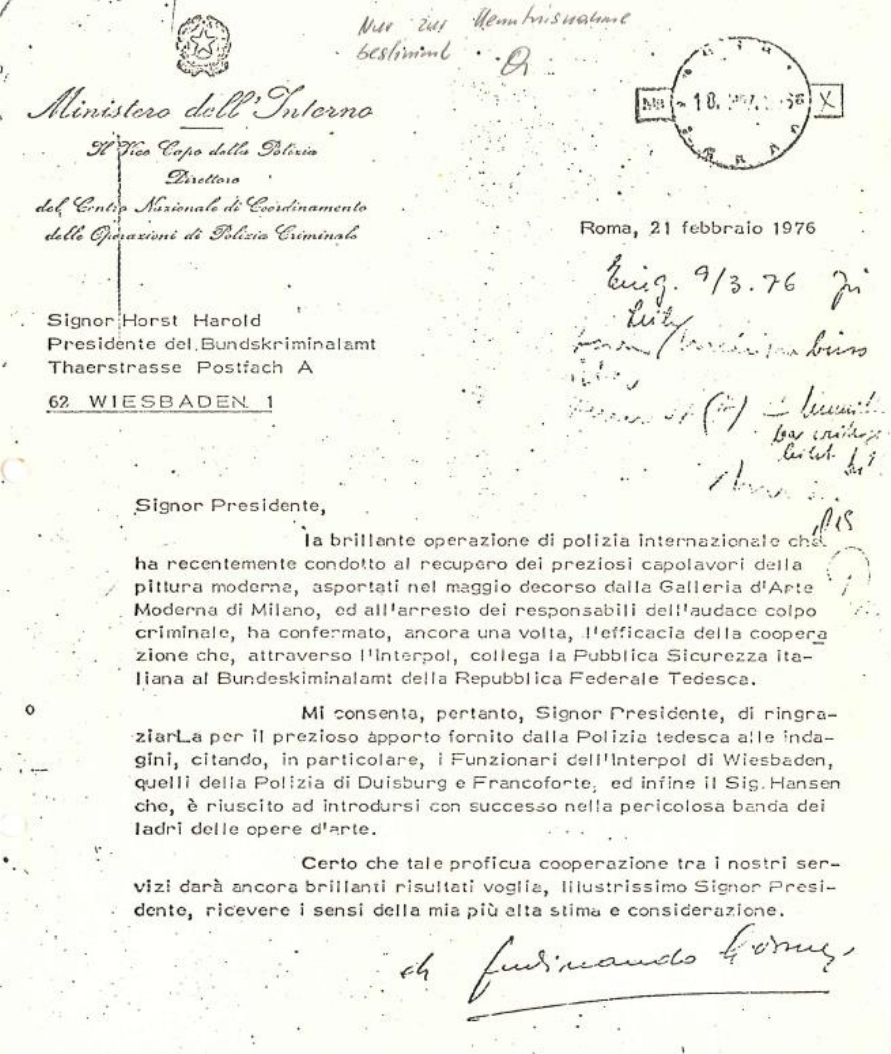
These serious criminals had also raided the Gallery of Modern Art in Milan on the night of May
14 to 15, 1975, and stolen paintings worth approximately 20 million German marks - see the
letter of thanks below regarding the operation from the Chief of Police of Frankfurt/Main, Albert
Kalk, to BKA President Dr. Herold dated February 26, 1976, as well as the letter of thanks
from Interpol Rome dated February 21, 1976, also addressed to BKA President Dr. Herold.
Working in collaboration with the aforementioned German investigative authorities and Inter-
pol Rome, Mr. Werner Mauss managed to infiltrate the group of perpetrators to such an extent
that the ringleaders led him to a woodworking shop near Rome, where the group had hidden
the paintings stolen in Milan inside cleverly veneered boards.
The main perpetrators were lured into a trap by Mr. Werner Mauss and arrested; the stolen
goods could be seized, and homicides committed by the group were solved, such as the mur-
der of an accomplice of the gang, 41-year-old Ricardo Bolchi, who was shot dead on the night
of August 1, 1975, in the northern Italian town of Cassinetta Di Lugagnano. The aforemen-
tioned man was suspected of having betrayed the gang. His bullet-riddled body was found
badly charred by the Italian police. The murderers had set fire to the car with the license plate
M-JM 2256 to cover their tracks.
15
16
17
18
19
20
21
22
1976 – Cologne Cathedral Treasure - UCA operation – Italy, Yugosla-
via, Germany - Arrest of the Yugoslav perpetrators and return of the
Cathedral Treasure
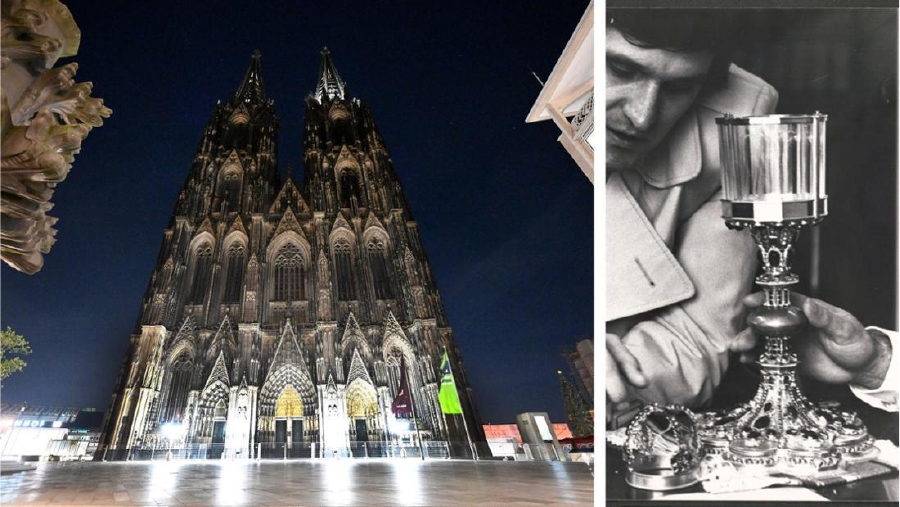
Mr. Werner Mauss succeeded in recovering the Cologne Cathedral treasure - which a special
task force of over 50 detectives had been unable to locate for months - in a short period of
time, in part because, as an experienced undercover agent, he has access to an appropriate
and necessary network. As Germany’s first UCA (undercover agent), he approached the crim-
inal target persons under a cover story, gained their trust through confidence-building intelli-
gence measures, and drove a wedge between the gang members in order to recover the loot
and have the perpetrators arrested. Mr. Werner Mauss, in secret coordination with the then-
Chief Public Prosecutor Maria Therese Mösch and the head of the Cologne Criminal Investi-
gation Department, Chief Inspector Hochscherff, led the perpetrators into a trap that yielded
crucial evidence. Under his cover, Mr. Werner Mauss met the burglars Tunjic and Dalavale in
Lugano. Prior to their arrest in Zurich, the perpetrators had hidden a large portion of the stolen
cathedral treasure in the side panels of a car. The main perpetrator, Ljubomir Ernst, was in
turn lured from Belgrade to Milan by Mr. Werner Mauss, in coordination with the Cologne
Public Prosecutor’s Office and Interpol Rome, and was arrested there while heavily armed.
The perpetrators were convicted, imprisoned, and sentenced to long prison terms in Cologne.
The German security and investigative authorities were behind all of this at every stage.
Excerpt from a press article in the Sauerlandkurier dated February 16, 2026:
New details about the robbery at the Cathedral Treasury
Georg Bönisch as a young reporter with the loot from the cathedral treasure heist.

23
What the three didn’t know - and what was kept secret for a long time - was that the rear-end
collision had been staged. It was a trap, meticulously planned by the undercover agent Wer-
ner Mauss, who was listed under the number 111 at the Federal Criminal Police Office (BKA).
Only now, 50 years later, are investigations bringing new details about his role to light. Co-
logne-based journalist and former Spiegel editor Georg Bönisch was at the scene of the crime
in the Cathedral Treasury as a young reporter for the Kölnische Rundschau. Even back then,
he uncovered failures on the part of the authorities. The case never left him. For a recently
published FAZ article, he spoke for the first time with Werner Mauss about his operation.
“Has this led to any new insights into the biggest art heist in Cologne’s history?” I ask Georg
Bönisch. “In terms of details, yes,” he says. “Because until now, it wasn’t known exactly how
Mauss went about it, how he portrayed himself as Jacques, an internationally active master
criminal, in order to infiltrate the circles of the cathedral robbers.” With the utmost sophistica-
tion, the secret agent managed to “ease the suspicion of the wanted perpetrators and lure
them out of hiding.” For example, he allegedly commissioned them to transport supposedly
stolen works of art from Rhineland museums abroad. To appear credible, Mauss even used
real paintings, on loan for an unusual purpose.
In the end, Cologne got its treasures back, especially most of the cathedral’s jewels. But has
this incident led to any lasting lessons? Opportunities for break-ins during construction work -
back then at Cologne Cathedral, and most recently at the Louvre - remain among the biggest
vulnerabilities in security systems to this day.
This documentary provides an excellent illustration of the unique nature of Mr. Werner
Mauss’s work as an undercover agent, which he has carried out since 1965 to the present day
in countless missions worldwide in the public interest against organized crime, drug gangs,
and terrorism, with a 98 percent success rate. This includes successful manhunts for serious
criminals and murderers. Between 1965 and 1978 alone, Mr. Werner Mauss infiltrated more
than 300 criminal organizations and, in collaboration with prosecutors, investigating judges,
and special police task forces in Europe, dismantled them from within. He also risked his life
to free more than 100 hostages who were under threat of death and torture in the Middle East,
South America, and Asia - see an ARD film clip on this subject in which Dr. Wolfgang Schäu-
ble, Federal Minister for Special Tasks and Head of the Federal Chancellery from 1984 to
1989, and Federal Minister of the Interior from 1989 to 1991, provides explanations regarding
intelligence operations conducted under extra-legal emergency.
Link: https://www.werner-mauss.de/eh5v.files/html5video/protokoll-en.html
24
This refers to the securing of the Seveso hazardous waste drums on May 19, 1983, in Anguil-
court-le-Sart, northern France, and in particular to Mr. Werner Mauss’s efforts on behalf of the
Lebanon Crisis Task Force to secure the release of the hostages Cordes and Schmidt, who
had been kidnapped in Lebanon.
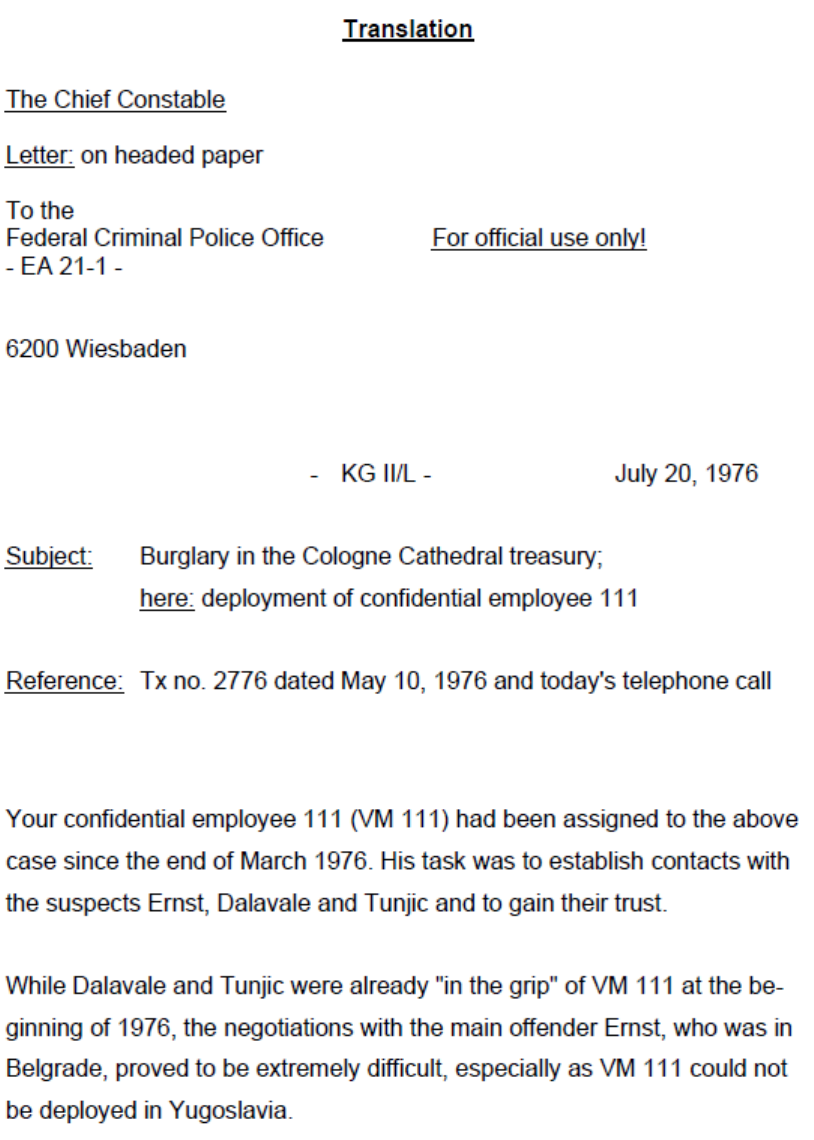
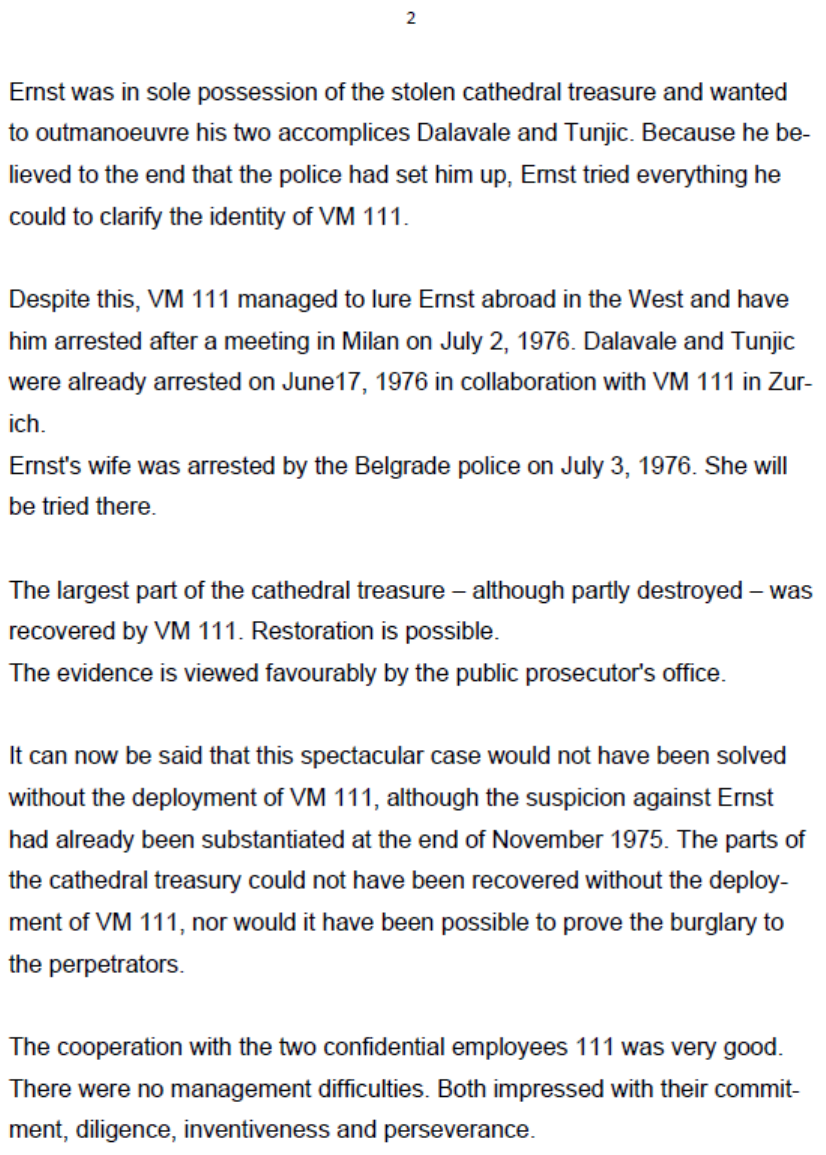
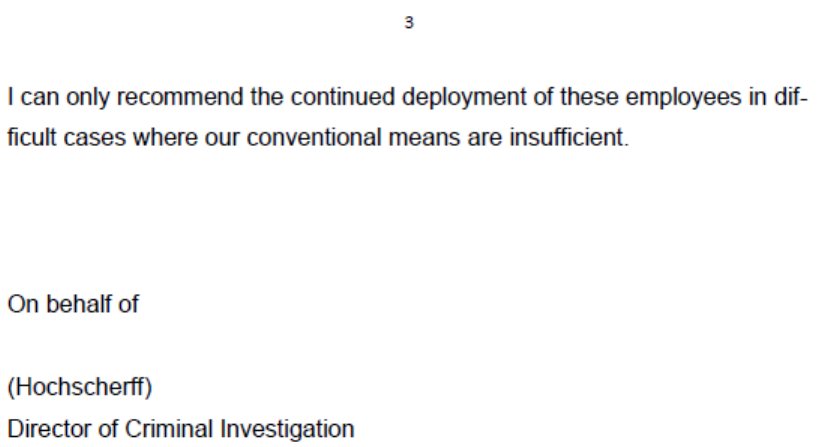
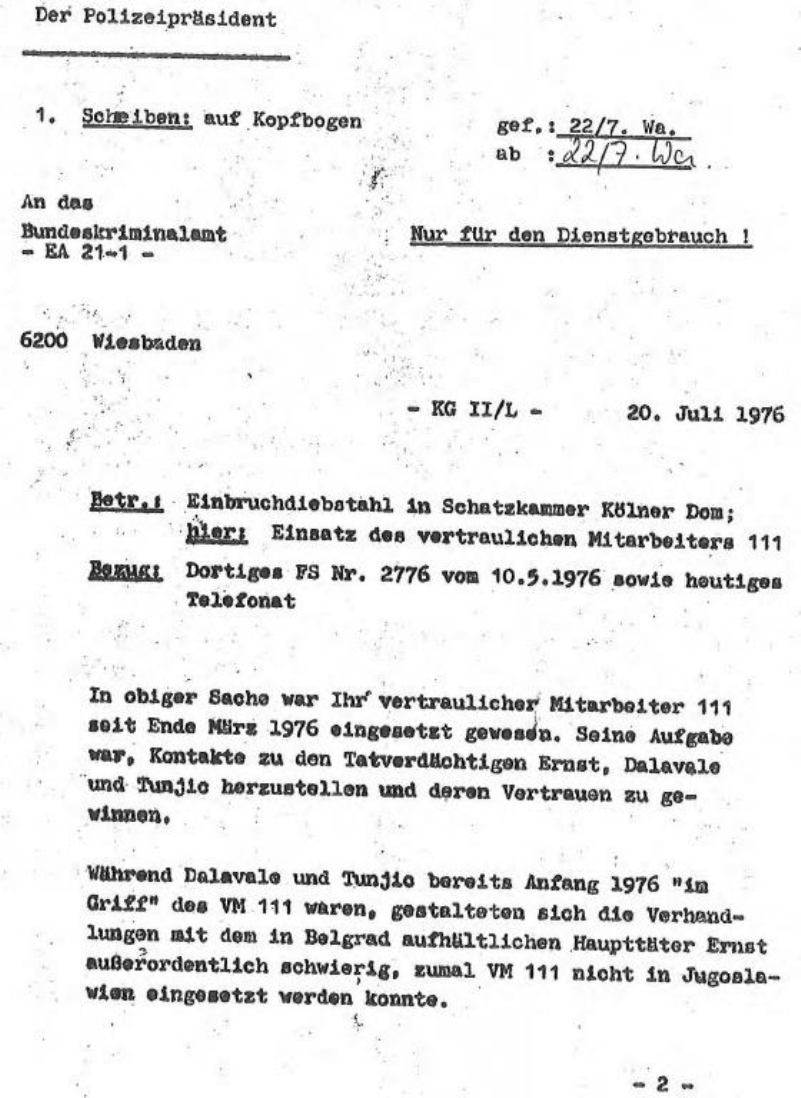
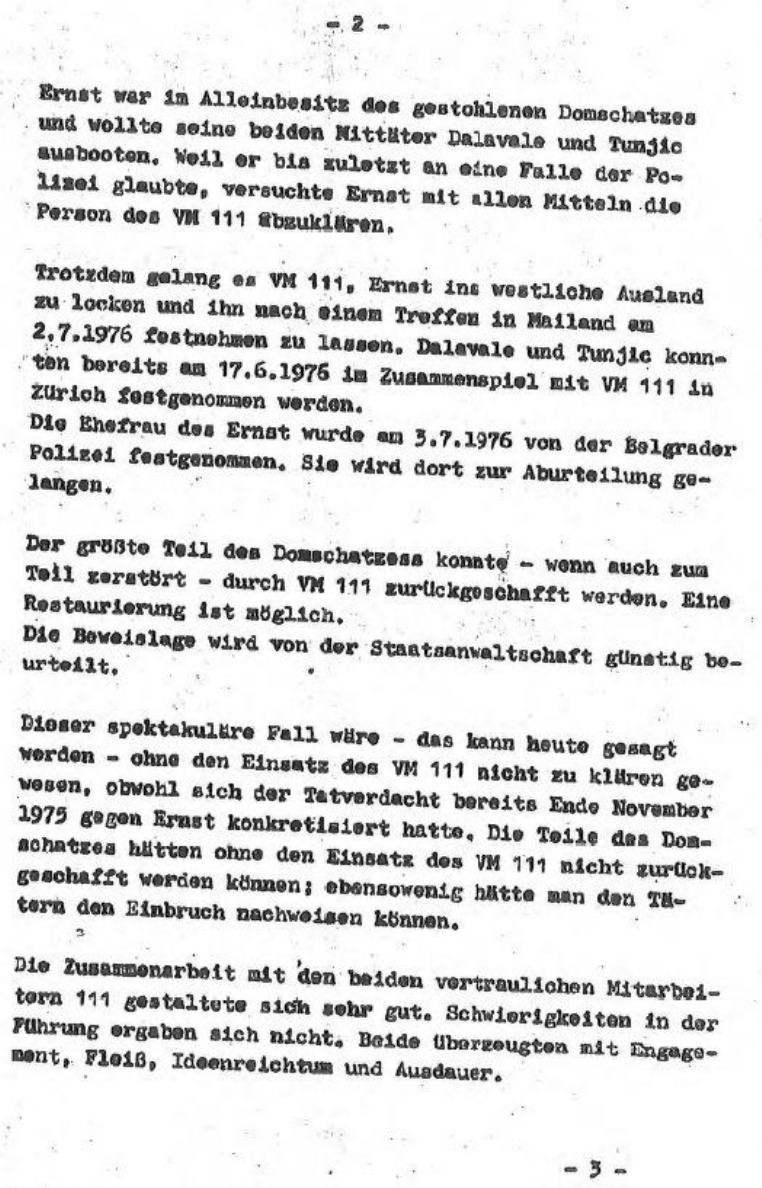
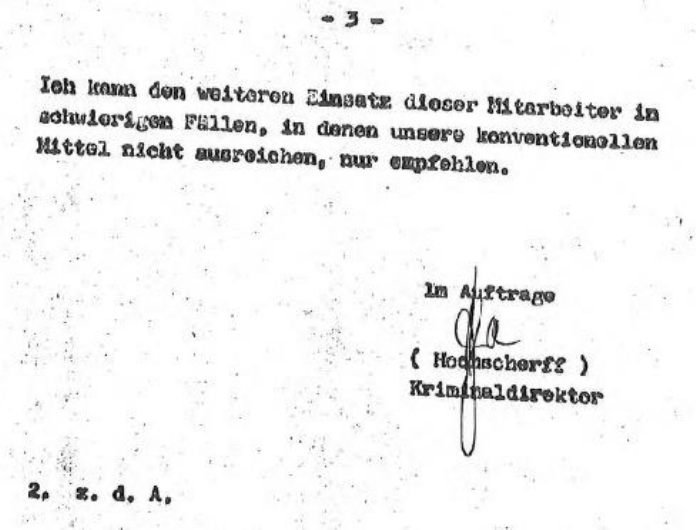
On July 20, 1976, the deputy chief of the Cologne Criminal Investigation Department ex-
pressed his gratitude to the Federal Criminal Police Office (BKA) for making Mr. Werner
Mauss available. Chief Inspector Hochscherff wrote to the BKA leadership – see the letter
below:
25
26
27
28
29
Upon receipt, the aforementioned letter was submitted to President Herold, Chief Detective
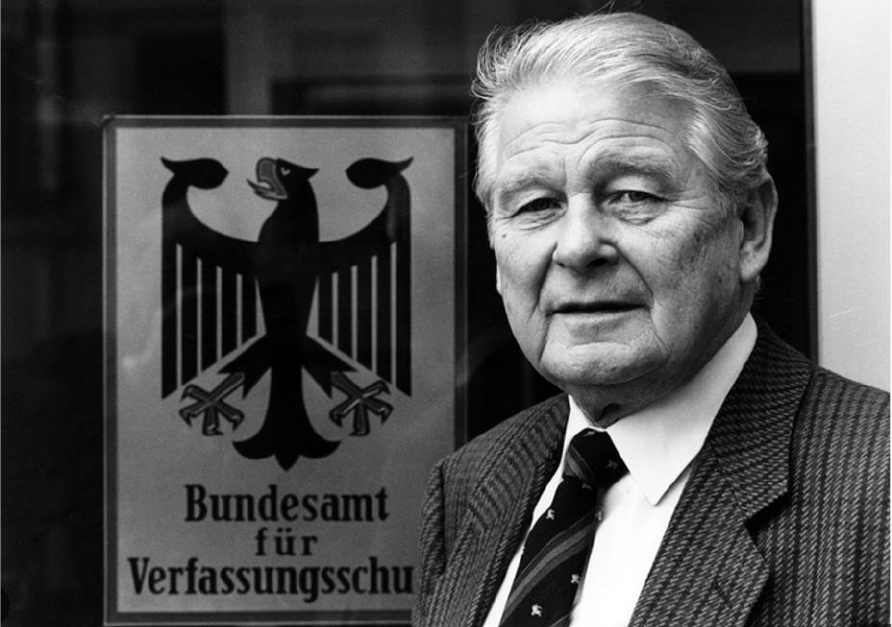
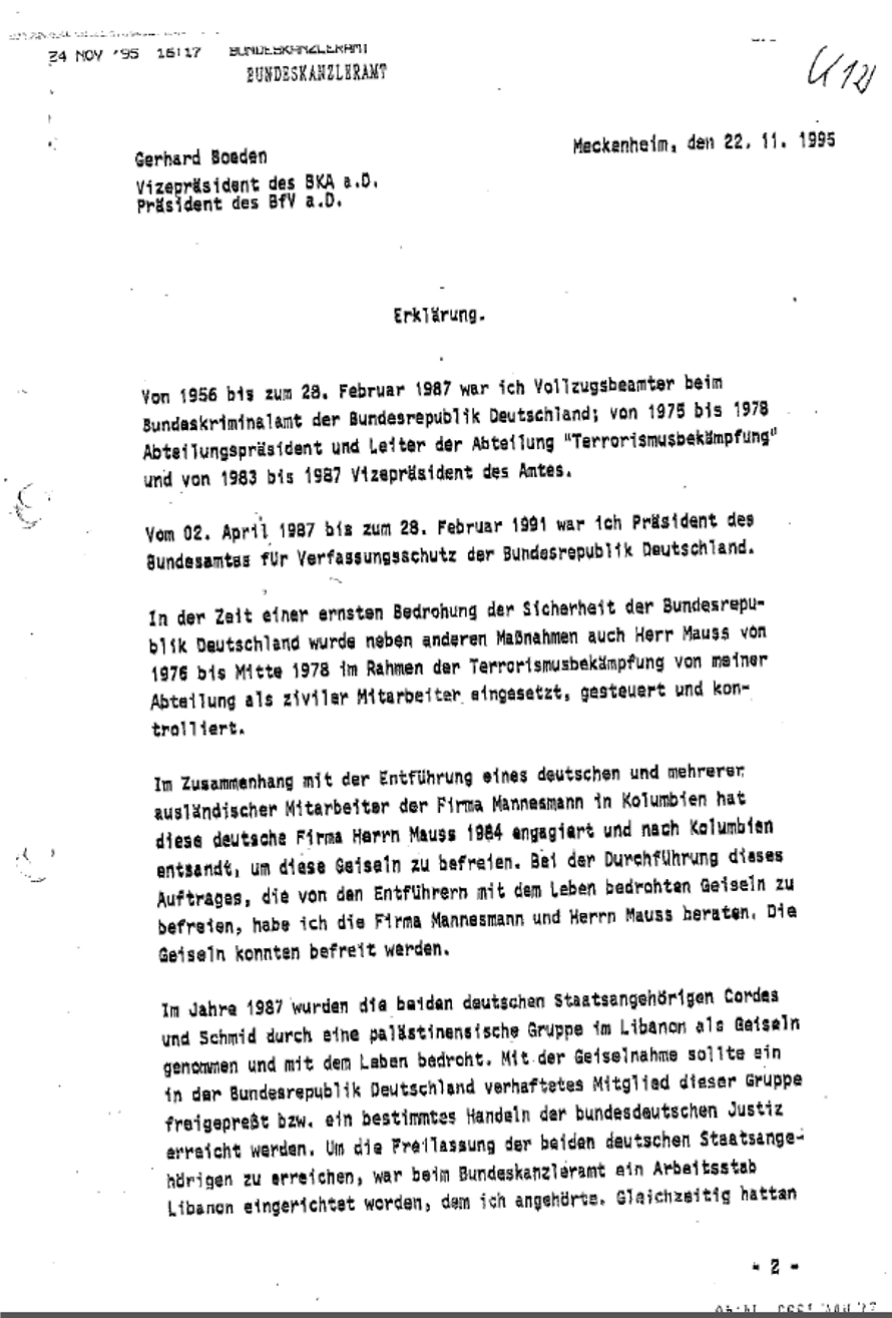
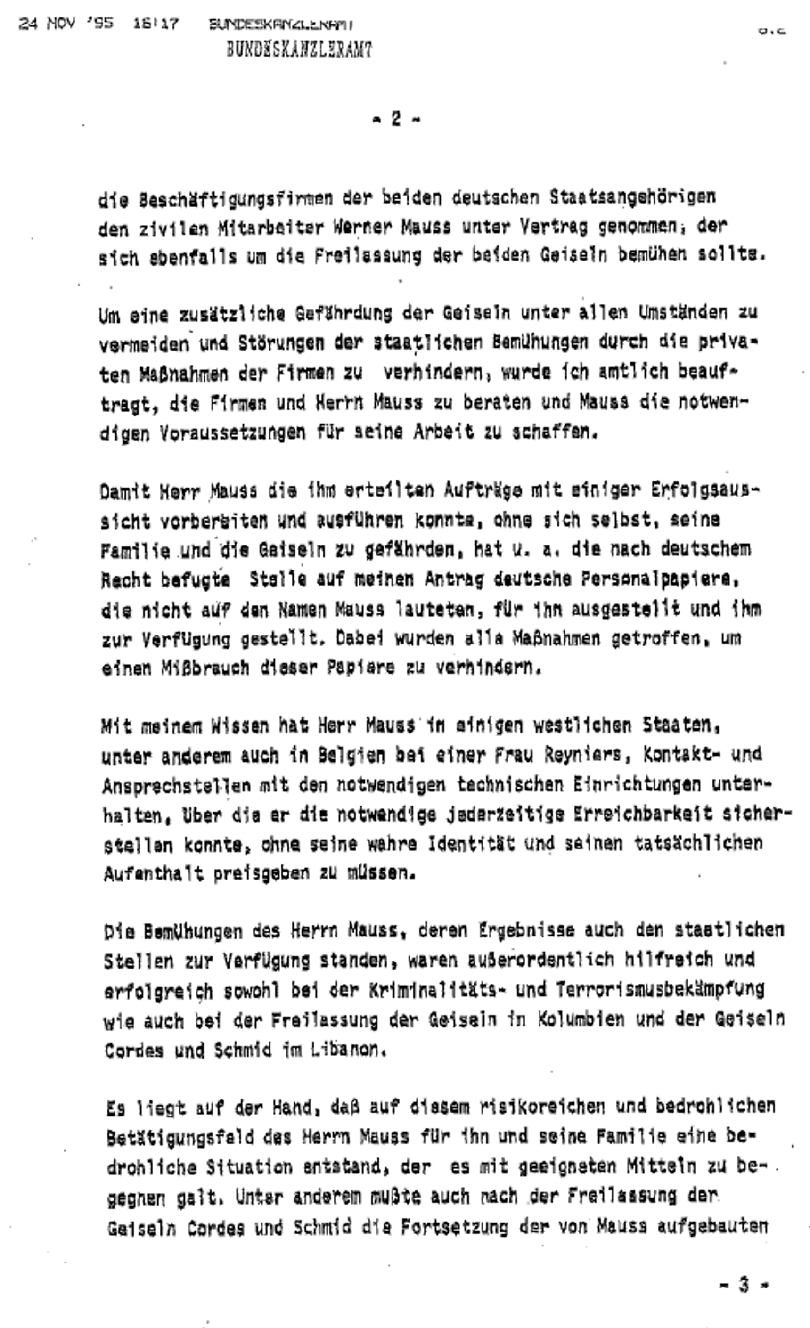
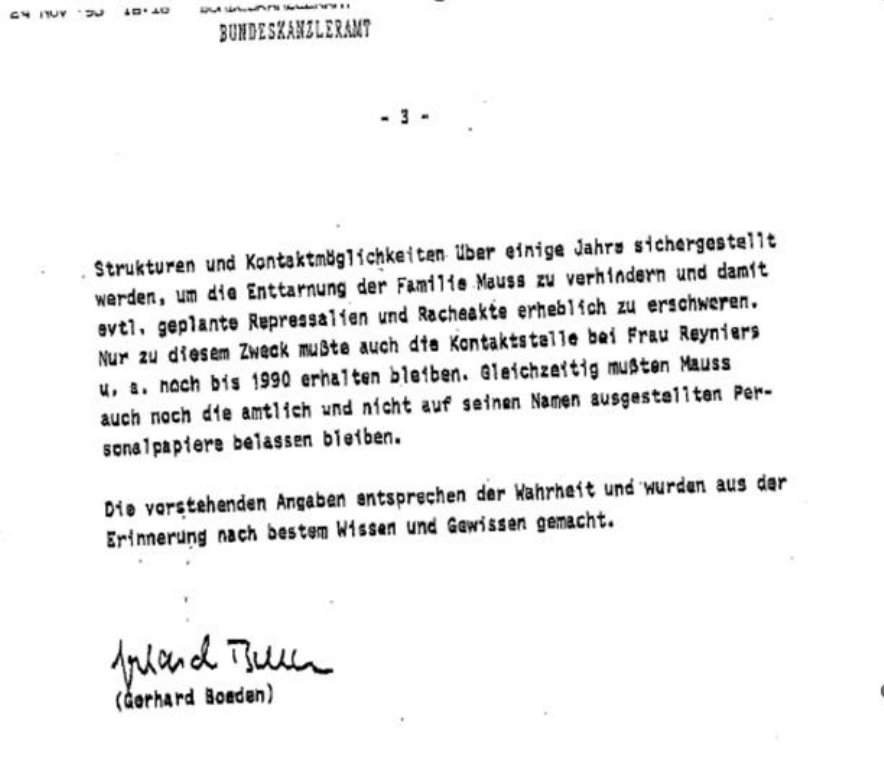
Schorm, Department President Scheicher, and Chief Detective Boeden.
Mr. Boeden served as Vice President of the BKA from 1983 to 1987 and as President of
the Federal Office for the Protection of the Constitution (BfV) from 1987 to 1991. As
Head of Department (AP), he had taken over Mr. Werner Mauss - “Institution M.” at the
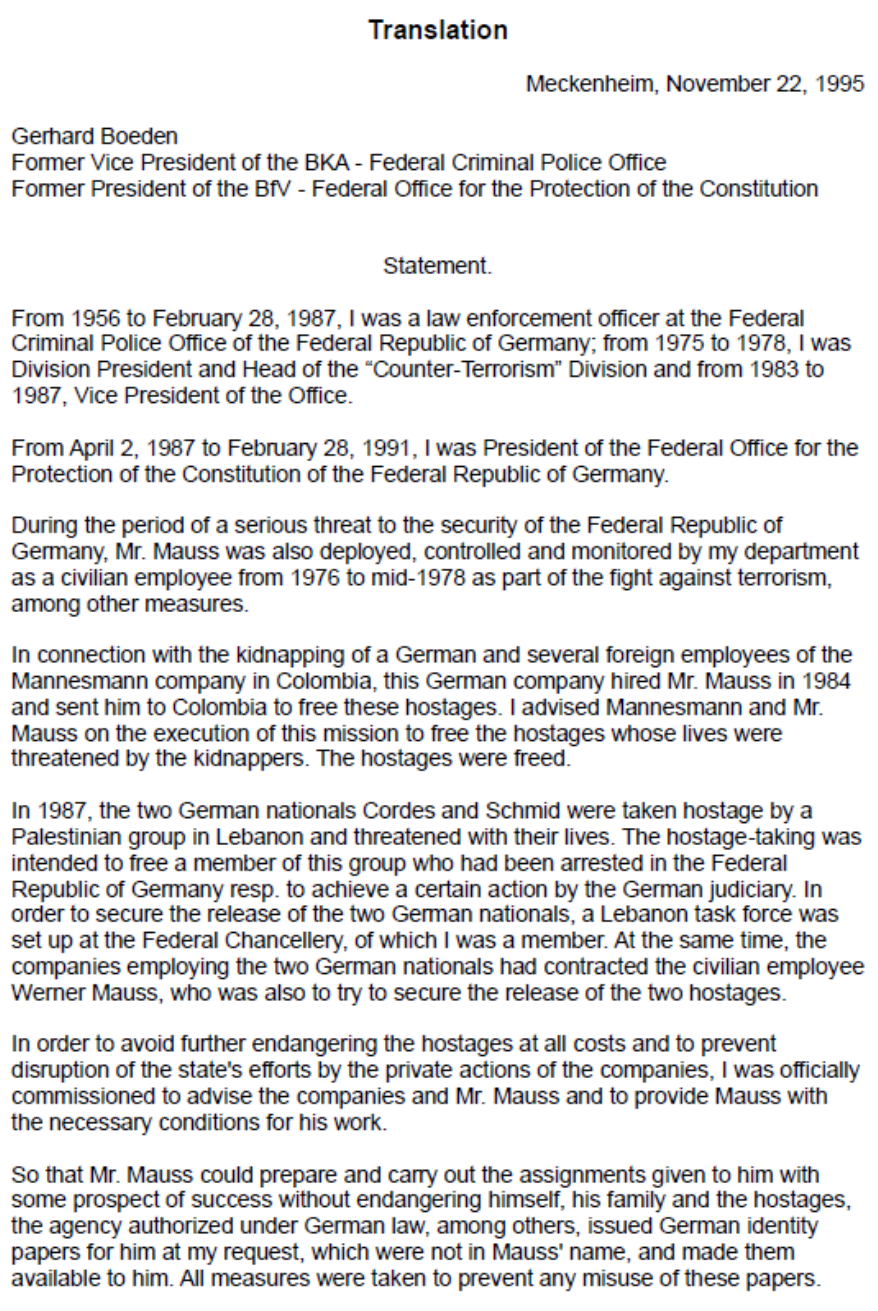
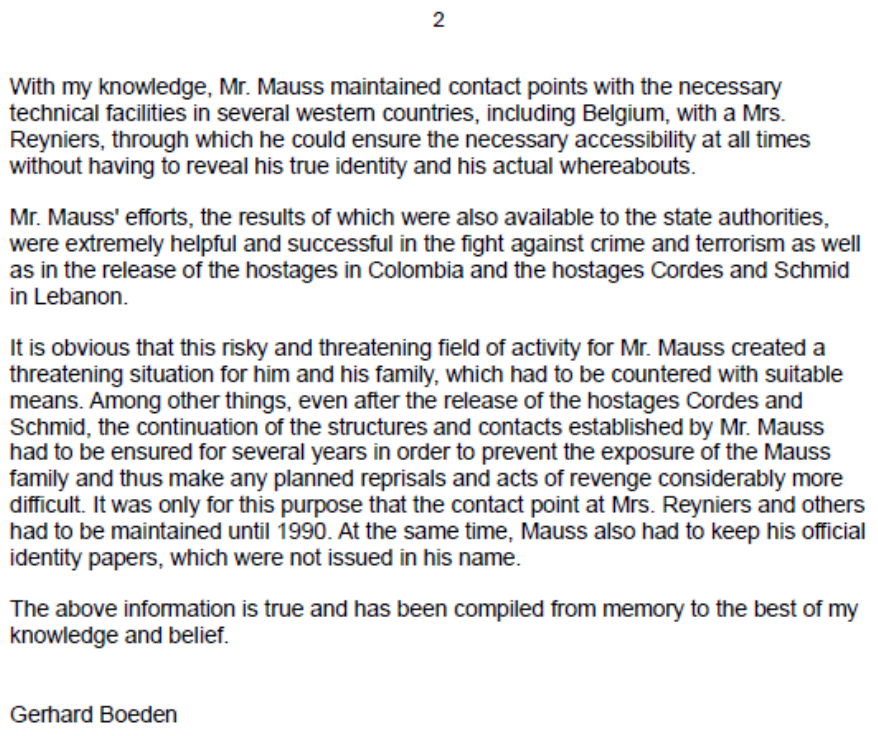
time. From 1983 to 1987, Mr. Werner Mauss was supervised by BKA Vice President
Boeden and was then taken over by the BfV under President Boeden – see the following
confirmatory statement by Mr. Boeden dated November 22, 1995.
Mr. Boeden was also the initiator of the trust fund that was demonstrably made availa-
ble to Mr. Mauss starting in 1985 to finance his operations, which were important for
the internal security of the Federal Republic of Germany and its Western partner agen-
cies.
30
Gerhard Boeden (born February 10, 1925; died May 26, 2010) was a German police officer,
Vice President of the Federal Criminal Police Office, and President of the Federal Office for
the Protection of the Constitution. He joined the North Rhine-Westphalia Police in November
1945. In 1951, he transferred to the Criminal Investigation Department as a senior sergeant.
Beginning in 1956, he worked at the Federal Criminal Police Office (BKA), where he was
promoted to the higher service (“Senior Service at the BKA”) in 1965. In 1972, he joined the
CDU (Christian Democratic Union of Germany). In 1974, he took over as head of the Security
Group, which was responsible for protection and security matters. In response to the attacks
by the Red Army Faction, Boeden established the Counterterrorism Division (TE) at the Bonn-
Bad Godesberg site in 1975; this division was relocated to the BKA headquarters in Wiesba-
den in 1978. He played a key role in establishing what would later become the BKA’s Mecken-
heim site, near the seat of government in Bonn. There, the State Security Headquarters was
established in a new building complex in the Merl district. In 1983, Boeden became vice pres-
ident of the BKA, and in 1987, after reaching the mandatory retirement age for police officers
- plus an extension of his term of service - he retired. A few weeks after his retirement as a
police officer, on April 2, 1987, he was appointed President of the Federal Office for the Pro-
tection of the Constitution and held that office until February 28, 1991.
At the suggestion of BKA President Jörg Ziercke, the Meckenheim City Council decided in
2012 to rename the access road to the BKA “Gerhard-Boeden-Straße.” Naming the street
after Gerhard Boeden was a sign of special appreciation in light of his great service to the
BKA.
31
32
33
34
35
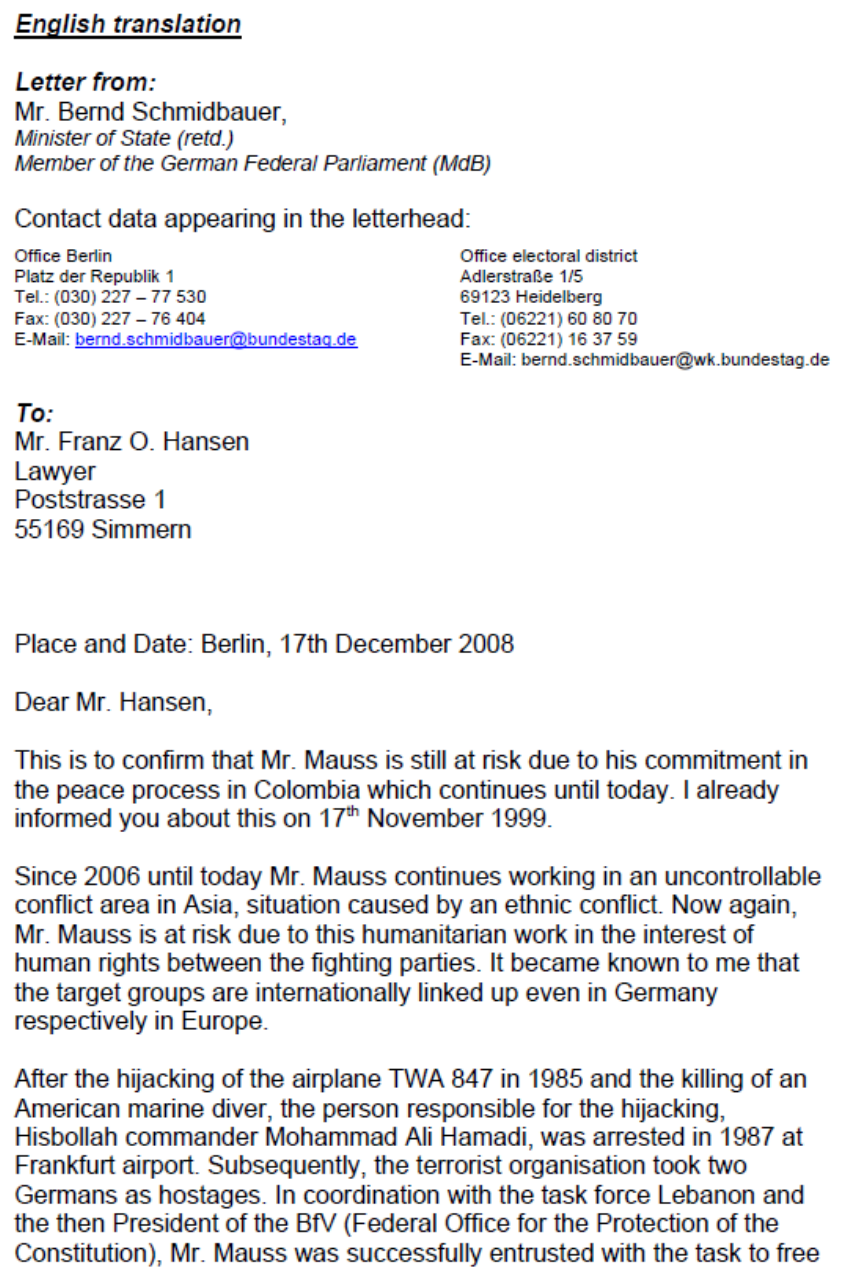
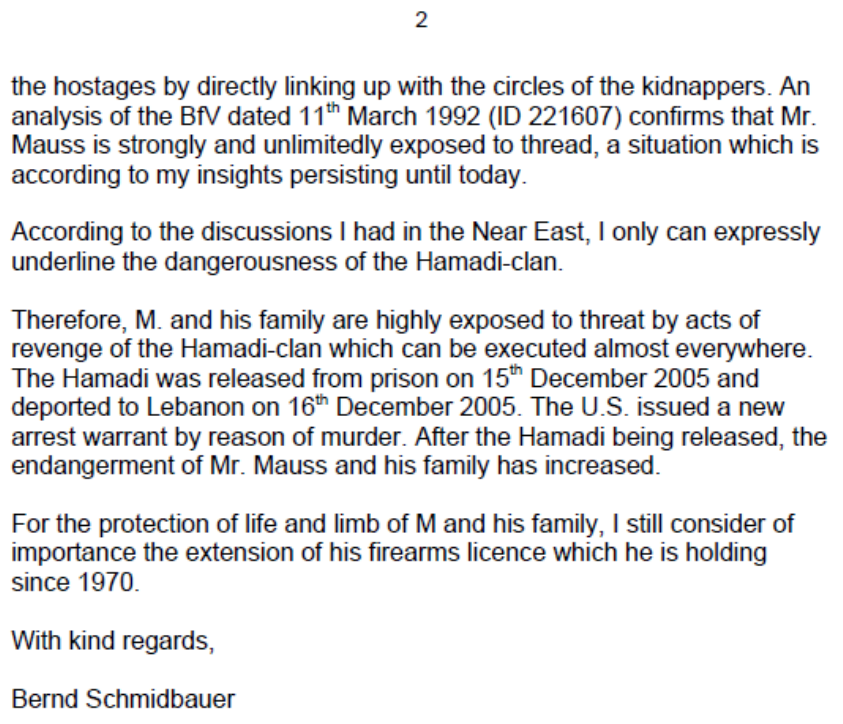
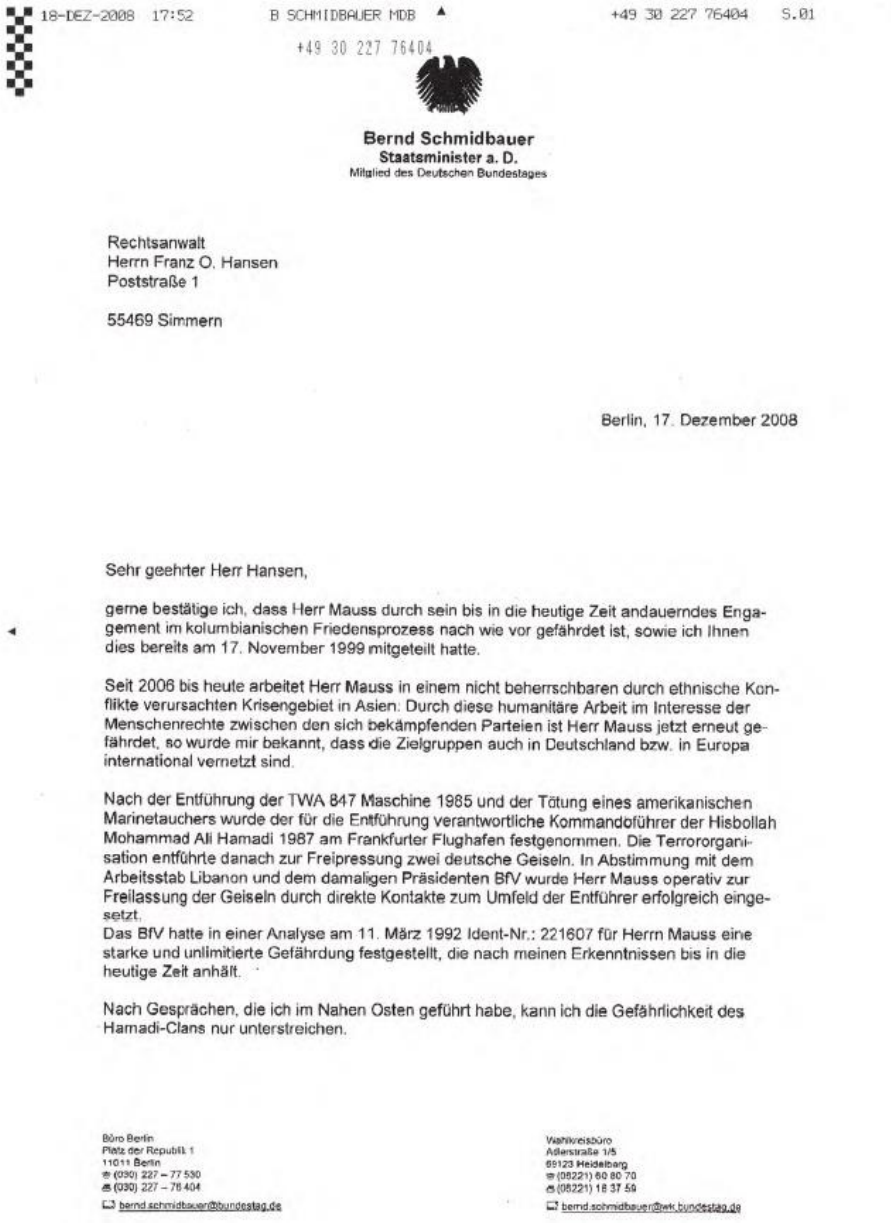
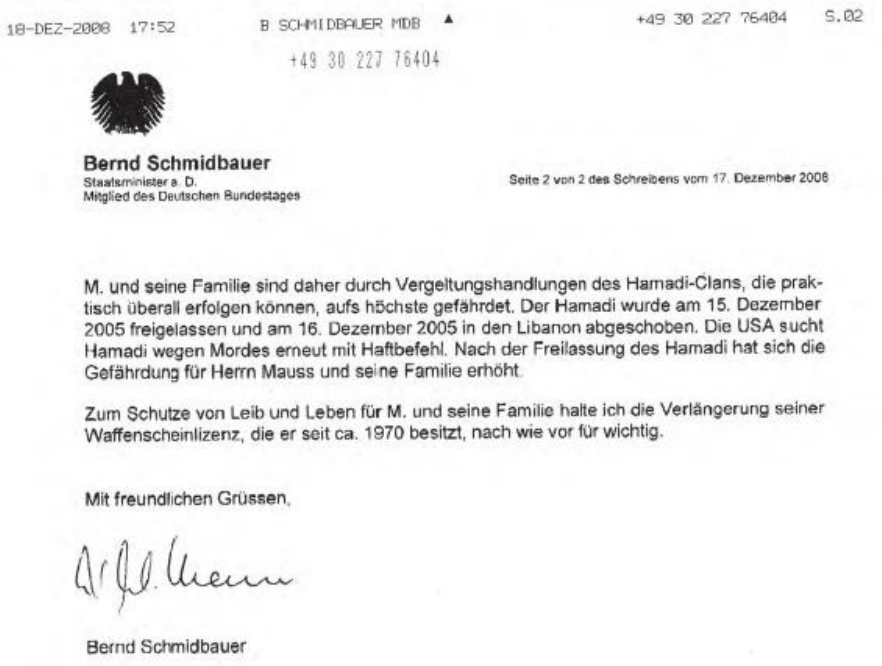
Mr. Boeden remained Mr. Werner Mauss’s main contact person until his retirement in 1991.
After that, Mr. Werner Mauss was taken over by the then Minister of State in the Chancellery,
head of the BND and coordinator of the BfV and BKA, Mr. Bernd Schmidbauer. Mr. Schmid-
bauer held this position until 1998 – see also the letter from Mr. Schmidbauer dated December
17, 2008, below, particularly the threat confirmed by the BfV.
36
37
38
39
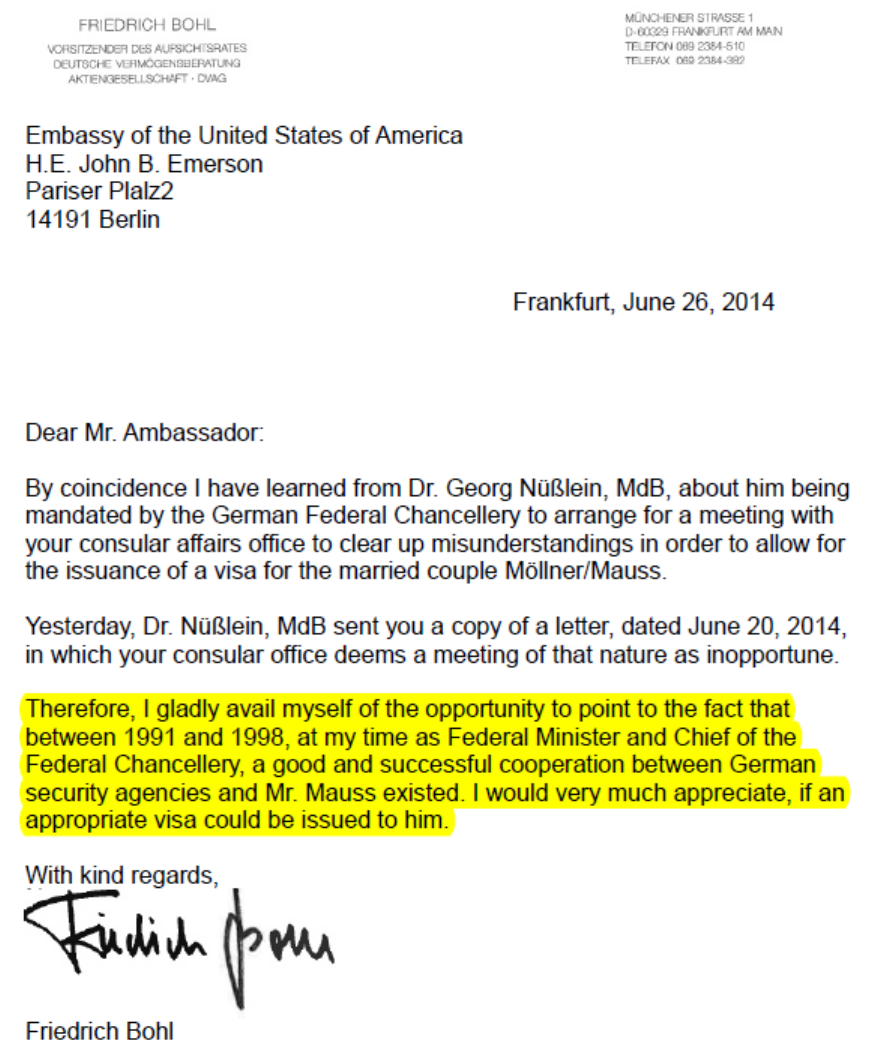
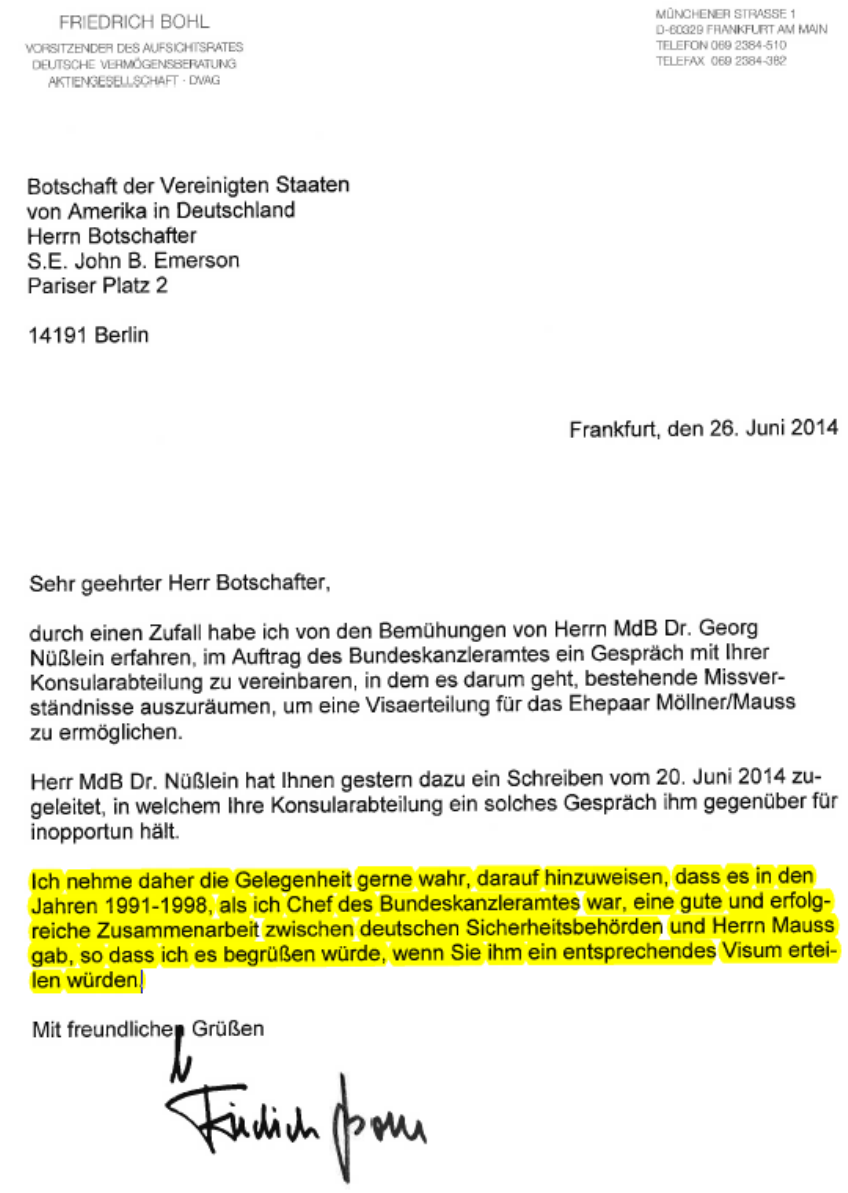
In his letter to U.S. Ambassador Emerson dated June 26, 2014, Mr. Bohl, who served as
Minister of the Chancellery from 1991 to 1998, also confirms that Mr. Werner Mauss cooper-
ated well with the security authorities of the Federal Republic of Germany – see Mr. Bohl’s
letter below.
All of this based on the trust fund made available by Mr. Boeden to Mr. Werner Mauss in 1985,
which ensured the financing of his special missions.
40
41
In keeping with his philosophy of life, Mr. Werner Mauss has, over the past decades and up
to the present day, risked his own life to save countless lives and rescue hostages in South
America, Asia, the Middle East, and Europe. As mentioned above, ARD has produced a short
film highlighting Mr. Werner Mauss’s lifetime achievements.

42
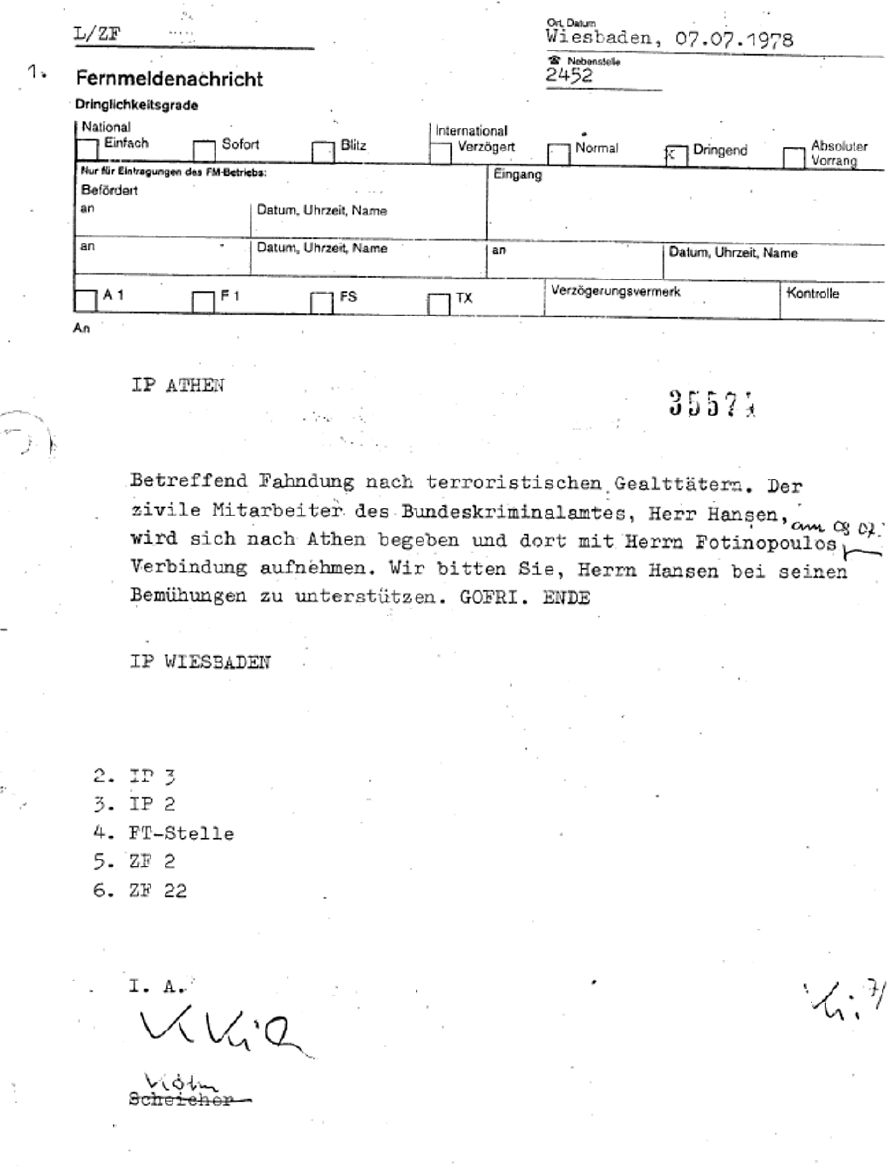
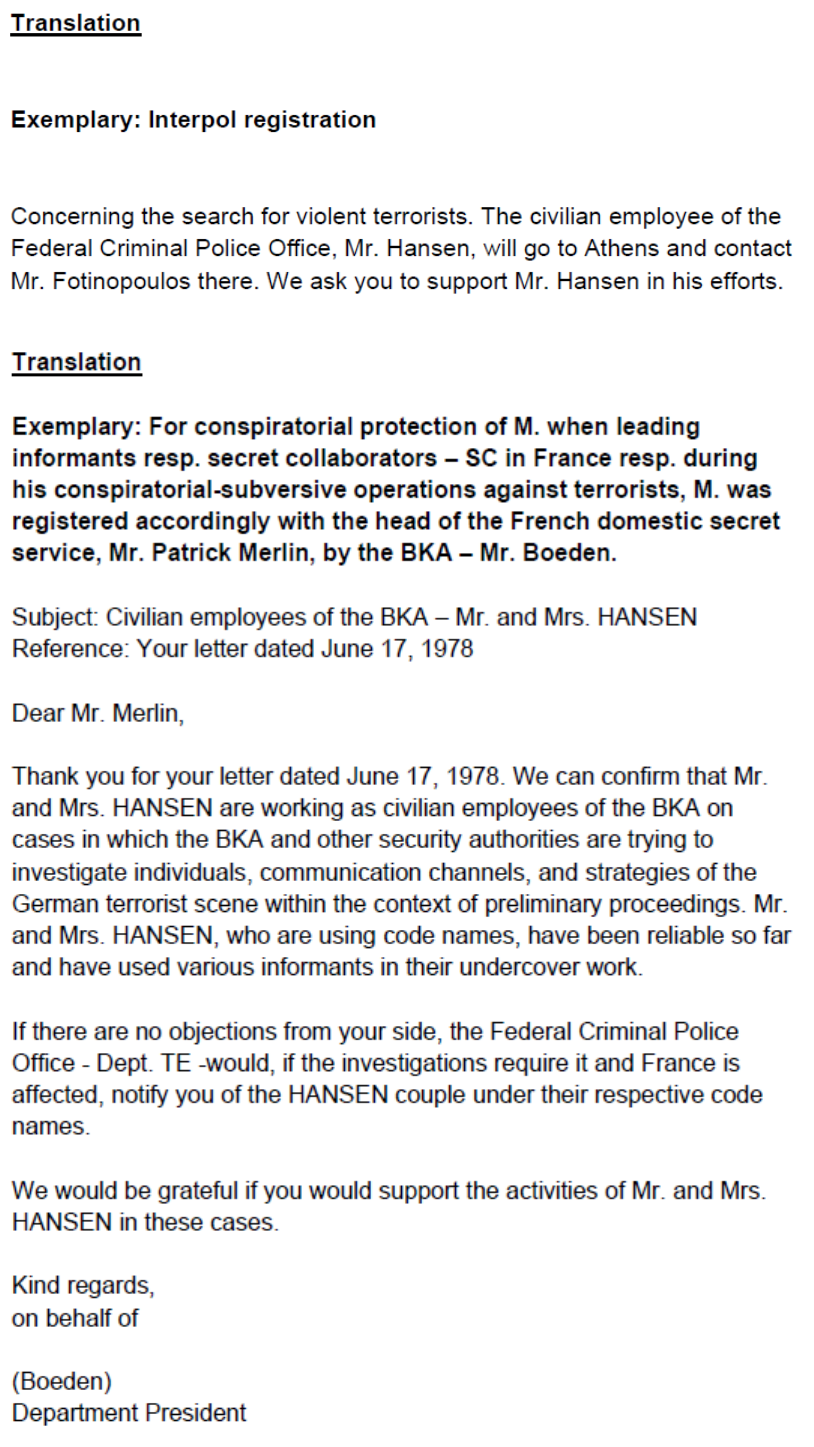
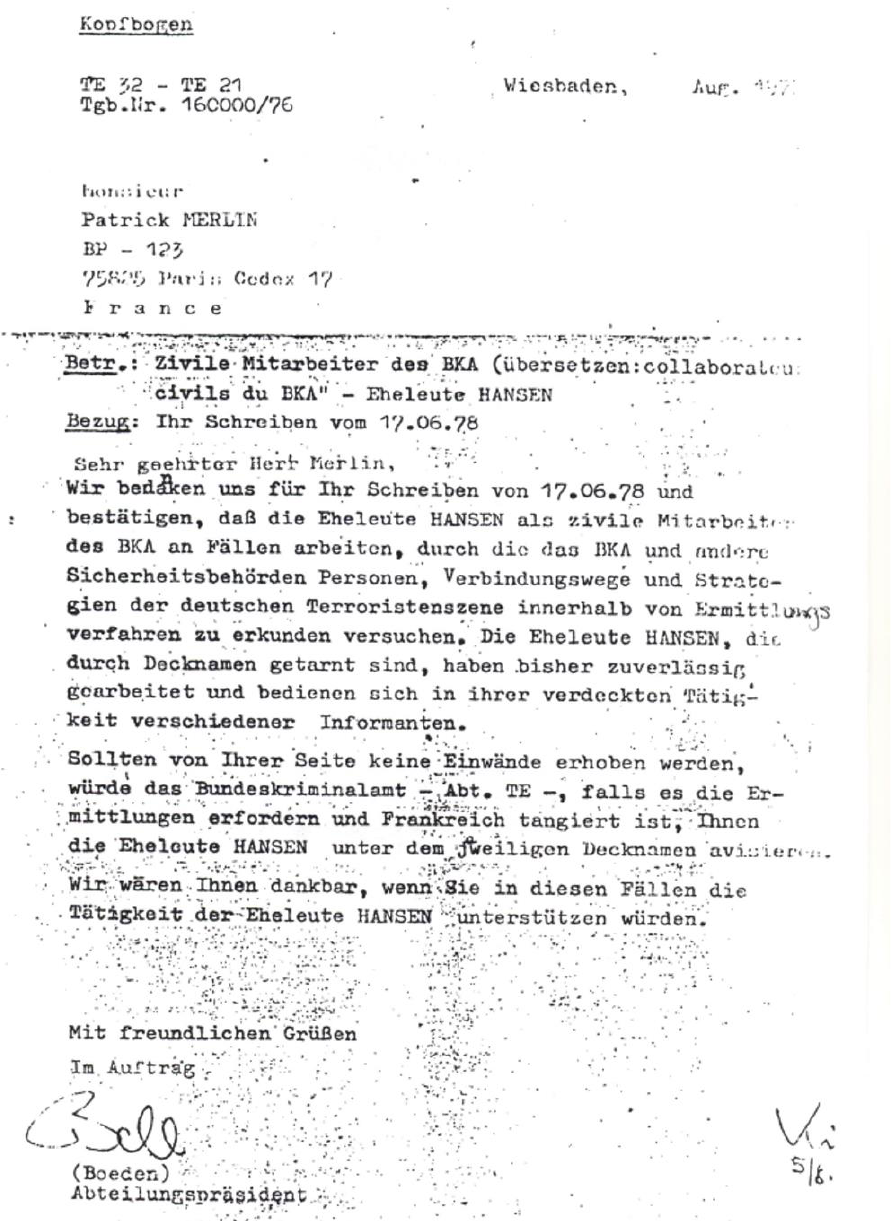
In July 1976, Mr. Werner Mauss was taken over under contract by the
BKA in Bad Godesberg, Counterterrorism Division, Mr. Boeden and
Mr. Scheicher, and was tasked with arranging for the arrest of RAF
terrorist Rolf Pohle - who had been forced out by the RAF in Berlin
and was spotted by chance by a journalist on the Aegean Islands in
Greece - as part of a targeted manhunt.
Using the pressurized twin-engine turboprop aircraft covered by the BKA that was available
to him at the time, Mr. Werner Mauss flew to Athens under a cover name, having been regis-
tered through Interpol. As agreed, he met in Athens with Nikolas Fotinopoulos, the Greek,
German-speaking Interpol chief whom he already knew from various operations as part of the
terrorism investigation, and flew with him to all the Aegean islands in search of Pohle. In the
process, Mr. Werner Mauss identified various grid tracks, such as the fact that Pohle always
wore sunglasses with a red frame, a shoulder bag, and a conspicuous head covering, and
that his face was marked by severe acne.
The most important grid point was Pohle’s daily purchase of the newspaper “Süddeutsche
Zeitung”. At the time, RAF terrorists used advertisements in the Süddeutsche Zeitung to com-
municate with one another across Europe. With the help of the then Greek Prime Minister
Karamanlis, who knew Mr. Werner Mauss from other operations, Mr. Werner Mauss arranged
for the Athens Police Chief to provide him with approximately 260 plainclothes police officers,
distributed across all 84 newsstands in Athens and Piraeus, for 60 minutes starting from the
arrival of the Süddeutsche Zeitung at the newsstands. Rolf Pohle appeared at Syntagma
Square 40 minutes after the operation began and purchased the newspapers Süddeutsche
Zeitung and Der Spiegel. The police arrested him on July 21, 1976, in Athens, coincidentally
20 meters away from Mr. Werner Mauss.
Following an invitation from President Karamanlis, who was impressed by the strategic suc-
cess of the manhunt, Mr. Werner Mauss flew back to Frankfurt. He reported in detail to Mr.
Boeden, then head of the Counterterrorism Division, and to BKA President Dr. Herold in Bad
Godesberg on the arrest of Pohle on the basis of the grid features identified by Mr. Werner
Mauss.
In 1976, electronic data processing was still in its infancy. Dr. Herold, however, had
already recognized that this technology would become enormously important in the
fight against crime. At the end of Mr. Werner Mauss’s presentation, Dr. Herold jumped
up enthusiastically and said, “What you invented in Greece will go down in criminal
history as grid search from this point on!” Dr. Herold and Mr. Boeden congratulated Mr.
Werner Mauss on this success and on the successful arrest.
43
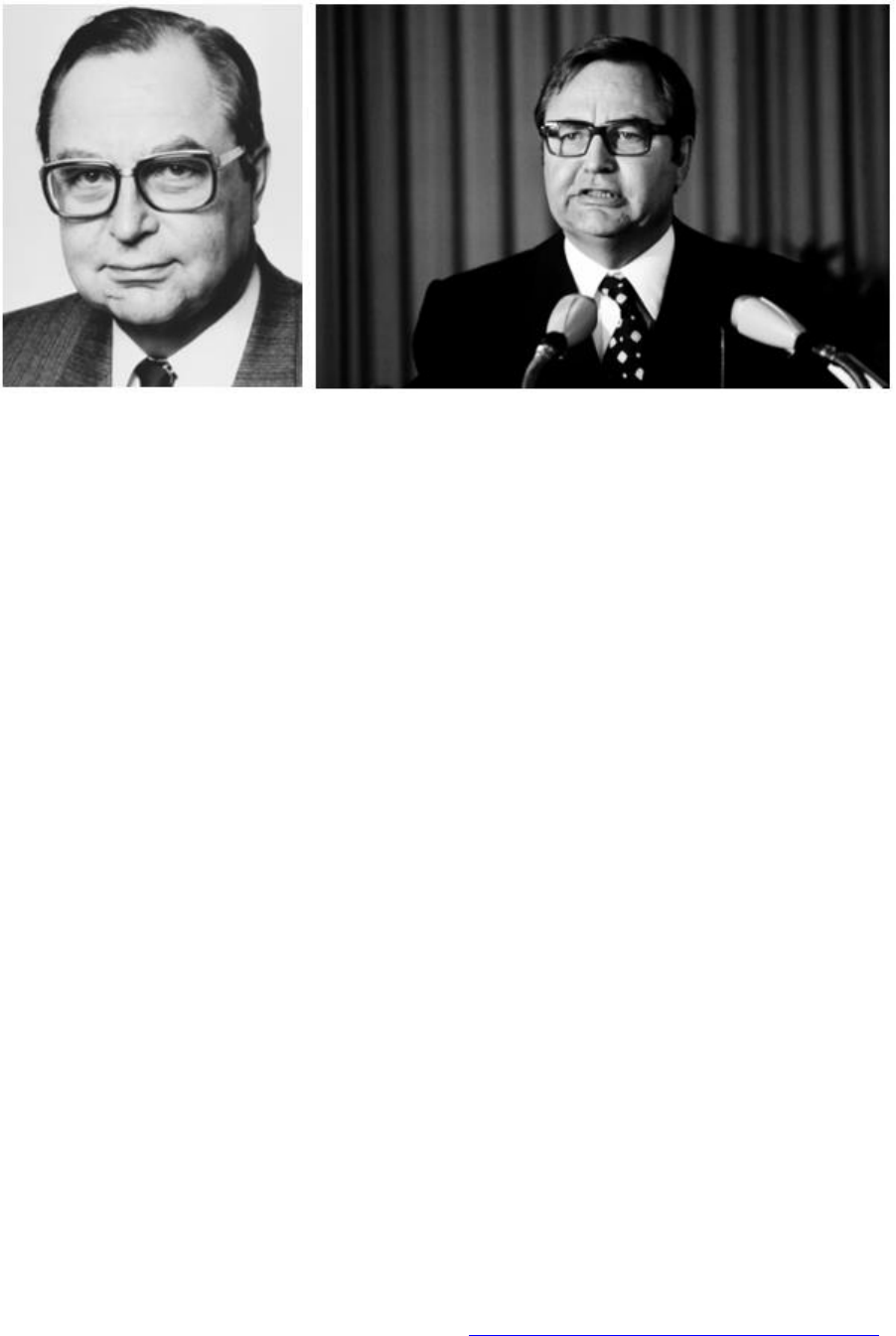
An obituary for Horst Herold, the late former president of the Federal Criminal Police Office
(BKA) and inventor of the “Rasterfahndung” (grid search).
Dr. Horst Herold (born October 21, 1923; died December 14, 2018) was a German lawyer and
served as president of the Federal Criminal Police Office from 1971 to 1981. In this role, he
became a symbolic figure in the fight against terrorism in the Federal Republic of Germany
during the 1970s, particularly in connection with the attacks carried out by the Red Army Fac-
tion (RAF).
In 1952, he became an assistant judge at the public prosecutor’s office of the Nuremberg-
Fürth Regional Court. In 1953, he was appointed public prosecutor. In 1964, he became head
of the Nuremberg Criminal Investigation Division. Just three years later, he assumed the po-
sition of Nuremberg Police Chief. From 1969 to 1971, Herold was a member of a reform com-
mission tasked with reviewing the work of the Federal Criminal Police Office (BKA). On Sep-
tember 1, 1971, he was appointed President of the Federal Criminal Police Office (BKA). Dur-
ing his tenure until 1981, he spearheaded a reform process at the BKA designed to make it a
global flagship of the German police force. Under his leadership, the “Rasterfahndung” (grid
search) was introduced as part of the domestic fight against RAF terrorism. Horst Herold was
placed on early retirement on March 31, 1981, at the age of 57.
Following Pohle’s arrest, Mr. Werner Mauss flew to Corfu that very night on behalf of the BKA
leadership and met with the former Minister of Labor of North Rhine-Westphalia and chairman
of the SPD state parliamentary group, Prof. Dr. Farthmann, at his vacation resort to warn him
of a possible RAF attack in retaliation for Pohle’s arrest. Prof. Dr. Farthmann immediately
returned to Germany; see his statement – Link: https://werner-mauss.com/FARTHMANN-1.html
44
45
46
47
Nikolas Fotinopoulos, the former Police General of Athens and head of Interpol from
1975 to 1984, made the following statement in a written declaration on January 24, 1996
– excerpt verbatim:
“I first got to know Werner Mauss in 1976, when the German Federal Agency for Investigations
(BKA) had announced him – under a cover name – via Interpol at the Greek Police and had
asked to support his covered investigations against German terrorists of the “Red Army Frac-
tion” (RAF). The Greek Police had granted him the requested help. Through Mauss work of
investigation the Greek Police was able to arrest an important German RAF terrorist. Due to
the Greek Police’s operations which had led to this success, the German Government and the
Bavarian regional government expressed their thanks to the Greek Government. At this op-
portunity I personally went to Germany, where I spoke with Mr. Boeden, then head of the
division against terrorism of the BKA. He as well found very approving words about the per-
formed work. Also the German Head of Interpol, Mr. Jeschke, and Mr. Mehler, Head of the
Bavarian Agency of Investigations, with whom I had also talked, expressed themselves in a
similar way.
During the Greek Prime Minister Karamanlis’ first visit in Germany Mauss was also entrusted
with his protection. I had accompanied Karamanlis to Bonn, because a terrorist attack against
him was feared. Maus was then with Karamanlis in the guest house of the German Govern-
ment in Bonn.
From 1976 onwards Mauss regularly operated in Greece as a civilian cooperator of the BKA,
each time after his announcement under legend by Interpol.
One of Mauss‘ actions became necessary because it had become known that an attack was
planned against the then Minister of Nordrhein-Westfalen, Prof. Farthmann, during his vaca-
tions in Greece. The BKA sent Mauss to Greece for the Minister’s protection. For security
reasons, Mauss flew the minister to Germany in the plane at his disposal.
After this, Mauss came to Greece several times, ordered by the BKA, which had always an-
nounced him via Interpol. These announcements were also done under a cover name. Mauss
always realized his investigations under a cover name. He disposed of the corresponding
cover papers, issued by the German authorities. In most cases German terrorists should be
found. At that time many German terrorists lived in Greece, on the Greek islands, on Cypress
or in the neighbour countries. There they had been occasionally beheld by German tourists.
The tourists had then advised the BKA by phone, which then sent Mauss.
48
The Greek police supported Mauss. After an Interpol request the Police had asked other
Greek police agencies to support Mauss in mutual assistance. With this also the heads of the
Greek criminal police and the police for foreigners were involved.
Greece as well had been suffering due to international terrorism. To fight terrorism in Greece,
Mauss gave valuable references upon the Greek police’s request.
Also between 1979 and 1984 Mauss repeatedly operated in Greece within BKA investigations,
in the majority of cases after announcement by Interpol. I knew that in the operations he real-
ized after 1979, Mauss was conducted by the German Federal Foreign Intelligence Agency
(BND). These were mainly operations in connection with the fight against terrorism.
From 1981 to 1984 there were basically two operations against terrorists who had also been
staying in Syria. Within these operations a contact place was installed in northern Greece, at
a lady’s who belonged to the terrorist scene. During the second operation, a legend was con-
structed for Mauss near Athens, from where he should – under cover – find contact to the RAF
members. For the control of this operation, a BND member stayed in Athens in 1982.
(...)
1983/1984 security authorities of the NATO had ordered Mauss to operate against interna-
tional terrorists. In this case I participated, together with Mauss, in a discussion regarding the
operation, which was also connected with the murder of an American marines officer by the
Greek terrorist organisation “17th November”. In connection with this case conversations that
I led on request of the Greek security authorities, took place also in Italy and France.
(...)“
1977 – Covert subversive operation against the terrorist organization
MPAIAC – leader Antonio Cubillo - successful dismantling of the
MPAIAC, which was completely dissolved in 1979
Mr. Werner Mauss was accompanied for support by the Coordination Office of the Security
Group, Counterterrorism Division, and the BfV, but was led by the Lower Saxony Office for
the Protection of the Constitution, on a covert subversive mission against the command struc-
ture of the Spanish terrorist organization MPAIAC and its leader, Antonio Cubillo. At the time
of the operation, the MPAIAC received massive logistical support from the Algerian govern-
ment, its president Houari Boumedienne, resp. the Algerian intelligence service. There were
training camps in Algeria where RAF terrorists were trained and financially supported at the
invitation of the MPAIAC.
49
Mr. Werner Mauss flew to destinations in Spain resp. the Canary Islands for talks with the
Spanish intelligence service using the aircraft at his disposal; for reasons of secrecy, he flew
without a co-pilot, accompanied by the head of Lower Saxony’s Office for the Protection of the
Constitution, Helmut Jüllig, and department head Harald Wiehe. Werner Smoydzin, who was
then ministerial director, also accompanied the mission from time to time.
Following a bomb attack on a flower shop at Las Palmas Airport carried out by the MPAIAC,
led by Cubillo, the diversion of air traffic on Tenerife on March 27, 1977, resulted in a collision
between two planes, killing more than 600 people. The MPAIAC also engaged in significant
extortion of German companies. Mr. Werner Mauss succeeded in dismantling the MPAIAC
from within through the use of carefully planted informants. As described earlier, the terrorist
organization was completely dissolved in 1979.
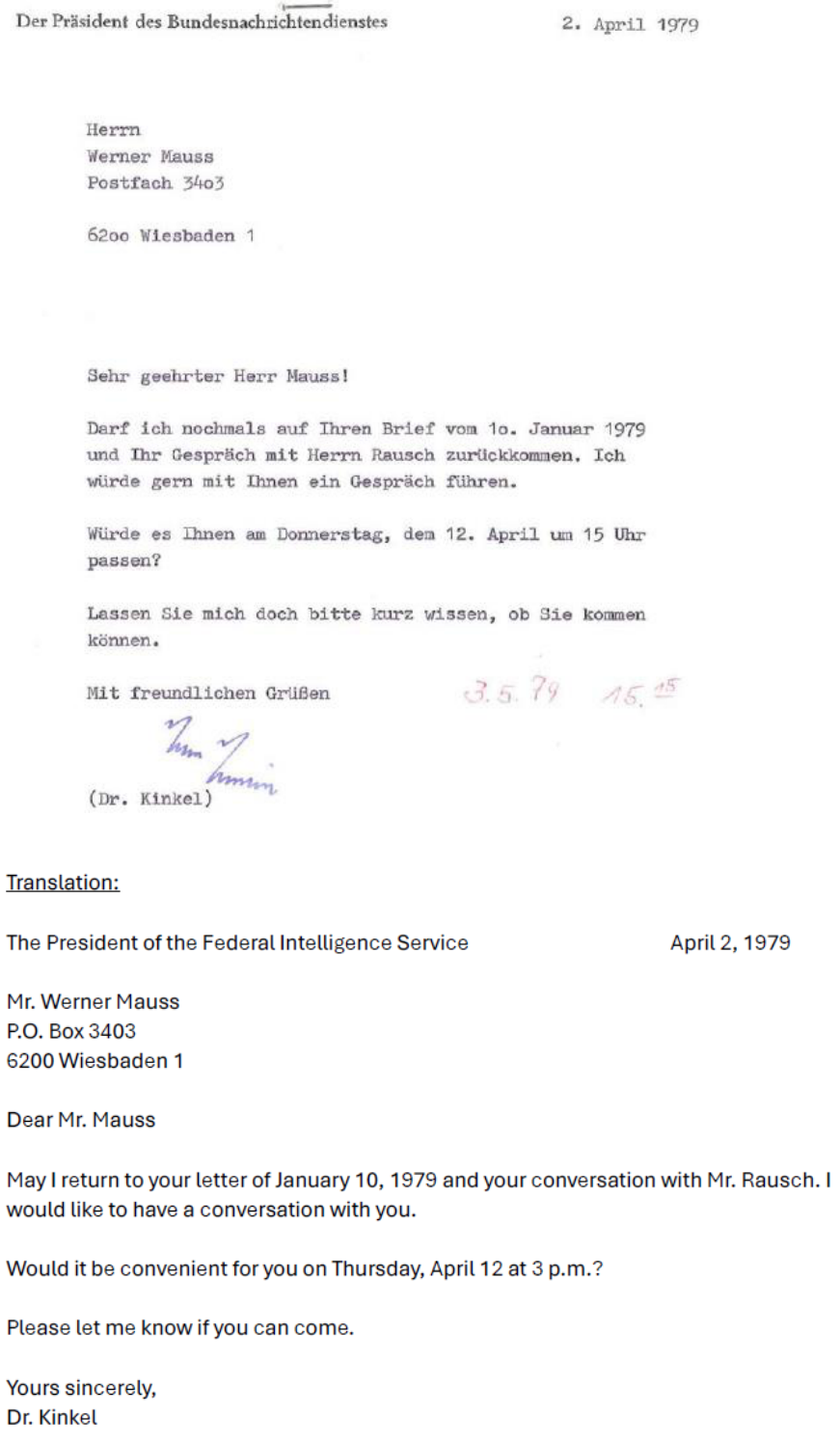
On the recommendation of BKA President Dr. Herold, who had always referred to Mr.
Werner Mauss as his “secret weapon” in conversations with experts, Mr. Werner Mauss
received a personal invitation from then-BND President Dr. Klaus Kinkel on April 2,
1979 to a confidential lunch, which took place on April 12, 1979, at the BND’s premises
in Pullach – see copy of the invitation letter below. This conversation took place directly
between Mr. Werner Mauss and Dr. Kinkel. Mr. Werner Mauss made factual proposals,
which were taken up by Dr. Kinkel. This was followed by the transfer of “Organization
M.” to the BND, coordinated with the BKA and the BfV.
To attend the invitation to Pullach, Mr. Werner Mauss had flown directly from his airfield
in Rhineland-Palatinate to Munich under IFR using the pressurized aircraft made avail-
able to him. A delegation from the BND was waiting at the airport and drove Mr. Werner
Mauss to the BND residence in Pullach. Discussions with the BND department heads
responsible for Mr. Werner Mauss - Mr. Rausch (Procurement) and Colonel Schmid -
did not take place until later.
50
51
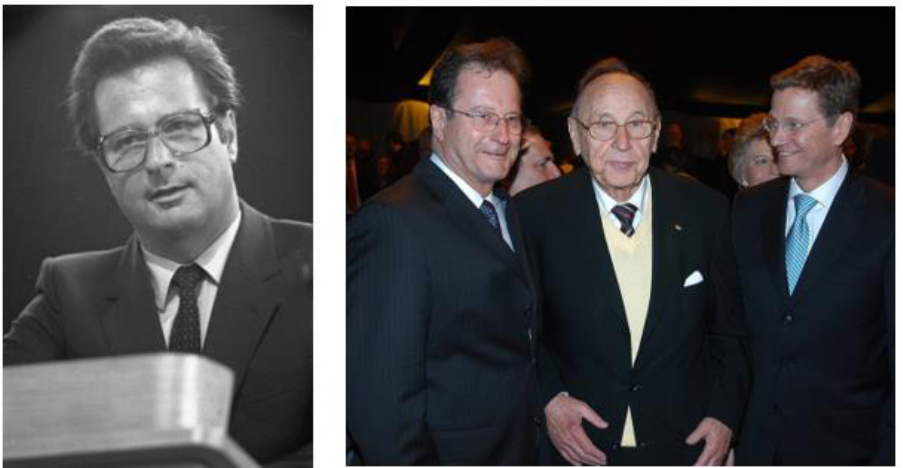
Dr. Klaus Kinkel (left) on March 21, 2007, with (from left to right) Hans-Dietrich Genscher
(1927–2016) and Guido Westerwelle (1961–2016)
Dr. Klaus Kinkel (born December 17, 1936; died March 4, 2019) served as President of the
Federal Intelligence Service from 1979 to 1982, as Federal Minister of Justice from 1991 to
1992, Federal Minister of Foreign Affairs from 1992 to 1998, Vice Chancellor from 1993 to
1998, and Federal Chairman of the FDP (Liberal Democratic Party) from 1993 to 1995. From
1994 to 2002, he was a member of the German Bundestag.
Mr. Werner Mauss worked from 1979 to 1983 on the basis of a contract with the BND;
that is, during this period he was directly supervised by the BND. In addition, all of Mr.
Werner Mauss’s cover documents were provided and rewritten by the BND. This also
included the Möllner documents. The primary focus of Mr. Werner Mauss’s operations
was counterterrorism. After 1983, he was once again, among others, assigned by the
BKA to work in the area of organized crime (OK). At the same time, he continued to be
deployed in follow-up operations by the BND against RAF terrorists in Greece and the
Middle East. He also worked on a subversive special operation against the Gaddafi re-
gime from 1982 to 1984 - an operation also overseen by a Western partner agency and
logistically supported by the BND, BKA, and BfV - which was effective and successful.
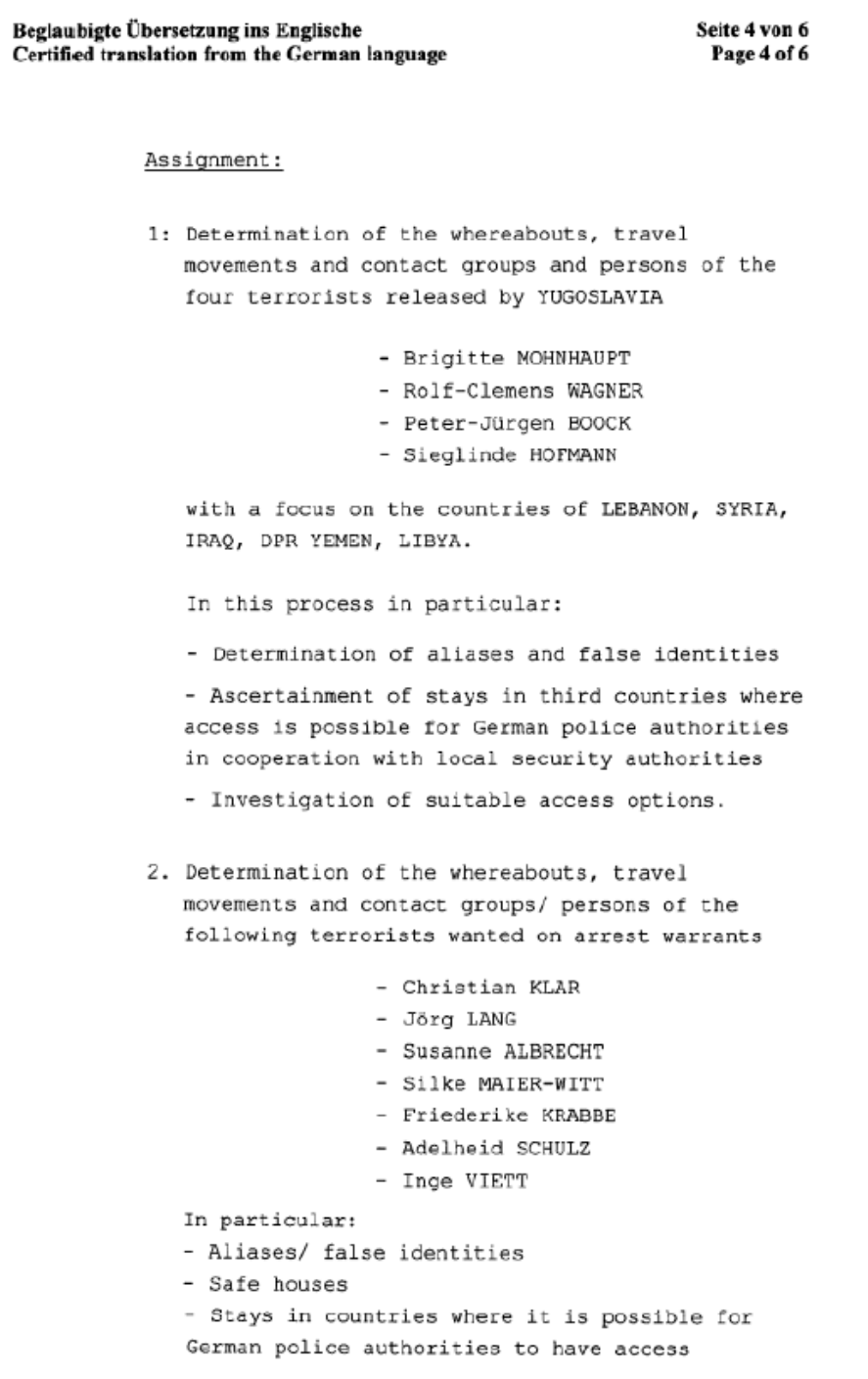
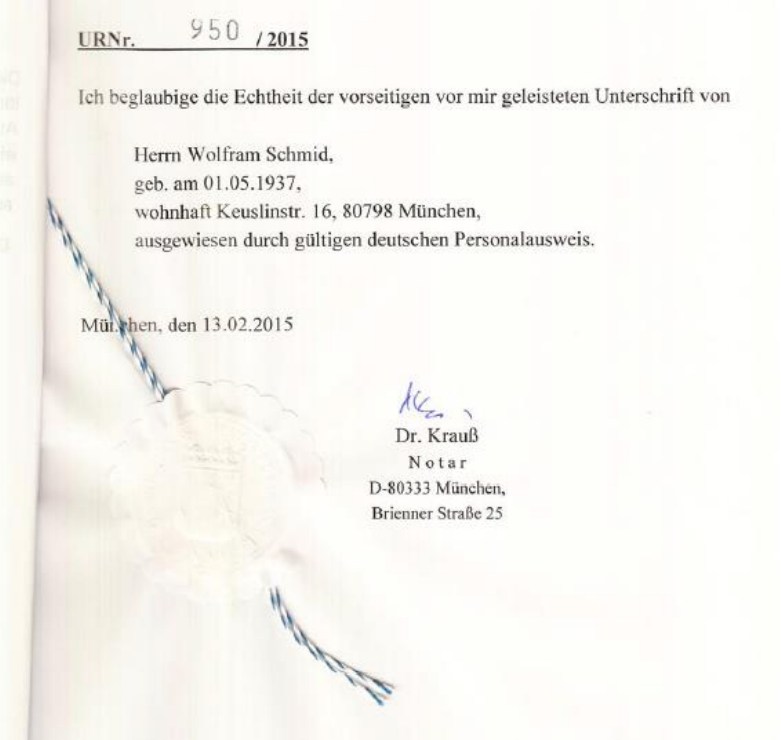
BND assignment, issued by the agency’s leadership; contact person: Mr. Rausch (code
name), Procurement Division; primary contact: Colonel Wolfram Schmid (real name) – see
also the following affidavit by Mr. Schmid:
52
53
54
55
56
57
58
59
60
61
1979-1983 – Operation on behalf of the BND
Counterterrorism, operations against RAF terrorists in Greece and the Middle East, including
an operation against RAF terrorist Mohnhaupt.
1979-1981 – Preliminary operation
Led by the BND and with logistical support from the BKA and BfV, as described above, place-
ment of a female secret collaborator within the circle of RAF supporters in Heidelberg.
Infiltration and guidance of the aforementioned informant by Mr. Werner Mauss within the
circle of RAF supporters in the Heidelberg area. This led to the exposure and accidental
deaths of RAF terrorists Juliane Plambeck and Wolfgang Beer. As was later determined, RAF
terrorists Christian Klar and Adelheid Schulz were in another vehicle nearby at the time of the
accident.
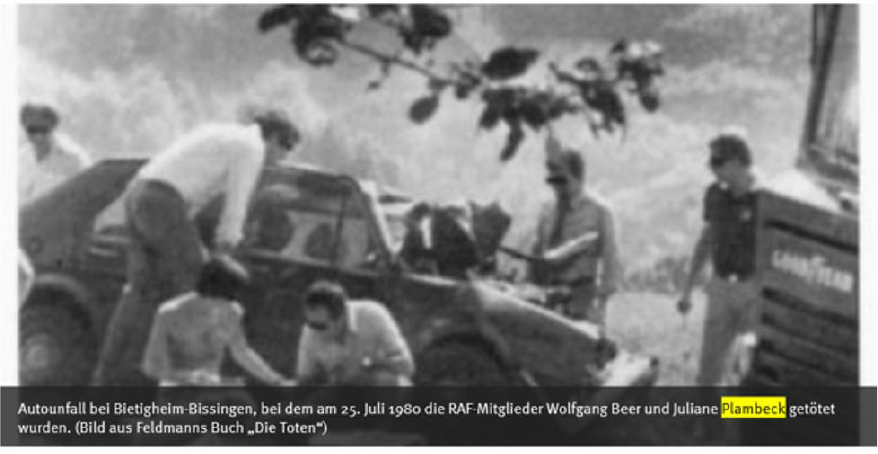
62
Through a female secret collaborator of Dutch nationality - who had been recruited by Mr.
Werner Mauss under the cover of being an arms procurer in Spain and later transferred to
Heidelberg, who bore a striking resemblance to the wanted female RAF terrorist von Dyck -
Mr. Werner Mauss succeeded in 1980 in establishing contact with the terrorists Plambeck and
Beer through RAF supporters. Plambeck and Beer intended to purchase four submachine
guns from the female secret collaborator through a female RAF supporter residing in Heidel-
berg. The Baden-Württemberg State Office for the Protection of the Constitution (LfV) pre-
pared the operation in cooperation with federal authorities. As part of this operation, a suspi-
cious vehicle was spotted on July 25, 1980. Believing it was being followed, this target vehicle
then crashed head-on into a gravel truck near the town of Unterriexingen—Bietigheim-Bis-
singen train station, Baden-Württemberg. The vehicle’s occupants, RAF terrorists Plambeck
and Beer, were killed instantly. The murder weapons (submachine guns of Polish origin) used
to kill the four companions of employers’ association president Hanns Martin Schleyer during
his abduction in September 1977 were found near the bodies.
The last known trace of RAF terrorist Klar, as documented by the police: On July 25, when
the terrorist couple Juliane Plambeck and Wolfgang Beer were killed in a crash near Bie-
tigheim, he was driving with his girlfriend Adelheid in the red BMW 2002 that had been follow-
ing the car involved in the accident and managed to speed away.
Years later, the press learned details about the background of the case from third parties, in
particular that Mr. Werner Mauss had been in charge of the informant. Journalists also claimed
that, while the operation was underway, he had deliberately orchestrated events in such a way
that the terrorists were killed. This was later published as such in an article in the press. The
same information was leaked to the press as a smear campaign through the Stasi’s Disinfor-
mation Department at the time.
63
1980 – Covert, subversive operation for the BND against PLO terror-
ists
In 1980, Mr. Werner Mauss was once again involved in a special mission for the BND, which
had begun in 1976 as part of intelligence-gathering during the manhunt for the RAF terrorist
Pohle. The operation against the right-wing extremist and arms procurer for PLO terrorists,
Udo Helmar Albrecht, born April 13, 1940, in Beyrode/Mühlhausen, was conducted in a covert
and subversive manner. Mr. Werner Mauss succeeded in being introduced to the terrorist
supporter Udo Albrecht under a cover identity in January 1980. Mr. Werner Mauss received
information from Albrecht about weapons caches near the Belgian city of Liège and in the
Ardennes, which Albrecht had set up on behalf of the PLO and which were intended for use
in terrorist attacks. Albrecht also informed Mr. Werner Mauss about numerous planned PLO
attacks in Western Europe and Israel. In consultation with Mr. Werner Mauss, the trips with
Albrecht - some of which were undertaken at great personal risk - were secured by Belgian
and German authorities.
Albrecht was later arrested in coordination with the BND for his numerous crimes. He claimed
to have information about another weapons cache on the GDR border. During the inspection,
he deceived the police and suddenly ran toward the GDR border, where Stasi officers met him
and escorted him across the border into GDR territory. Prior to this, GDR military units sta-
tioned along the border had pointed their weapons at West German security forces, who, due
to this aggression, were unable to prevent Albrecht from escaping. Albrecht had been coop-
erating with the Stasi on intelligence matters for years. The Stasi headquarters subsequently
transferred Albrecht to a Palestinian camp in Lebanon (a training camp for PLO terrorists).
There, Albrecht was accused by the PLO of betraying weapons caches to the BND. The
charges brought by the PLO terrorists concerned intelligence cooperation with Mr. Werner
Mauss against the PLO. In the fall of 1981, he was arrested again in Frankfurt. According to
available information, Udo Albrecht was shot in Lebanon because of the alleged cooperation
with Mr. Werner Mauss resp. the BND.
1981 – UCA assignment for the BKA and the Lower Saxony State
Criminal Police Office (LKA) - Special Task Force “Zitrone” (Lemon)
Operations in northern Germany, Italy-Sardinia, and Greece. Special prosecutors were ap-
pointed in Germany and Sardinia to authorize the UCA operations. The criminal organization
consisted primarily of Italian criminals who carried out arson attacks and homicides against
gang members. In 1982 arrest of the main perpetrators during an attempted arson in Rhodes,
further arrests in Sardinia and Germany, dismantling of the gang.

64
1981/1982 – UCA operation against a criminal organization in Ham-
burg and Bielefeld - Focus: Robberies, burglaries, handling of stolen
goods
Mr. Werner Mauss led police to the criminals’ leaders during an arrest operation in Bielefeld.
During the operation, an officer from the special operations unit accidentally fired a burst from
his submachine gun; the bullets flew just a few centimeters past Mr. Werner Mauss and fatally
struck one of the perpetrators, who was sitting in a car. The accomplices in Hamburg who had
not yet been arrested therefore organized a demonstration in front of the police headquarters
in Bielefeld. Mr. Werner Mauss was accused by the criminal group of causing the death of the
man who was shot by setting the trap. This was the reason why the Hamburg “underworld”
was searching nationwide for Mr. Werner Mauss to take revenge.
Retired Associate Judge and retired Chief Detective Gerd Steffen described these events in
a letter dated January 2, 1996 – the following is a verbatim excerpt:
„(…)
A subsequent case handled by Mauss involved another criminal gang that had committed
robberies, burglaries, and drug offenses. One burglary had taken place in the Free Port of
Hamburg. In this case, the police also assigned Mauss to conduct an undercover investi-
gation. The perpetrators were arrested in Bielefeld. The information provided by Mauss
was crucial to this outcome. During the arrest, a police officer shot and killed a gang mem-
ber.
(…)“
1982 – Successful special operation led by the BND against RAF ter-
rorists
Primary targets: Brigitte Mohnhaupt and others; areas of operation: Greece, the Middle East.
1983 – BKA Chief Inspector Hans-Georg Haupt commits a breach of
official secrecy to the detriment of the BKA and Mr. Werner Mauss
From late 1973 to 1976, BKA Chief Inspector Hans-Georg Haupt was tasked by the BKA
leadership with providing logistical support to Mr. Werner Mauss during his undercover oper-
ations. Chief Inspector Haupt’s duties included providing Mr. Werner Mauss with cover docu-
ments, procuring fake license plates, etc., as well as protecting the residential complex in
Altstrimmig where Mr. Werner Mauss lived under an officially assigned alias.
65
During the aforementioned period, Mr. Werner Mauss worked, among other things, against a
criminal organization under Section 129 of the German Criminal Code (StGB), led by an in-
vestigator from the BKA, and concurrently on the “Cathedral treasure” special task force in
Cologne. The case officer and contact person was the deputy head of the Cologne Criminal
Investigation Department, Chief Inspector Hochscherff. The perpetrators were arrested and
the cathedral treasure recovered in 1976.
Following the aforementioned operations, Mr. Werner Mauss also conducted a successful
manhunt in Greece in 1976 on behalf of the Bavarian State Criminal Police Office (BLKA) and
the BKA for Rolf Pohle, the RAF terrorist who had been released from prison in Berlin and
who had procured the weapons used in the Drenkmann murder. Mr. Werner Mauss worked
alone with the case officers; Chief Inspector Haupt merely provided support from Wiesbaden
to the case officers by arranging security measures for Mr. Werner Mauss’s covert operations.
Due to various malicious schemes attempted during the aforementioned period from late 1973
to 1976, Mr. Haupt was abruptly relieved of his duties as an assistant to Mr. Werner Mauss
by the then-President of the BKA, Dr. Herold, and his department head, Chief Detective
Schorm, in the fall of 1976. From that point on, Mr. Werner Mauss continued to receive logis-
tical support from the BKA’s Security Group - Counterterrorism Division - only from Criminal
Director Köhn and Chief Inspector Ostermann.
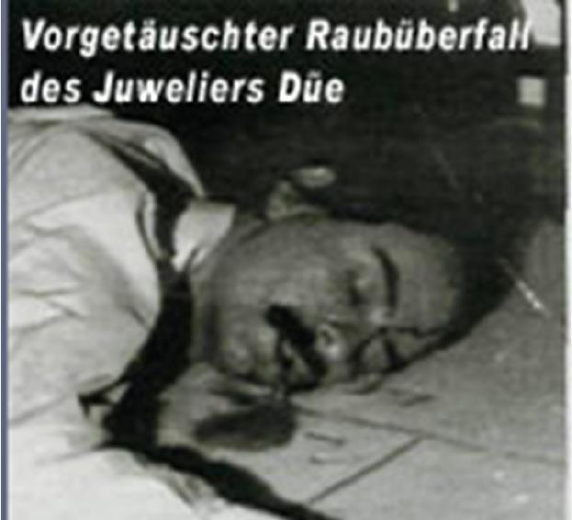
Police photo – the vomit is visible
In 1981, Düe had a Turkish career criminal he knew knock him unconscious for the
staged robbery. He had previously hidden the jewelry in the ceilings and walls of his
jewelry store. While Düe was in prison, his father sold the jewelry store. During reno-
vation work in June 2000, the new owner found the hidden jewelry. No new charges
could be filed; the statute of limitations had expired.
66
1982-1983 – UCA operation against jeweler René Düe on behalf of
the Lower Saxony State Criminal Police (LKA) - staged robbery on
October 31, 1981 - damages: 13 million German marks
BKA Chief Inspector Haupt commits breach of official secrecy to the
detriment of Mr. Werner Mauss
In 1982, Mr. Werner Mauss was assigned to investigate the staged robbery (13 million Ger-
man marks) carried out by jeweler René Düe. Mr. Werner Mauss had previously been se-
conded by the BKA to the LKA as an undercover agent. He had infiltrated Düe’s criminal group
in connection with the robbery Düe had staged. As an undercover investigator, he managed
to obtain fifteen pieces of jewelry from Düe that Düe had previously reported as stolen. Düe
had hidden the jewelry in a suitcase among towels at the Hotel Kolumbus in Bremen for the
handover. He intended to use these pieces of jewelry to illegally incriminate his main supplier
in New York. Düe was arrested on August 5, 1982.
The BKA had agreed with the Lower Saxony Ministry of the Interior that Mr. Werner Mauss
would testify as the main witness against Düe. The investigation of the case by the witness
Mauss was supported by state authorities, even though Mr. Werner Mauss was operating as
an undercover agent. This was intended to prevent financially strapped businessmen from
emulating Düe’s criminal behavior. The Lower Saxony Ministry of the Interior had ordered the
covert interrogation of Mr. Werner Mauss for June 16, 1983. The blocking declaration states
verbatim:
“The witness ‘Claude’ is a police informant. He is being used to combat serious crimes.
Any media coverage resulting from a ‘public hearing’ would allow criminals to deduce the
witness’s identity. This would not only endanger the life and safety of the witness “Claude”
and his family members, but also jeopardize the welfare of the state of Lower Saxony and
that of the Federal Republic of Germany. Questioning the witness “Claude” in front of a
staged “public” would make his current and future work in the field of serious and organized
crime impossible.”
Mr. Werner Mauss was dropped off at a highway rest stop in Lower Saxony by a vehicle
belonging to the BKA, where he was picked up by a Lower Saxony police helicopter while
wearing a police uniform and dropped off on the roof of a police academy in Hanover. A make-
shift hut had been set up there. The press had surrounded the police academy with cameras.
In the rooms beneath the academy’s roof, the criminal court hearing the Düe case awaited Mr.
Werner Mauss’s testimony, given in secret.

67
As agreed in the blocking declaration issued by the Lower Saxony Ministry of the Interior, he
testified against Düe under the alias “Claude,” providing via microphone all the evidence-rel-
evant information he had obtained. In this first-instance trial, Düe was sentenced by the Han-
over Regional Court on January 4, 1984, to seven and a half years in prison. Due to a witness
who had not been heard, the Federal Court of Justice overturned the verdict on Nov. 2, 1984.
On appeal Düe was acquitted by the criminal court on March 13, 1989, due to lack of evidence,
as the prosecution had disregarded all the circumstantial evidence related to the operation of
Mr. Werner Mauss. Despite the acquittal, the Civil Division of the Hanover Regional Court
convicted Düe of fraudulent misrepresentation and gross negligence based on the evidence
not introduced during the appeal phase of the criminal proceedings. It also rejected his appli-
cation for legal aid for a damages claim against the insurance company Mannheimer Versi-
cherung in the amount of 73 million German marks. Even so, Düe received several million
German marks in compensation for wrongful imprisonment from the State of Lower Saxony.
The Federal Court of Justice upheld the ruling of the Regional Court of Hanover, thereby ex-
empting the insurance company from paying damages for the alleged Düe robbery. As it
turned out later, this was the right decision. See the ruling of February 26, 1992, Regional
Court of Hanover, Case No. 130192/91; pp. 17, 18, and 19 – Link: https://www.werner-
mauss.com/documents/1_Judgment_Regional_Court_Hanover_February_26_1992.pdf
Regarding the ruling: newspaper HAZ, February 27, 1992 – Link: https://www.werner-
mauss.com/documents/2_Article_HAZ_February_27_1992.pdf
Working in criminal collusion with his accomplices, Düe had managed in 1983 to manipulate
a group of journalists - whose identities have since been established - who were coordinated
by a “freelance television journalist” from Frankfurt am Main. According to available infor-
mation, these individuals succeeded in bribing Chief Inspector Haupt, formerly of the BKA,
who was then being held in pretrial detention in North Rhine-Westphalia.
At that time, BKA Chief Inspector Haupt was being held in pretrial detention in the high-security
wing of a Düsseldorf prison. This had nothing to do with Mr. Werner Mauss. Chief Inspector
Haupt had already been arrested on June 10, 1981, for the following offenses: abuse of au-
thority, breach of custody, breach of entrustment, counterfeiting, obstruction of justice, fraud,
embezzlement, forgery, illegal gambling, and bribery.
Chief Inspector Haupt sold all of his confidential BKA information regarding Mr. Werner Mauss
- including details about the secure, secret residence where Mr. Werner Mauss lived under an
alias - to Düe’s criminal defense attorney, Mr. Brehm in Hanover, for 380,000 German marks,
as was later established in court proceedings, for his own financial gain.
68
Part of this breach of official secrecy involved Haupt disclosing to the press the information he
had obtained between 1974 and 1976 regarding all the backgrounds of the undercover oper-
ations that Mr. Werner Mauss had carried out with the police and the public prosecutor’s office
up to that point. This is the reason why Mr. Werner Mauss has been hounded by the press,
unlawfully “criminalized,” and dragged into the public eye from that time until today.
With the help of Chief Inspector Haupt, the journalists were thus able to expose the witness
Claude (Mr. Werner Mauss). They illegally purchased from Chief Inspector Haupt confidential
information protected by law regarding various ongoing prosecutorial investigations within
Germany, in which Mr. Werner Mauss had been deployed and directed by the police as an
undercover agent.
Through their unauthorized access to these proceedings, which were being handled by spe-
cial prosecutors, the journalists learned in which cities Mr. Werner Mauss had carried out
confidence-building measures authorized by the public prosecutor’s office in the interest of
solving crimes. Mr. Werner Mauss was, of course, not committing a criminal offense by doing
so.
Against their better judgment, in violation of journalistic due diligence, and knowing full well
that they were committing the criminal offense of “misleading the authorities,” the journalists
deliberately filed criminal complaints in Hanover, Koblenz, Stuttgart, Frankfurt am Main, and
other cities against Mr. Werner Mauss for receiving stolen goods and other offenses, all for
the purpose of personal gain. The aim was to criminalize him in order to discredit him as a
witness in the Düe trial.
However, the public prosecutors’ offices in the cities mentioned quickly saw through the
scheme, consolidated the individual cases reported into a single proceeding in Frankfurt am
Main, and, ex officio, discontinued the investigation against Mr. Werner Mauss regarding all
of the criminal offenses reported by the journalists.
It therefore came as no surprise to official observers at the time that the freelance television
journalist from Frankfurt am Main - and coordinator of the criminal journalists’ circle - began
producing a television documentary already in 1983 that sought to criminalize Mr. Werner
Mauss, following the exposure of Agent Mauss, which he had helped facilitate. In the fall of
1983, the journalist from Frankfurt began visiting serious criminals serving prison sentences
in German prisons to reveal to them the information he had purchased regarding the under-
cover operations in which Agent Mauss was involved. In doing so, the journalist had in mind
exclusively the agreements made with Düe and his own financial interests.
69
In the television documentary in question, the man from Frankfurt then gave the serious crim-
inals an “opportunity” to “complain”. “In unison, as if in a choir,” the aforementioned individuals
insisted that they had been wrongfully convicted. The journalist skillfully manipulated the film
against Mr. Werner Mauss in favor of Düe, who was on trial in Hanover. The goal, as was also
practiced in subsequent years, was to use this fabricated polemic to criminalize and discredit
the prosecution’s key witness, “Claude” (Mauss), in the Düe case, all in the interest of personal
gain.
Even after Dües’s “acquittal,” his supporters continued to exert considerable influence on print
media and television stations in an effort to defame Mr. Werner Mauss and portray him as a
shady character through misleading reporting.
In 1987/88, the Mauss couple were deployed as undercover agents in various covert opera-
tions coordinated among European security agencies to track down murder suspects and kid-
nappers. The “journalists’ circle” once again illegally obtained information about an operation.
It did not hesitate to put the Mauss couple in grave danger by carrying out disruptive actions
while they were on a mission abroad.
In one case, journalists had set up equipment not far from where the negotiations were taking
place in order to expose the couple to their criminal counterparts. The criminal investigation
department of the state involved in the operation immediately secured the evidence as soon
as it was discovered. Today, it is stored as evidence in the basement of the Mauss's attorneys.
In another case, the aforementioned individuals passed information to criminals, who then
ambushed the police agents in an underground parking garage in Frankfurt. The Mauss cou-
ple noticed a car parked across the exit, apparently intended to block their way out. At the
same time, five men were moving toward the vehicle. Mr. Werner Mauss used a jack to smash
the passenger-side window of the locked, blocking vehicle in a flash, pushed the car aside,
and drove past the men - who appeared to be of Southern European descent and were trying
to prevent him from continuing - together with his wife. They forced their way through the
closed exit barrier of the parking garage. After the attack, Mr. Werner Mauss contacted a
federal agency to set the incident straight with the police.
The schemers’ intention, once again, was to eliminate Mauss as a witness for the prosecution
in the Düe case. According to reports available to Mr. Werner Mauss, the aforementioned
associates of Düe pocketed the full amount of the compensation for wrongful imprisonment
that the state of Lower Saxony had determined and paid out to Düe following his “acquittal” in
March 1989.

70
Suddenly, in June 2000, after 19 years and following the expiration of the statute of limitations,
10.8 kg of jewelry - which Düe had reported stolen at the time - was recovered during renova-
tion work at the former store of his father, Friedrich Düe, in Hanover, Am Ballhaus, approxi-
mately 400 meters from the crime scene at Am Kröppke, still bearing the original tags. The
new owner had found the alleged stolen goods behind walls and ceilings in his father’s store.
While René Düe was in pretrial detention starting in the fall of 1982, his father, Friedrich Düe,
had sold his business. This was the reason why the criminal son was prevented from clearing
out the hiding place containing the alleged stolen goods until the jewelry was discovered in
June 2000.
This finally proved that Düe had staged the robbery. In any case, it is ridiculous to assume
that the robbers had hidden their loot in Düe’s father’s store on October 31, 1981, after the
crime. Düe’s statement in the appellate court that he had “accidentally” rediscovered the in-
criminating fifteen pieces of jewelry handed over to Mr. Werner Mauss in his father’s store is
- in hindsight - actually correct. Düe had “merely” “forgotten” to inform the criminal court in
1989, prior to his acquittal, that 10.8 of the 40 kilograms of jewelry were still hidden in the
ceilings and walls of his former shop.
From today’s perspective, It is shocking to realize how it could have come to pass back
then that Düe, with the help of his supporters, managed to manipulate prominent poli-
ticians, deceive them, and harness them as unwitting accomplices to his criminal en-
terprise under the guise of “supposed success.” Among them was the press secretary
of the then-opposition politician, later Lower Saxony Minister-President and Federal
Chancellor Gerhard Schröder, attorney Elmar Brehm. The then-prosecutor Grasemann
led a renewed and reopened criminal proceeding against Düe and ensured that the 15
pieces of jewelry seized from Düe could not be presented again as evidence against
him. As a result, Düe was acquitted. He received compensation for wrongful imprison-
ment of approximately 2.5 million German marks, which was passed on to a group of
people in order to unlawfully discredit police agent Mauss.
The news situation in the Düe case provides the following overview today:
- October 31, 1981: “Robbery” Düe.
- Düe reports that more than 40 kilograms of jewelry have been stolen, consisting of approx-
imately 3,400 individual consignment items.

71
- Eyewitnesses observe two men of Mediterranean appearance hurriedly leaving the store,
each carrying a small briefcase.
- The police in Hanover considered it impossible that these “potential perpetrators or accom-
plices” could have removed 40 kilograms of jewelry during the time they were observed.
The briefcases were too small to hold that many individual items, etc.
- 1991: During a murder trial in Istanbul, Turks claim to have helped Düe stage the robbery
– Links:
https://www.werner-mauss.com/documents/3_Article_Mannheimer_Morgen_Febru-
ary_5_1992.pdf
https://www.werner-mauss.com/documents/4_Letter_Loffler_Wenzel_Sedel-
meier_to_Higher_Regional_Court_Celle_Jan_20_1992.pdf
- Are the Turks the same Southerners who were seen by witnesses immediately after the
incident?
- 1982: The Lower Saxony State Criminal Police Office (LKA) forms a special task force in
response to various serious suspicions.
- Summer 1982: Düe hands over to police agent “Claude” (Mauss) the fifteen pieces of jew-
elry he had reported stolen
- Düe is arrested and sentenced by the Hanover Regional Court on January 4, 1984, to
seven and a half years in prison
- Between his conviction in 1984 and his acquittal on appeal in 1989, Düe and his criminal
associates orchestrate a smear campaign - likely unprecedented in the Federal Republic -
against a key prosecution witness (police agent Mauss) in order to discredit him as a wit-
ness for the prosecution.
Just as Düe and his helpers had planned:
- March 13, 1989: René Düe is acquitted on appeal due to lack of evidence. The criminal
division in Braunschweig had previously disregarded all evidence obtained through covert
means.
Just as Düe and his helpers had planned:
- Mauss is not called as a witness for the prosecution in the Braunschweig criminal trial.

72
Just as Düe and his helpers had planned:
- Düe is questioned: He explains that he happened to find the fifteen pieces of jewelry he
had reported stolen in his father’s store. The court accepts this account.
Contrary to what Düe and his helpers had expected:
- Despite the acquittal by the Braunschweig Criminal Court, the Civil Division of the Hanover
Regional Court evaluates all evidence presented by undercover agent Mauss and other
police officers. It finds Düe guilty of fraudulently deceiving the insurance company. By the
decision of the Hanover Regional Court dated February 26, 1992, upheld by the Federal
Court of Justice, the insurance company is released from all payments based on, among
other things, the fraudulent misrepresentation by Düe as established in the judgment. The
court also denies Düe’s application for legal aid for a damages claim against the insurance
company in the amount of 73 million German marks.
- Controversial: Although these rulings were in place, the state of Lower Saxony paid Düe
millions in compensation for wrongful imprisonment. His criminal associates immediately
pocketed the money.
- June 20, 2000: During renovation work on this day, 19 years after the crime, 10.8 kilograms
of jewelry from the Düe robbery - still bearing its original tags - is found hidden between the
walls and ceilings of the former Düe store at Am Ballhaus, which had once belonged to the
father, and is seized. The location where it is found is 400 meters from the crime scene.
- Following this discovery, even those who had been swayed by the smear campaign - which
had been organized at great expense and with considerable effort - against the undercover
agent Mauss in previous years, are now convinced of his guilt.
Summary:
Internationally active criminologists, judges, prosecutors, and others who were interviewed
agree: The Düe case serves as an excellent case study for police academies. But it also
clearly demonstrates that Düe, with his criminal energy and the power he and his supporters
organized - trampling on the rule of law - secured an acquittal, with the result that the crime
became time-barred without punishment.
Nevertheless, the bottom line for Düe and his criminal accomplices was nothing but significant
damage without any financial gain. For all these individuals, it remained a dream that vanished
into thin air, leaving a bitter aftertaste.
All individuals with significant criminal energy and any potential copycats must recognize from
this case: Crime does not pay!!!

73
Documentation:
Article from newspaper WamS no. 25 dated June 18, 2000 – Link:
https://www.werner-mauss.com/documents/5_Article_WamS_June_18_2000.pdf
Article from newspaper HAZ dated June 29, 2000 – Link:
https://www.werner-mauss.com/documents/6_Article_HAZ_June_29_2000.pdf
Article from newspaper Wochenspiegel dated July 12, 2000 – Link:
https://www.werner-mauss.com/documents/7_Article_Wochenspiegel_July_12_2000.pdf
Article from news agency dpa dated June 28, 2000 – Link:
https://www.werner-mauss.com/documents/8_Article_dpa_June_28_2000.pdf
Article from magazine Der Spiegel no. 26/2000, p.71, 72 und 73 – Link:
https://www.werner-mauss.com/documents/9_Article_Spiegel_June_26_2000_No_26-
2000.pdf
Article from newspaper Bild dated June 24, 2000 – Link:
https://www.werner-mauss.com/documents/10_Article_Bild_June_24_2000.pdf
Article from newspaper Bild dated June 26, 2000 – Link:
https://www.werner-mauss.com/documents/11_Article_Bild_June_26_2000.pdf
Preliminary injunction against Düe dated July 31, 2000, Regional Court of Stuttgart, Case No.
17 O 406/2000 – Link:
https://www.werner-mauss.com/documents/12_Preliminary_injunction_Re-
gional_Court_Stuttgart_July_31_2000.pdf
Prof. Wenzel, Statement of Reasons dated September 4, 2000, regarding the enforcement of
the judgment in the preliminary injunction proceedings before the Regional Court of Stuttgart
against Düe – Link:
https://www.werner-mauss.com/documents/13_Statement_of_reasons_Prof_Wenzel_Sep-
tember_4_2000.pdf
Injunction against René Düe became final on September 28, 2000, Case No. 17O406/400
– Link:
https://www.werner-mauss.com/documents/14_Injunction_against_Due_Septem-
ber_28_2000_final.pdf
Düe's Declaration of Submission – Link:
https://www.werner-mauss.com/documents/15_Declaration_of_Submission_Due_Novem-
ber_2_2000.pdf
Legal Notice from his lawyer Malottke dated November 3, 2000 – Link:
https://www.werner-mauss.com/documents/16_Legal_notice_Att_Malottke_Novem-
ber_3_2000.pdf
Letter dated January 20, 1992, from Prof. Wenzel to the Attorney General of Celle and the
Chief Public Prosecutor in Hanover regarding the suspicion that Turkish national Aydin Yild-
izsoy was involved in the staged robbery on October 31, 1981, orchestrated by Düe.– Link:
https://www.werner-mauss.com/documents/4_Letter_Loffler_Wenzel_Sedel-
meier_to_Higher_Regional_Court_Celle_Jan_20_1992.pdf

74
On March 20, 1991, Yildiszoy murdered his accomplice in Istanbul and, in true mafia style,
sewed the victim’s mouth shut with thread. His statement in court: The victim was to be pre-
vented from “revealing what he knew” even after death. During his interrogation, he had stated
that he knew René Düe and that the robbery on October 31, 1981, had merely been staged.
The victim’s brother, Nevzat Avan, testified before the same criminal court in Istanbul that the
murdered Nevzat, together with Yildizsoy, had assisted Düe in the role of robbers - in a crim-
inal conspiracy - in staging the robbery of his store.
Regarding the above-mentioned facts of the case – Link:
https://www.werner-mauss.com/documents/4_Letter_Loffler_Wenzel_Sedel-
meier_to_Higher_Regional_Court_Celle_Jan_20_1992.pdf
Article from newspaper "Hürriyet" dated February 1, 1992 – Link:
https://www.werner-mauss.com/documents/17_Article_Hurriyet_February_1_1992.pdf
Article from newspaper "Mannheimer Morgen" dated February 5, 1992 – Link:
https://www.werner-mauss.com/documents/3_Article_Mannheimer_Morgen_Febru-
ary_5_1992.pdf
Article from magazine "Der Spiegel" dated June 26, 2000, no. 26/2000 – Link:
https://www.werner-mauss.com/documents/9_Article_Spiegel_June_26_2000_No_26-
2000.pdf
1983 – UCA mission - Search for the 41 “Seveso toxic barrels” and
recovery in northern France - Prevention of the world’s largest envi-
ronmental disaster
The newspaper Neue Zürcher Zeitung on June 5, 2023 (https://www.werner-
mauss.com/downloads/2-25/Press_article_NZZ_05_06_2023.pdf) reports that in 1983, all
federal authorities in Germany, as well as those in Italy, France, and Switzerland, had worked
meticulously - though unsuccessfully - to prevent an environmental disaster.
Acting on a direct order from Interior Minister Zimmermann and with the support of Greek
authorities, Mr. Werner Mauss succeeded in uncovering the first lead in the Seveso case in
1983. This was facilitated by an operation carried out by Mr. Werner Mauss on behalf of a
German federal agency seven years earlier, in July 1976, during a targeted manhunt as part
of a UCA operation to arrest the RAF terrorist Rolf Pohle (the arms procurer for the murder of
Drenkmann, President of the Berlin Court) in cooperation with the Greek authorities. As a
result, in 1983, thanks to the trust he had built up, he had access to all the necessary contacts
with the Greek security authorities for the Seveso operation.
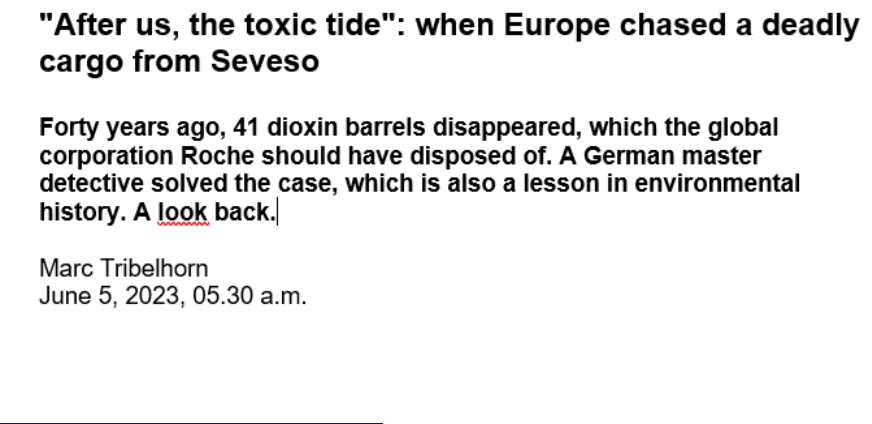
75
Supported by the legend he had built up in Athens, Mr. Werner Mauss - after unmasking the
group of perpetrators and carrying out numerous covert and subversive operations - managed,
within just 14 days, to locate the toxic barrels on May 19, 1983, in a disused butcher shop in
Anguilcourt-le-Sart, northern France, in the immediate vicinity of the Atlantic Ocean.
Since the group of perpetrators was involved in corrupt dealings with key figures in the French
authorities, he requested, through the office of the then German Interior Minister Zimmermann,
an appropriate number of surveillance vehicles from the BfV to secure the site of the discovery,
in order to secure the entire area for the operation in such a way that the toxic barrels could
not be moved to another location again, especially since the criminals, under intense investi-
gative pressure, were on the verge of dumping the toxic barrels into the Atlantic Ocean. This
would have caused the greatest environmental disaster in world history. In their naivety, the
target persons had failed to recognize the consequences of their actions. Dumping the barrels
into the Atlantic would not only have contaminated the entire Atlantic coast for centuries, but
also - through the evaporation of dioxin, a carcinogen that causes severe allergies and rashes
– would have poisoned vast swaths of Europe with dioxin-contaminated rain. When two kilo-
grams of dioxin were released in Seveso in 1976, 120 children developed chloracne, 4,000
small animals died, and 80,000 farm animals had to be emergency slaughtered, as reported
by the newspaper Neue Zürcher Zeitung on June 5, 2023. In contrast, the barrels discovered
by Mr. Werner Mauss contained 8,200 kilograms of the highly toxic substance - that is, 4,100
times the amount that had already led to devastating consequences in July 1976. Article from
the NZZ dated June 5, 2023:
ZDF - Terra X History – Film “Top Spies – The Great Secret Agents” – aired on June 29, 2025:
https://werner-mauss.com/TERRAX-EN.html
The film documents Mr. Werner Mauss's Seveso operation.
76
1982-1984 – North Africa - subversive secret operation against an
Islamic terrorist regime
Under Allied laws, Mr. Werner Mauss - under U.S. leadership, in coordination with the BND
and the BfV and with their logistical support, and with the knowledge of the BKA, Mr. Boeden
- was commissioned from 1982 to 1984 to take operational, covert, and subversive action -
using intelligence resources - against a North African state that, at the time, was training ter-
rorists worldwide, dispatching them to carry out attacks, and establishing Islamic schools in-
volved in terrorist activities. Mr. Werner Mauss had access to an opposition faction within this
regime. For four years, with the support of the United States, he succeeded in intercepting
secret and highly important communications from the regime. The operation, carried out at
the risk of his life, was extremely successful. Mr. Werner Mauss and his assigned assistants
succeeded in uncovering terrorist orders and thereby preventing them. To finance the afore-
mentioned, very costly covert operation, Mr. Werner Mauss again had access to a fund about
which, in accordance with instructions, he was not permitted to disclose any information to the
tax authorities.
1984-1986 – Assignment Mannesmann, Colombia
Release of seven kidnapped Mannesmann executives in Colombia and restoration of peace
along the pipeline route, which had been the scene of fighting in an area plagued by anarchy.
The local population lived below the poverty line and largely without medical care. Due to
attacks by the ELN guerrillas in connection with the kidnapping, construction of the Caño
Limón pipeline in the Arauca and Cucutá sections had come to a halt during this period. The
pipeline’s “first oil,” which Mannesmann had contractually committed to for the summer of
1986, was in jeopardy and would have meant bankruptcy for Mannesmann Anlagenbau due
to the agreed-upon contractual penalty.
In 1984, Occidental/Hammer, based in Los Angeles, USA, awarded Mannesmann a contract
to construct an oil pipeline in Colombia for the Arauca-Cucutá section. Seven key managers
were kidnapped in Colombia in August 1984 by the ELN guerrillas. Consequently, in August
1984, Mr. Werner Mauss was dispatched to Colombia - in consultation with the Federal Min-
istry of the Interior (BMI), Minister Zimmermann, and with logistical support from the BKA, Vice
President Boeden - to free the seven managers and secure the construction site. The con-
tractual relationship for the construction of the oil pipeline existed between Occidental/Ham-
mer and Mannesmann. Mannesmann would have had to pay a contractual penalty of 1 billion
U.S. dollars if “first oil” had not flowed by the end of 1986. The contract from Occidental/Ham-
mer to Mannesmann was awarded at the time without a competitive bidding process, as the
oil pipeline had to be laid in a region plagued by terrorism and the American company initially
commissioned for the project declined the contract due to the high risk involved.
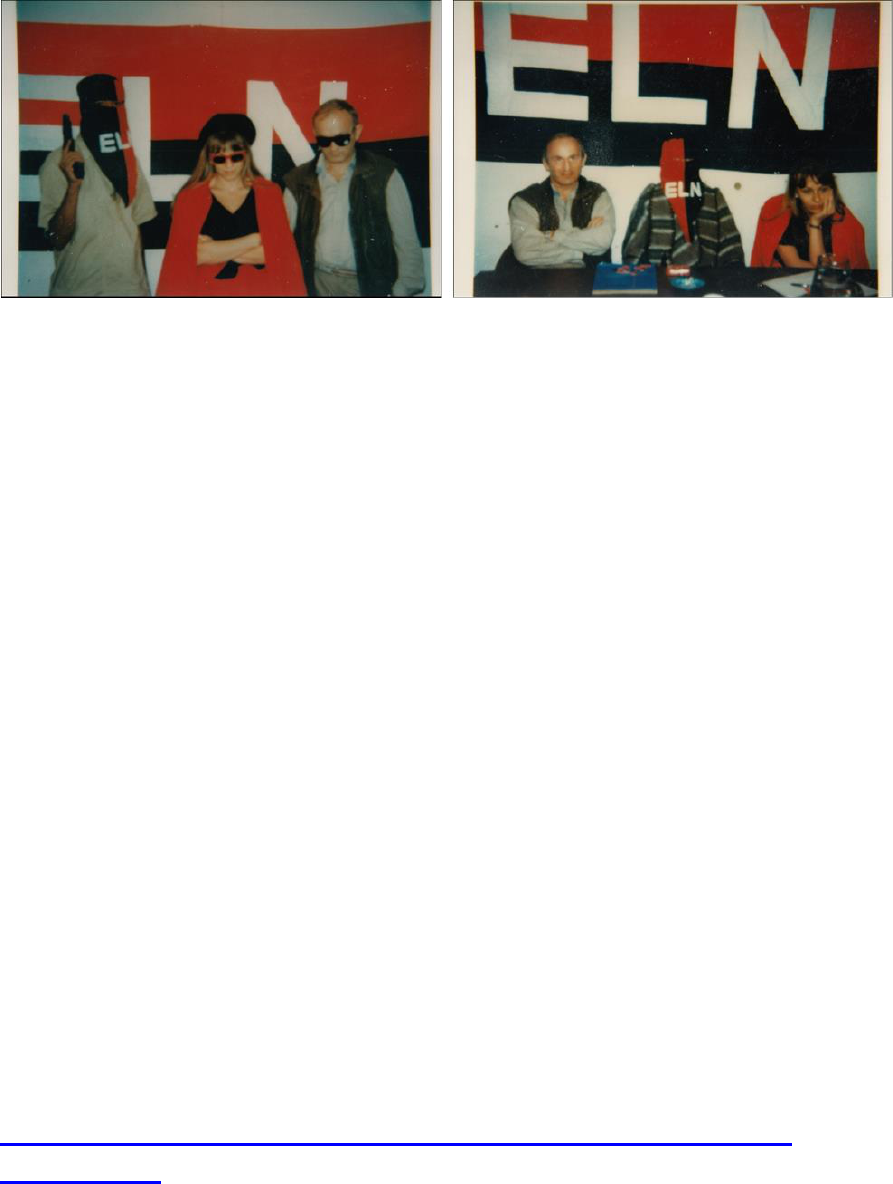
77
Risking life and limb, Mr. Werner Mauss succeeded in negotiating directly with the ELN’s Co-
mando Central to establish a humanitarian aid program called PRASCOL, under the auspices
of the Catholic Church and the Bishop of Arauca, Monsignor Jesús Emilio Jaramillo Monsalve,
which led to the release of the hostages without the payment of a ransom.
1985: Negotiations at the ELN’s central camp. Before each meeting, Mr. Werner Mauss and
his then-wife were picked up at the edge of the jungle by a heavily armed ELN commando unit
consisting of about 20 vehicles disguised as taxis. The ELN fighters covered the couple’s eyes
with insulating tape and placed sunglasses over them. The negotiations took place on average
every four weeks, and a round of talks generally lasted 48 to 60 hours.
This was made possible through negotiations and an agreement with the guerrillas stipulating
that, among other things, kindergartens and schools would be built 30 miles to the left and
right along the construction route of the oil pipeline to Cucutá, and that medical equipment,
antibiotics, etc., would be supplied to the guerrillas for distribution to the suffering population.
In return, the ELN, in agreement with Mr. Werner Mauss, assumed security duties at the facil-
ity. The first oil was then able to flow as planned at the end of 1986. Meeting this deadline was
very important for Occidental/Hammer, as Occidental/Hammer intended to sell approximately
40% of the oil production to Shell that same year.
Mr. Werner Mauss received a special bonus from Mannesmann for the successful completion
of the Caño Limón pipeline project, with the approval of Vice President Boeden of the BKA.
Mr. Werner Mauss was a non-resident for tax purposes starting in 1984 and, upon his return
to Germany in the 1990s, declared this money as part of his personal assets to the tax office.
He later used part of this money to fulfill a childhood dream and build an indoor riding arena.
On September 9, 1985, Mr. Werner Mauss received the Peace Prize from the Bishop of
Arauca, Colombia – Link:
https://werner-mauss.com/documents/Peace_Award_Bishop_Jaramillo_Septem-
ber_9_1985.pdf – see the following excerpt from the document.

78
Regrettably, on October 2, 1989, Bishop Jaramillo was murdered, after being tortured - not by
guerrillas, as claimed, but by paramilitary mercenaries of a drug cartel for the sake of personal
gain. Bishop Jaramillo was considered one of Mr. Werner Mauss’s closest confidants in the
Colombian peace process. Following the murder, the paramilitaries declared Mr. Werner
Mauss a military target.
Excerpt from the Peace Prize: “You have helped me understand my people, who come from
poor families. I know from personal experience that the tragedy of those who have nothing is
that they lack a future. That is why I know that the greatest gift one can give us is hope or a
reason to live. ……In the sky, stained with human blood, your heart shines like a star. I praise
God for choosing you to launch an aid program for the Third World. In my diocese, you are
writing the finest chapter of your life.”
The guerrillas showed respect and responded humanely. Instead of violence, secret talks took
place with Mr. Werner Mauss in the Colombian jungle: enemies became supporters and pro-
tectors of the project. Mannesmann was able to complete the pipeline in 1986 without further
endangering its employees.
Right at the start of the project, Mr. Werner Mauss summed it up this way: Pressure creates
counterpressure. To neutralize violence in Colombia, it is not the guerrillas that must be ad-
dressed, but rather the poverty of the population that must be alleviated and combated.
Starting in 1985, at the initiative of Mr. Gerhard Boeden - who was serving as Vice Pres-
ident of the BKA at the time and became President of the BfV in 1987 - Mr. Werner
Mauss received a secret trust fund following the execution of a trust agreement signed
by him on October 4, 1985. He was able to use the proceeds from this fund in the future
- under the supervision of representatives of the trust grantors (operators) of a third-
country intelligence service - to finance his worldwide operations against terrorism and
organized crime, with logistical support from Germany, but without oversight by the
German Parliament.
In the aforementioned context, Vice President Boeden had instructed the German Em-
bassy in Panama, in an urgent request dated May 20, 1985, to issue new passports to
Mr. Werner Mauss - Möllner and his family. The passports were then issued and handed
over one day later, on May 21, 1985. In a follow-up letter, Mr. Boeden thanked the am-
bassador for his prompt assistance and stated, verbatim: “Through your commitment
in this specific case, you have helped facilitate the Federal Criminal Police Office’s abil-
ity to fulfill its duties. For this, I thank you once again.” – see the letters below.
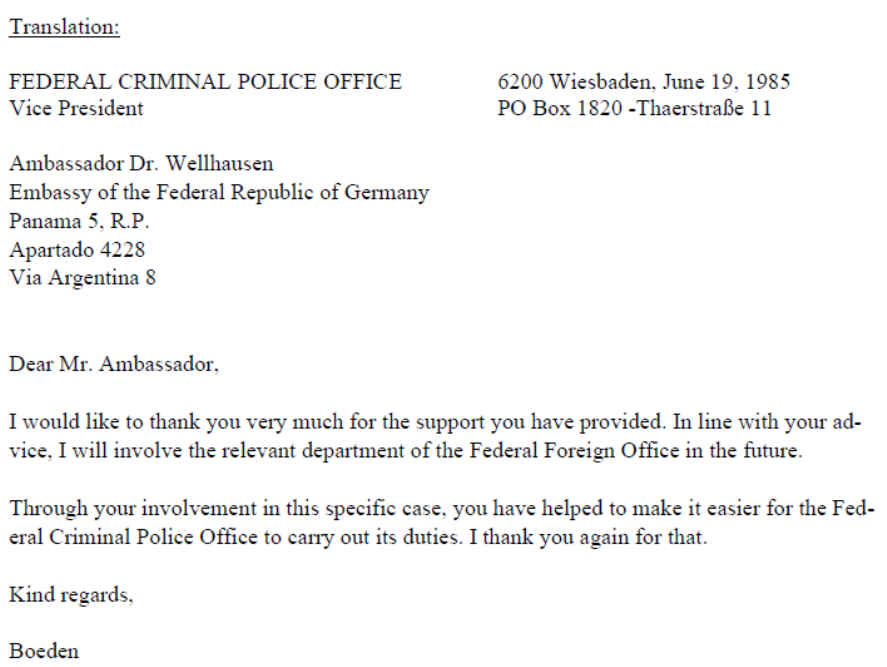
79
As Mr. Boeden had intended, the issuance of the new Möllner passport served as prep-
aration for the trust agreement, which was signed in Panama under the alias Möllner
upon presentation of the new passport. The new Möllner passport was copied into the
trust deed.
During a review of the files in the summer of 2017, the following letters, which are re-
lated to the aforementioned facts, were found at the BKA and copied:
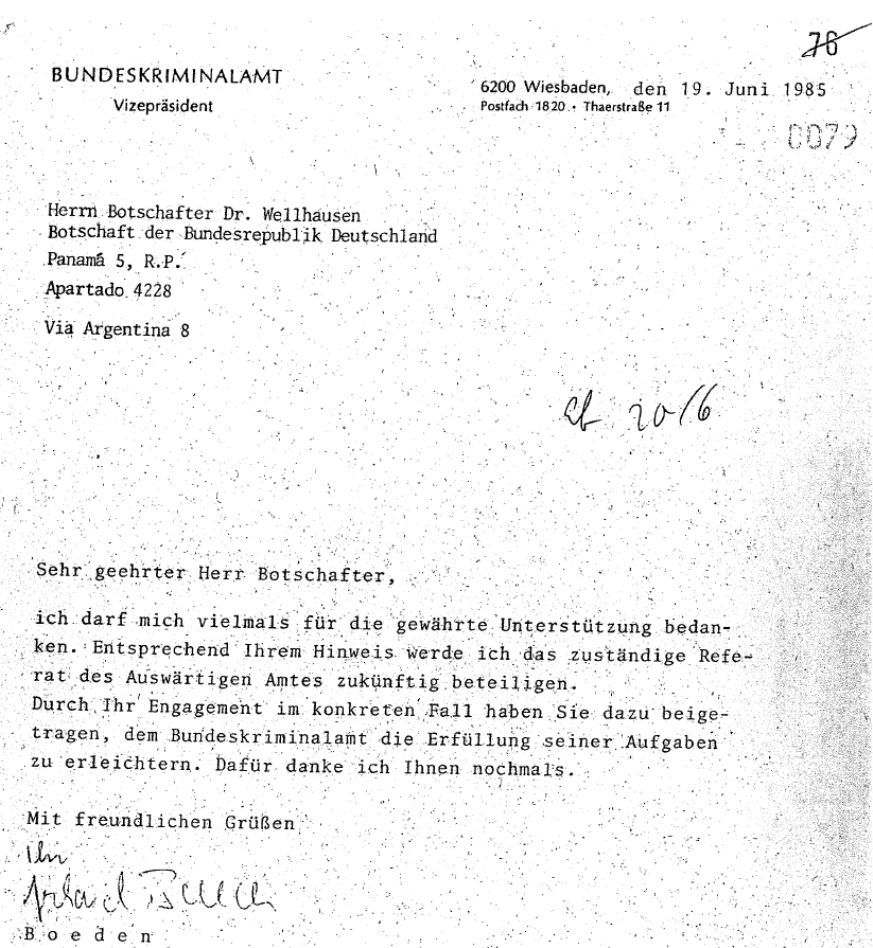
80
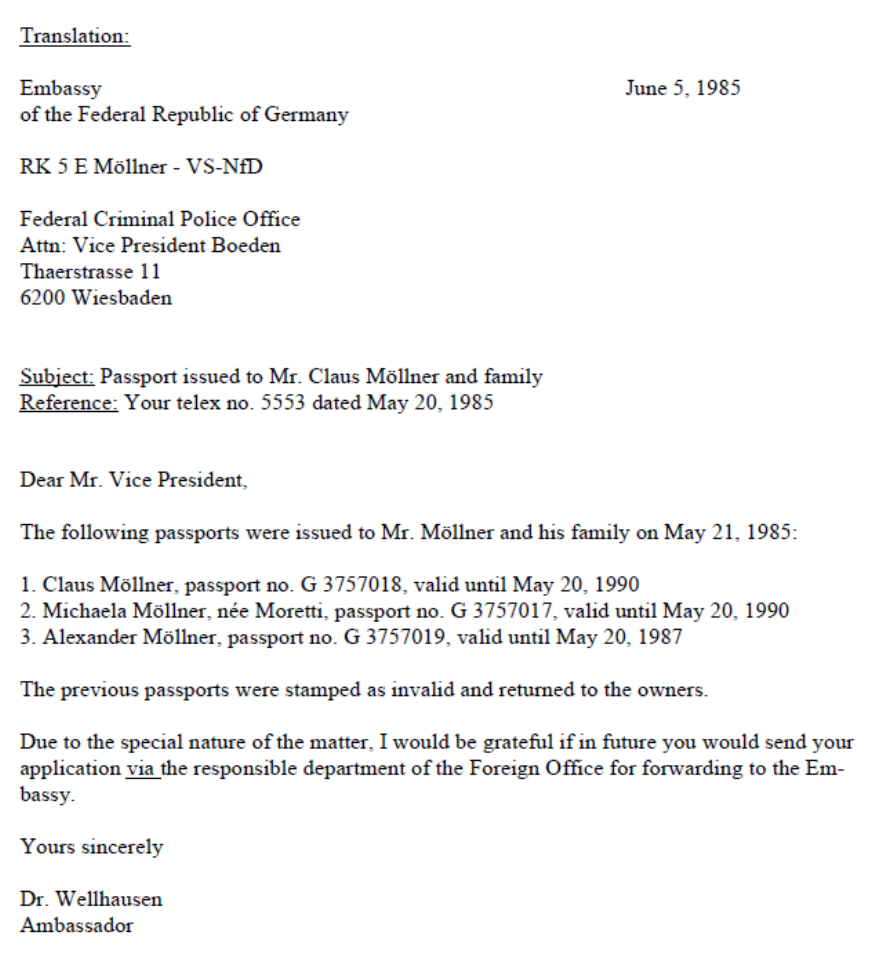
81
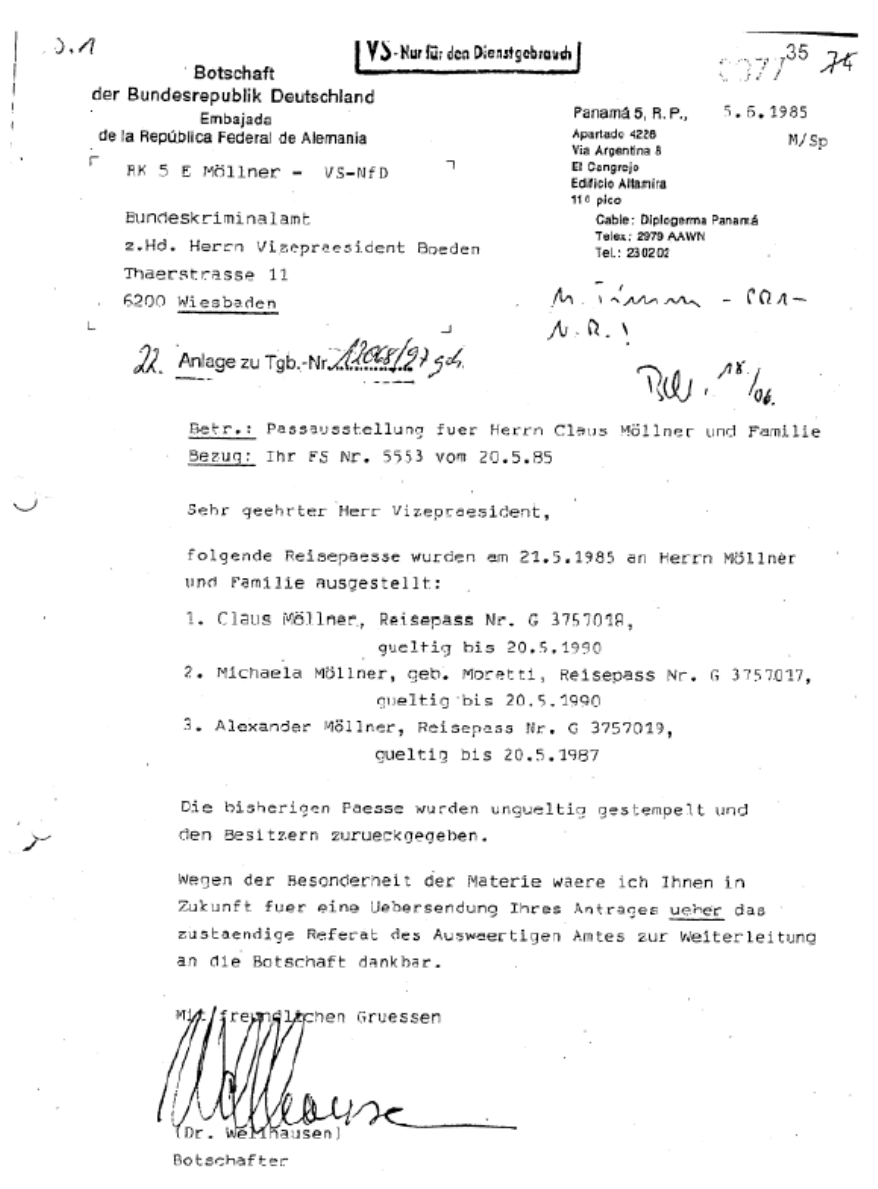
82
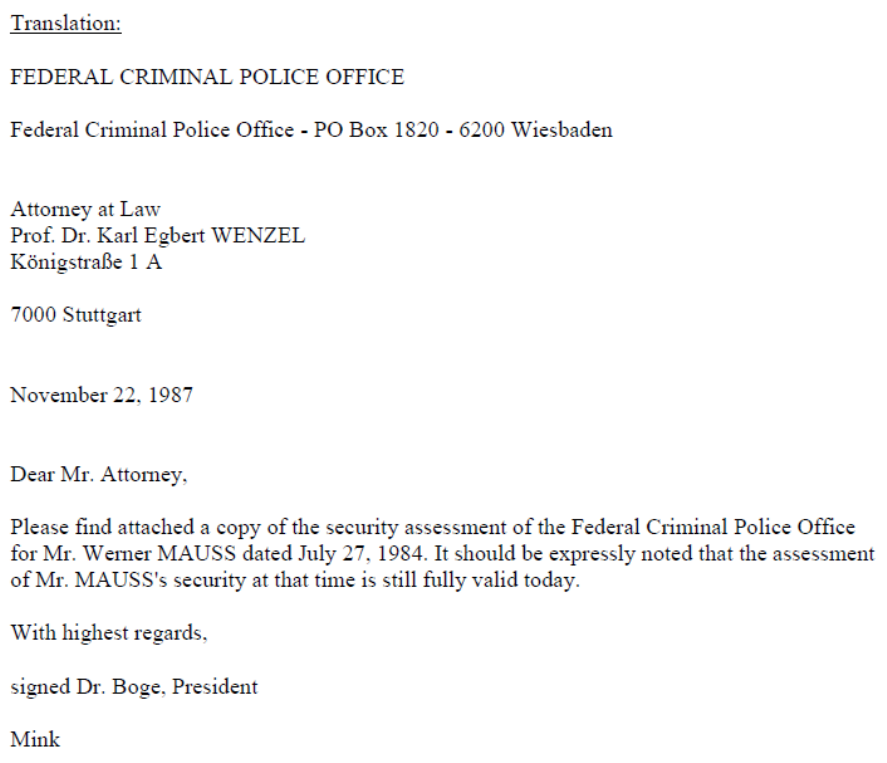
83
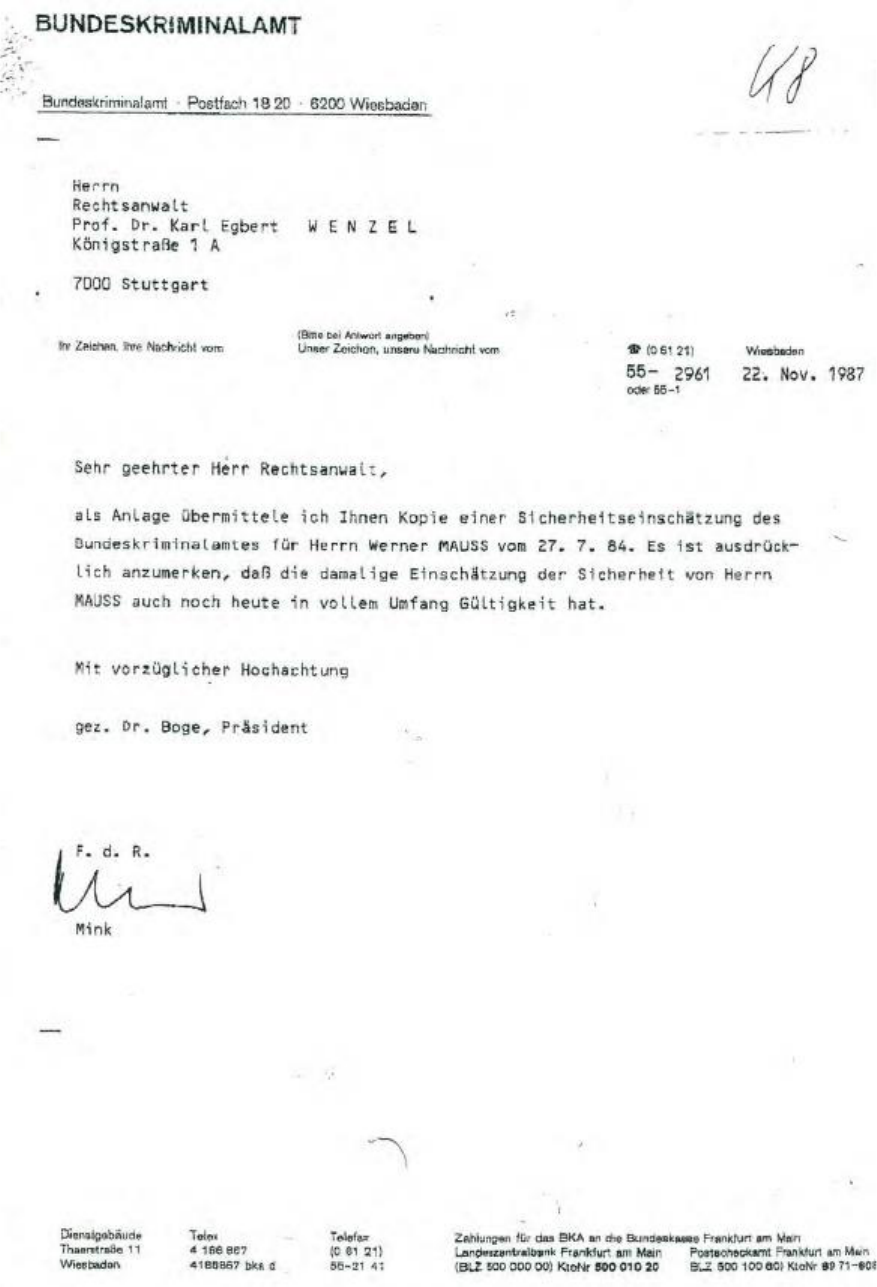
84
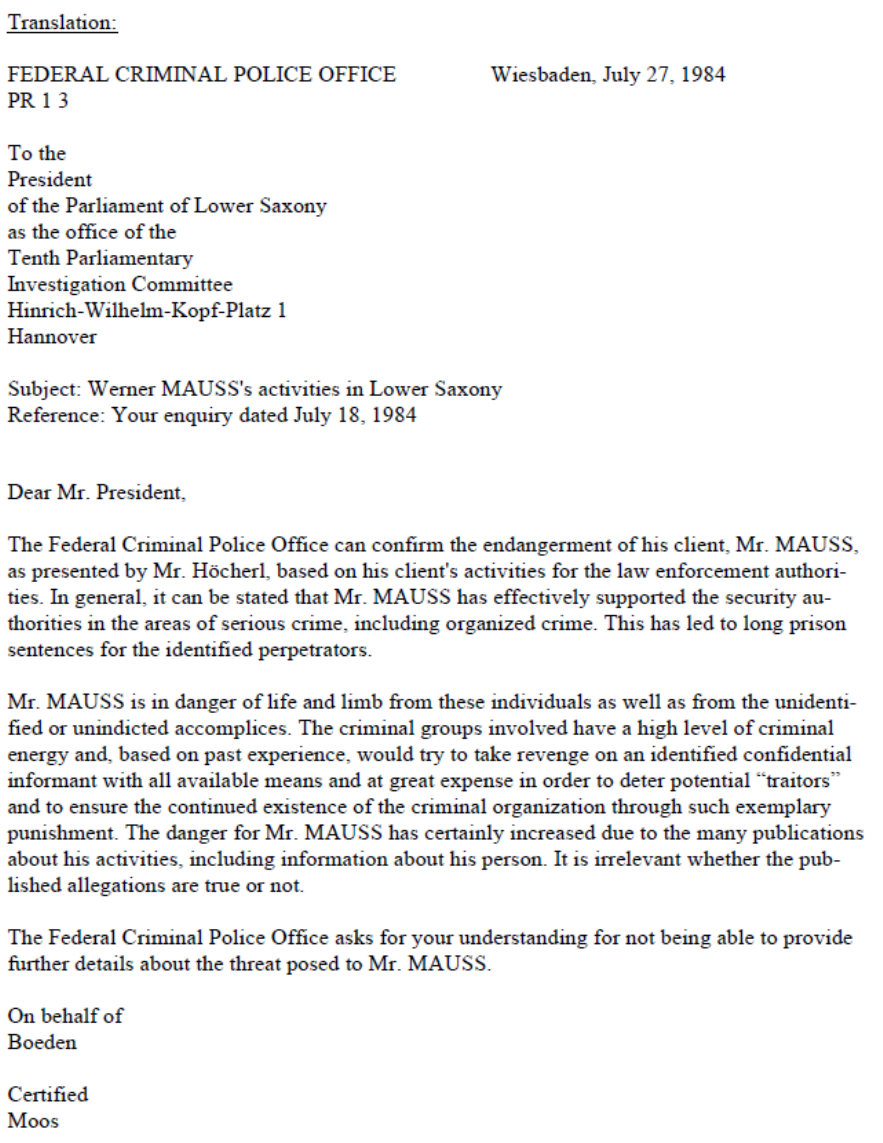
85
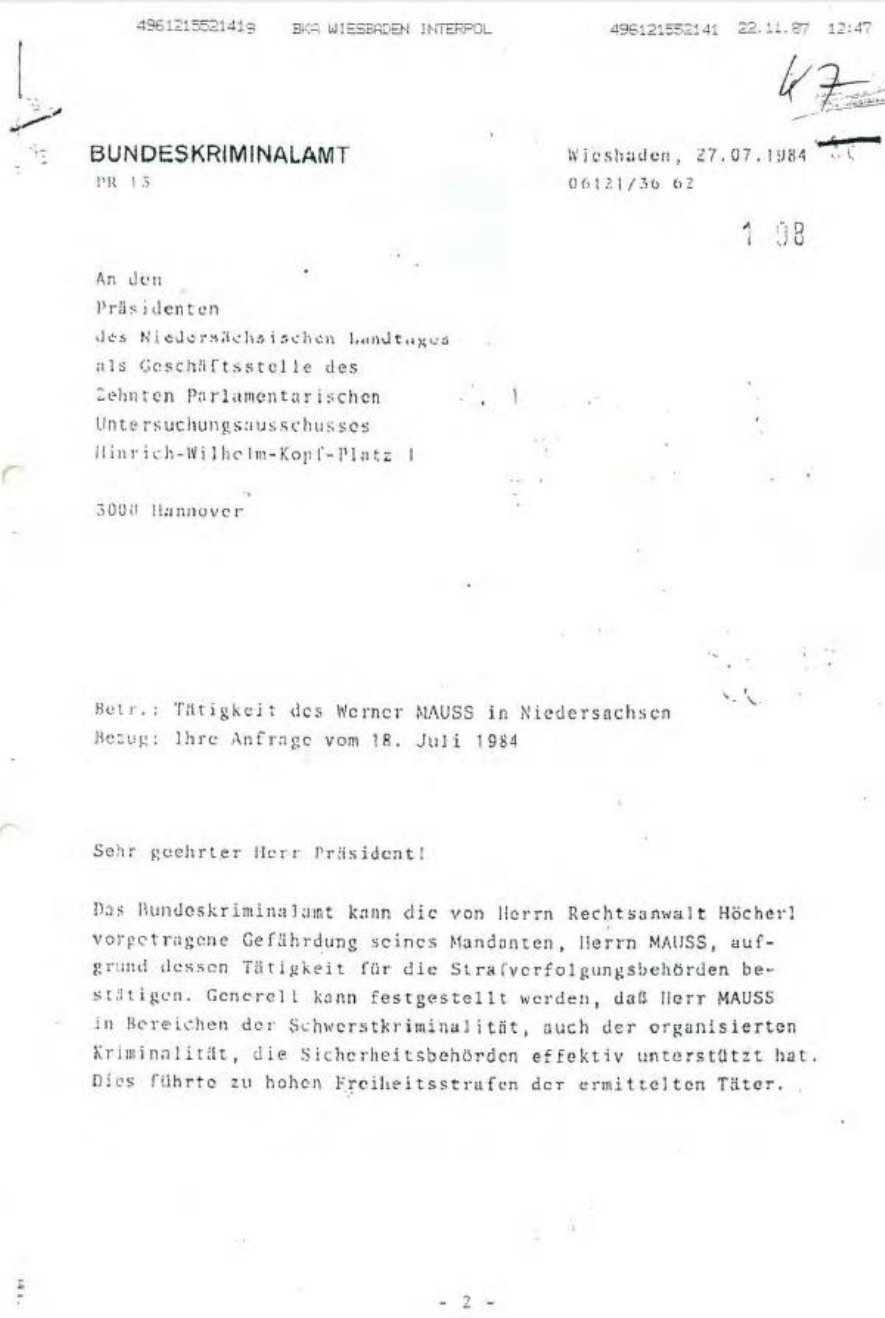
86
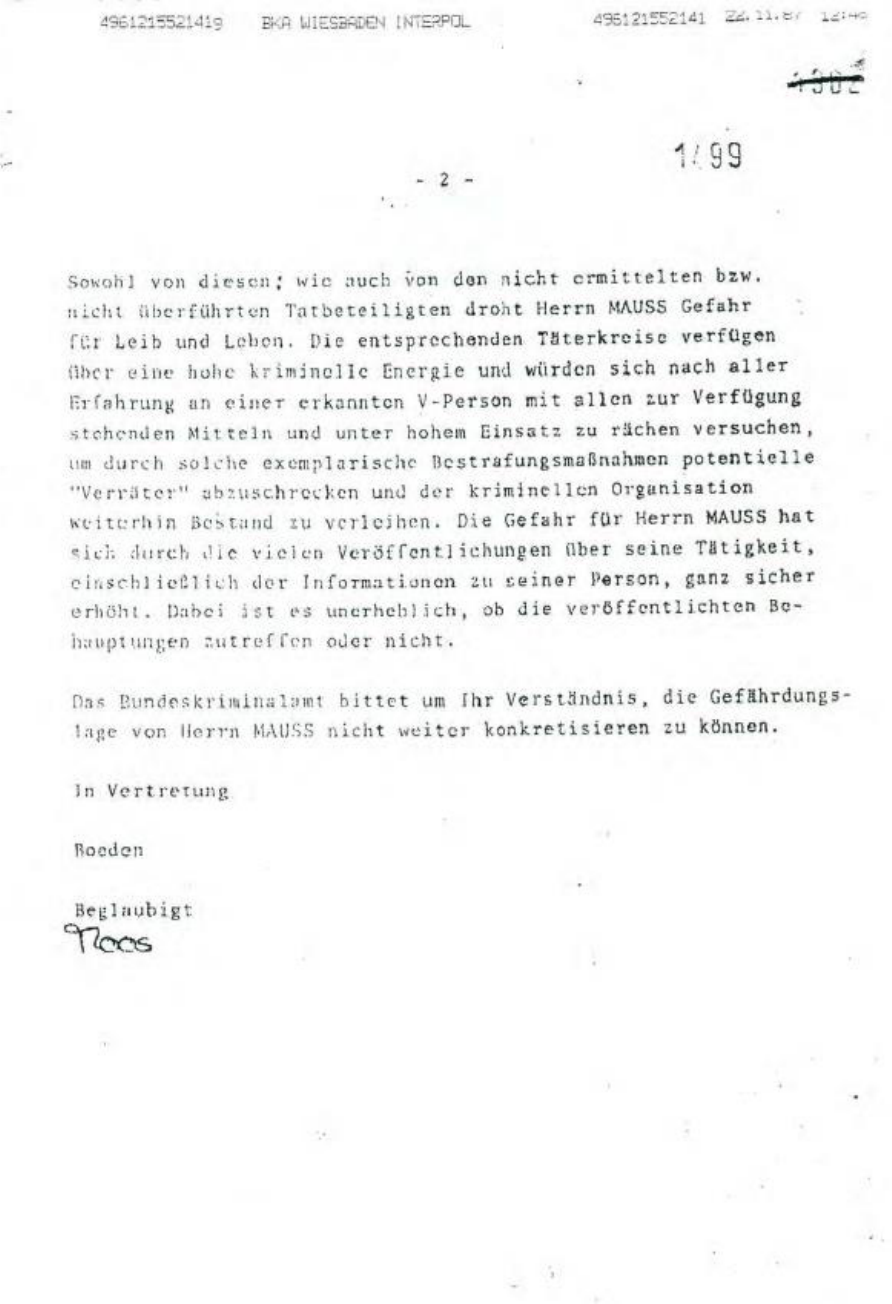
87
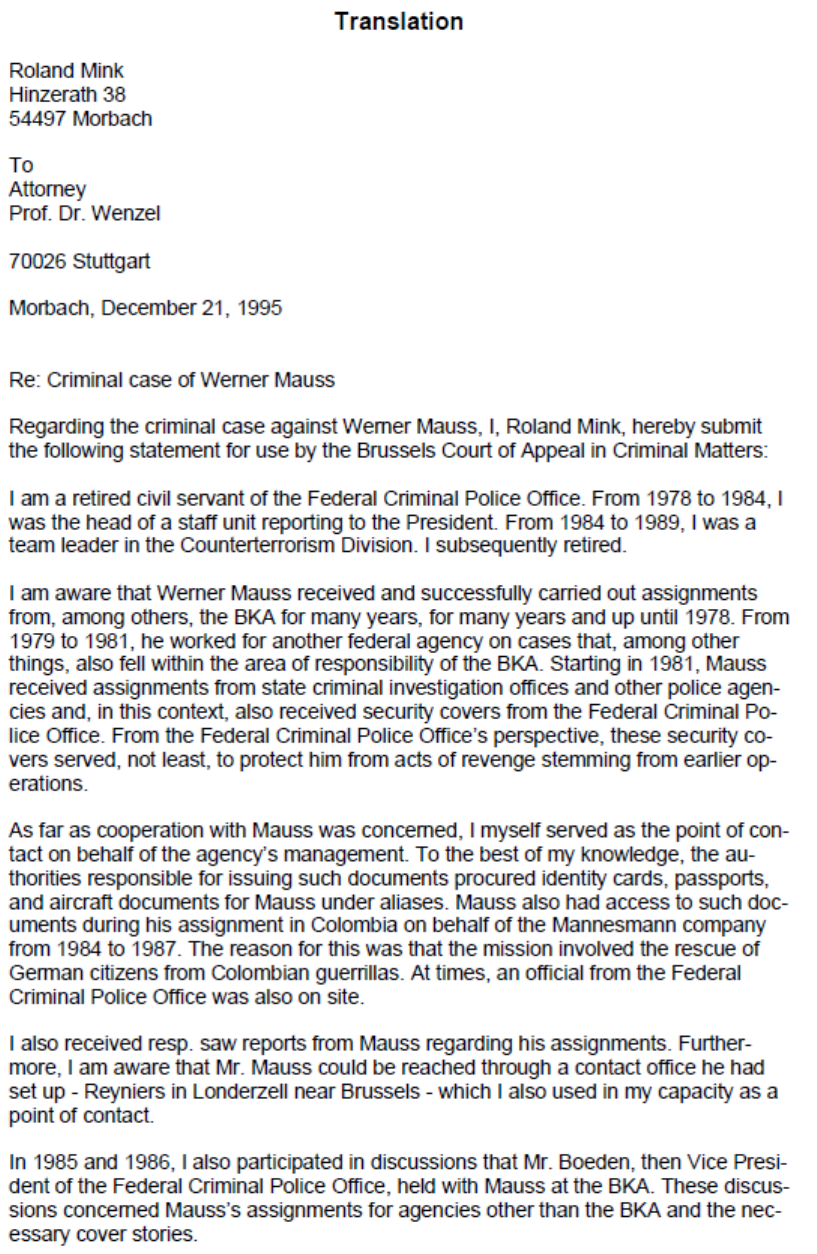
88
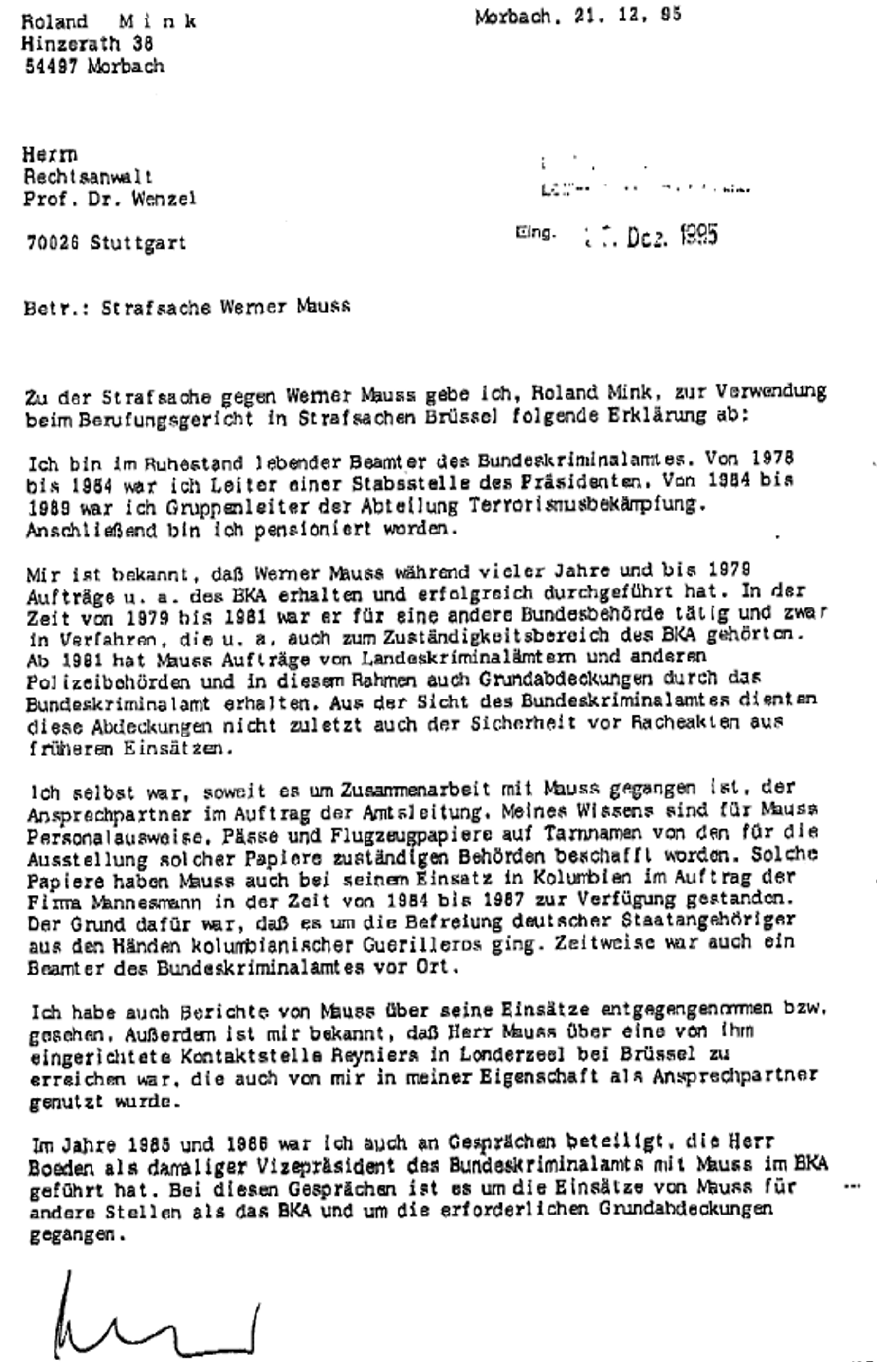
89
90
Starting in 1985, all of Mr. Werner Mauss’s operations in the interest
of Western security agencies - including those aimed at gathering
intelligence on the Colombian drug cartels - were financed exclu-
sively from the proceeds of the trust fund.
From 1984 through February 1987, Mr. Werner Mauss, drawing on the contacts and infor-
mation he had gained during the Mannesmann mission in Colombia, simultaneously carried
out covert operations against Colombian drug cartels. The vice president of the BKA, Mr.
Boeden, personally oversaw Mr. Werner Mauss’s mission, in part because of the danger to
life and limb of Mr. Werner Mauss and his family.
Because of Mr. Werner Mauss’s successes, Mr. Boeden came up with the idea of involving
him in purely government activities in the future. For these missions, Mr. Boeden provided Mr.
Werner Mauss with additional identities issued under various names, as well as logistical and
intelligence support. Mr. Werner Mauss frequently flew to Germany to meet with Mr. Boeden
and share specific intelligence. At the same time, he secretly got to know in person members
of the Medellín Cartel - in particular, the target person Pablo Escobar - as well as members of
the Cali Cartel. However, Mr. Werner Mauss got to know these members of the Medellín and
Cali cartels under a different cover story.
Mr. Werner Mauss continued to fight against the Medellín and Cali drug cartels until early 1987
- with government authorization and in coordination with Mr. Boeden and the intelligence
agency of a friendly third country.
1987: BfV takes over Mr. Werner Mauss BfV - President Gerhard
Boeden (BKA no longer responsible)
The Vice President of the BKA, Mr. Boeden, became President of the BfV in March 1987. With
the approval of Mr. Werner Mauss, the BfV took over the coordination of his operations from
that point on in cooperation with the aforementioned third country, based on the trust fund
initiated by Mr. Boeden and also supported by the then Minister of the Chancellery, Dr. Wolf-
gang Schäuble.
As a result of this measure, the BKA was no longer responsible for Mr. Werner Mauss. In
consultation with the then Minister of the Chancellery, Dr. Wolfgang Schäuble, Mr. Boeden
became the primary point of contact for Mr. Werner Mauss.
91
Beginning in March 1987 – subversive operations against the Gad-
dafi regime, focusing on Iran, Libya, Lebanon, Syria, Iraq, etc., with
follow-up missions to protect Israel, requested by the German fed-
eral government
In a parallel operation - also led by Mr. Boeden - against the leadership of the Libyan intelli-
gence service, Mr. Werner Mauss, after making the necessary preparations, succeeded in
persuading the head of procurement for the Libyan service at the time - and a close confidant
of Gaddafi - to engage in covert intelligence cooperation with the Federal Republic of Ger-
many.
In 1987, Mr. Werner Mauss met secretly with the aforementioned Libyan intelligence agent on
a Libyan yacht outside the three-mile zone near Athens. Mr. Werner Mauss traveled to the
meeting place on a Greek boat. After extensive preparatory work and various clandestine
meetings, most recently in Brussels, the Libyan confided that the RAF terrorist Weinrich was
in Damascus together with “The Jackal” Carlos, and that they were being guided and provided
with logistical support for their international terrorist operations by the Syrian secret service,
the Aircraft Secret Service. Mr. Werner Mauss also received information that Weinrich occa-
sionally provided interpreting services for the GDR embassy and that the GDR also supported
Weinrich and other RAF members in other European countries. Through this, Mr. Werner
Mauss learned that the RAF was also responsible for a murder in Munich and another murder
in Bonn. After a dinner on the yacht, the Libyan handed Mr. Werner Mauss secret photographs
of photocopied Arab and European passports, each bearing a code name. The passport pho-
tos depicted the aforementioned terrorists.
Immediately upon his return to Athens, Mr. Werner Mauss met, for the first time in his life, Mr.
Klaus Grünewald, the confidant of BfV President Boeden who headed the BfV’s counterter-
rorism division for decades. The operation continued, and various secret meetings took place.
Mr. Werner Mauss did not see Mr. Grünewald again until 2000, after his special mission had
concluded, when he was tasked by a special BKA commission with investigating the betrayal
of official secrets by federal and state officials. During this time, Mr. Grünewald had been
assigned to Mr. Werner Mauss by the BfV as an assistant and coordinator between the BKA
and the BfV.
1987 – BfV - Operation against Hezbollah - Intelligence gathering
counterterrorism - Iran, Libya, Lebanon resp. Syria, Iraq, etc. - Arrest
of Mohammed Ali Hamadi at Frankfurt Airport with two bottles of ex-
plosives

92
On June 14, 1985, Hamadi hijacked a TWA plane and shot and killed
an American Navy diver. The United States demanded his immediate
extradition; he faced the death penalty. To prevent his extradition,
Hezbollah kidnapped the German citizens Cordes and Schmidt. The
Federal Chancellery established the Lebanon Crisis Task Force.
The new BfV President, Gerhard Boeden, took charge of the operation to free the hostages
and tasked Mr. Werner Mauss with a covert special mission, also with the approval of the then
Minister of the Chancellery, Dr. Wolfgang Schäuble. Mr. Werner Mauss was tasked with using
intelligence resources to take action against Islamic terrorist organizations in Lebanon, with
the goal of freeing the hostages kidnapped by Hezbollah without releasing Hamadi. The op-
erations were directed between 1987 and 1991 through intelligence structures established by
Mr. Werner Mauss in Geneva, Larnaca, Athens, and Beirut. The subversive operations in the
Middle East were carried out in coordination with the new BfV president, Mr. Gerhard Boeden
as the primary point of contact as well as with the head of the trust fund established on Mr.
Boeden’s initiative, and were financed by the trust fund.
Without Hamadi having to be released by the German judicial system, Mr. Werner Mauss
succeeded in freeing the first German hostage, Schmidt, on September 7, 1987, and the sec-
ond hostage, Cordes, on September 12, 1988, through negotiations and with the support of
extensive intelligence measures. Hamadi was deported to Lebanon on December 15, 2005.
The U.S. is once again seeking him on an arrest warrant. These new circumstances also pose
an incalculable threat to Mr. Werner Mauss and his family.
Operations against Islamist terrorist organizations were also financed from the trust fund, as
described. Mr. Werner Mauss’s missions were carried out in coordination with the Lebanon
Crisis Task Force, which was led by the Federal Chancellery and headed by then-Minister of
the Chancellery Dr. Wolfgang Schäuble, who personally went to Damascus to retrieve
Schmidt - the first hostage to be freed - in cooperation with Mr. Werner Mauss and Mr. Boeden.
Since late 1987 – Operation for the protection of Israel
Covert, subversive operation - recommended and endorsed by BfV President Boeden and
Interior Minister Zimmermann - to support the Israeli intelligence service. Target areas: Leba-
non, Libya, Iraq, Syria, Iran, Belgium, Greece, Cyprus, and Malta.
On July 11, 2015, Mr. Werner Mauss receives the Knesset Peace Prize for his subversive
operation to protect Israel – see below:
93
94
95
1990 – Saddam regime, Iraq - Rescue of 35 hostages tied to missile
launchers - Intelligence gathering and counterterrorism - Special
mission coordinated with BfV President Boeden prior to the Second
Gulf War
In 1990, before the start of the Second Gulf War, dictator Saddam Hussein had German en-
gineers tied up at missile sites, thereby delaying the start of the war as Saddam had planned.
In agreement with BfV contact person President Boeden, with the knowledge of U.S. intelli-
gence agencies, and with the full logistical support of the BfV, Mr. Werner Mauss was tasked
with a special mission to rescue the hostages and resolve the political entanglement of the
problem. After establishing a legend in Jordan and Egypt, he succeeded - with the help of 24
covertly recruited Iraqi, Iranian, and Jordanian nationals - in secretly contacting Saddam Hus-
sein’s family at the time, including his brother, a UN delegate in Geneva, and another brother,
the Minister of Industry, in Baghdad under the alias “Richter,” using intelligence resources.
During the operation, Mr. Werner Mauss himself negotiated covertly in Baghdad and indicated
that he was willing and able to “smuggle” a plane load of antibiotics into Baghdad by allegedly
“circumventing” the embargo regulations. With this argument, he achieved a breakthrough in
the negotiations. Following personal discussions in Baghdad - first with the Minister of Industry
and then with his brother, President Saddam Hussein - Mr. Werner Mauss received the as-
surance that the hostages would be handed over to him for pickup once the medications had
been delivered.
In a Bermuda-registered DC-8 chartered by Mr. Werner Mauss, he flew - backed by the legend
provided to him as an authorized representative of Mr. Kaske, then CEO of Siemens, and in
secret agreement with the BfV and NATO - to Ankara and, after a staged “inspection,” onward
to Baghdad. Mr. Werner Mauss was received by the Minister of Industry - the president’s
brother - and subsequently by Saddam Hussein himself. He traveled under a cover story and
the alias “Richter”. Due to its secret intelligence background, the operation was life-threatening
for Mr. Werner Mauss. After handing over the antibiotics, he received a corresponding exit
stamp for the passports of all the hostages he had presented and which he had previously
obtained from the German Embassy, from the military contacts of Saddam's regime.
On November 24, 1990, Mr. Werner Mauss succeeded in flying the 35 hostages to freedom
on a direct flight from Baghdad to Nuremberg aboard a DC-8 – see the article in the “Nürn-
berger Nachrichten” dated November 26, 1990:
96
97
Shortly after the operation, the war against Iraq and the liberation of Kuwait began.

98
1989-1993 – UCA operation - led by Western intelligence service -
initially supported logistically by BfV President Boeden
Mr. Werner Mauss was deployed on covert operational missions against leading members of
Islamic terrorist organizations in Lebanon, Syria, and Iran. These operations led to the arrest
and neutralization of key target persons who were involved - both in an organizational capacity
and as direct instigators - in numerous terrorist acts, particularly murders and bomb attacks.
Also as a result of this operation, Mr. Werner Mauss and his family remain at risk to this day.
1991 – Takeover of Mr. Werner Mauss by the Federal Chancellery,
direct contact person: Mr. Bernd Schmidbauer, Minister of State in
the Federal Chancellery and coordinator of the intelligence services,
member of the Bundestag at the time (BfV President Boeden retires)
The Minister of State in the Chancellery and Coordinator of the Intelligence Services, Mr.
Bernd Schmidbauer, then a member of the Bundestag, assumed operational command of
“Institution M” - Mr. Werner Mauss in Colombia resp. worldwide from 1991 to 1998, also in
consultation with the trustees and on the recommendation of Mr. Boeden, in particular to sup-
port a peace process between the ELN guerrillas and the Colombian government. All costs
for his operations related to that were, in turn, financed from the trust fund.
Confirming the aforementioned facts, Mr. Bohl, who served as Minister of the Chancellery until
1998, stated the following in a letter to U.S. Ambassador Emerson dated June 26, 2014 –
excerpt:
“I am therefore pleased to take this opportunity to point out that, during the years 1991-
1998, when I was Head of the Federal Chancellery, there was good and successful coop-
eration between German security agencies and Mr. Mauss.”
Mr. Schmidbauer covertly employed Mr. Werner Mauss under his personal supervision until
his resignation as Minister of State in 1998. Security and cover were provided, starting when
Mr. Schmidbauer took over, upon request, by other authorities acting in administrative assis-
tance for the Federal Chancellery. According to its files, the Federal Criminal Police Office had
always been aware of this – see also Mr. Schmidbauer’s affidavit dated April 5, 2017:
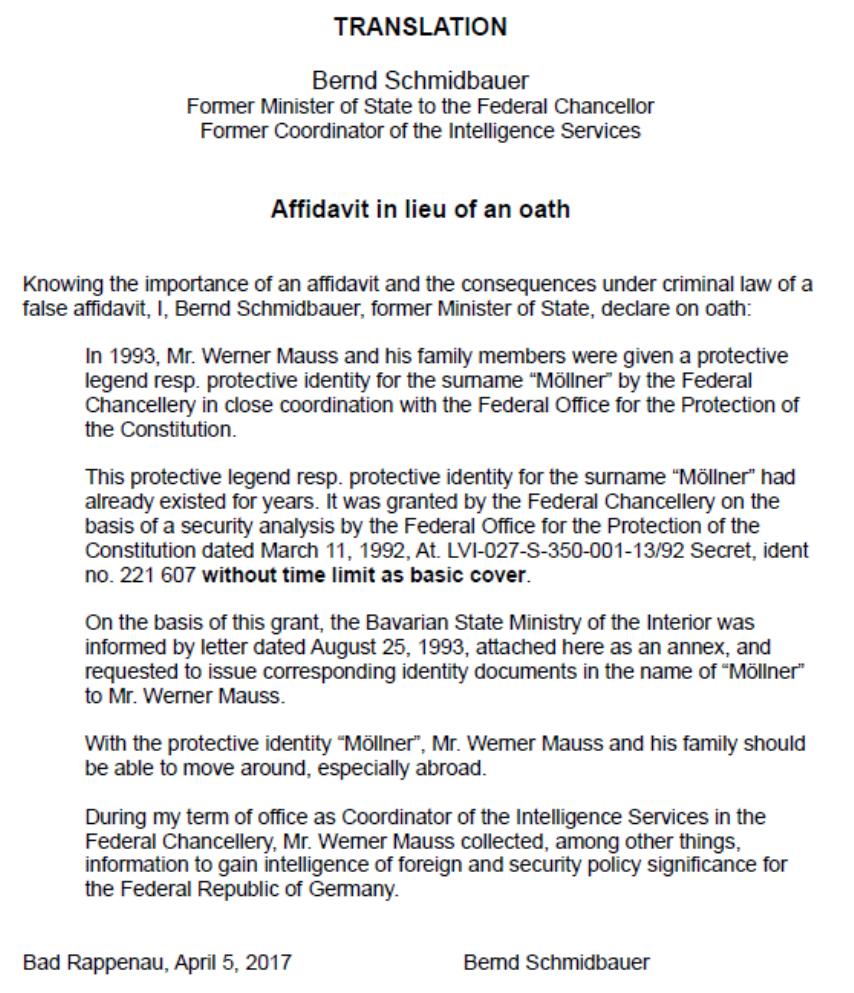
99
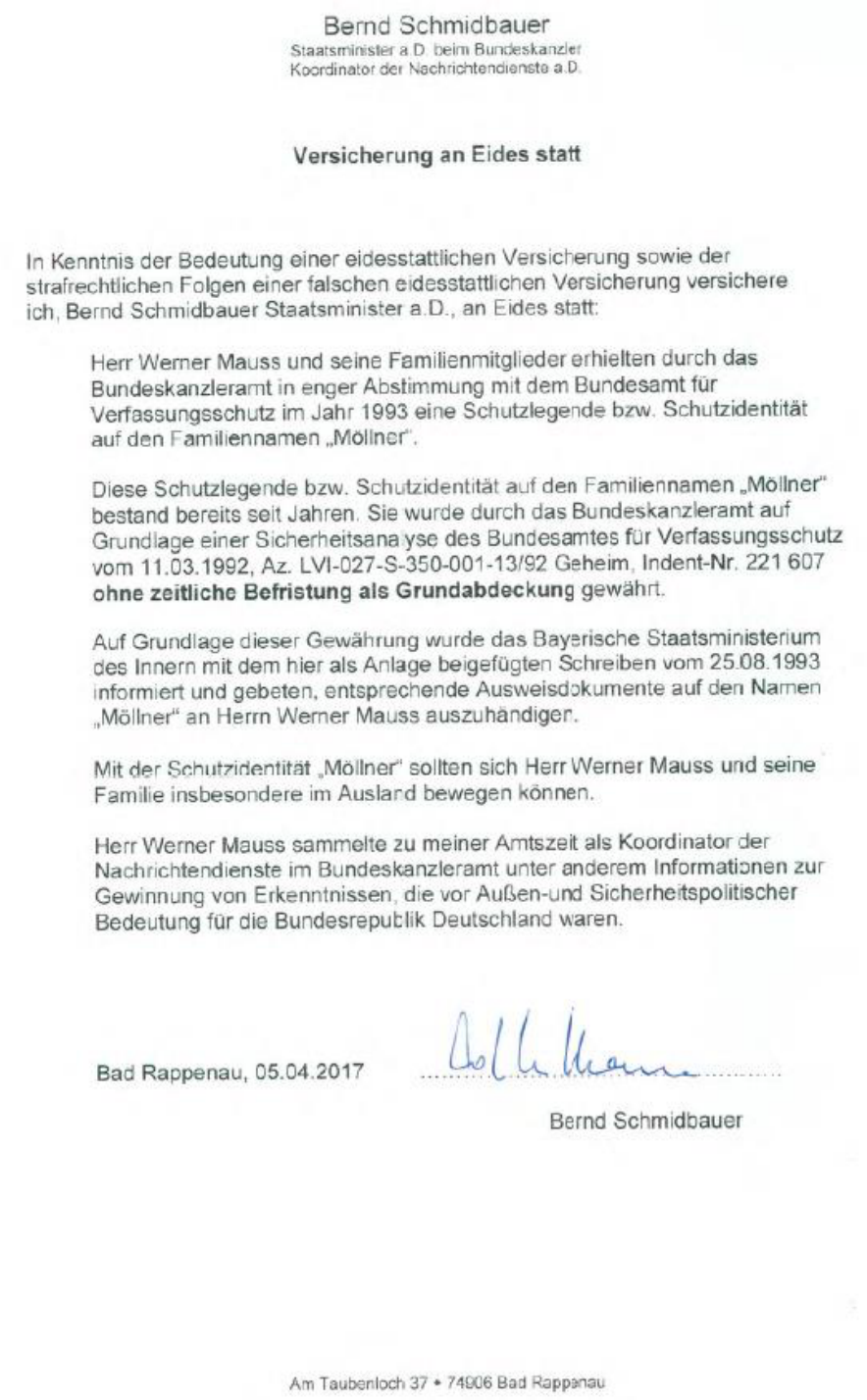
100
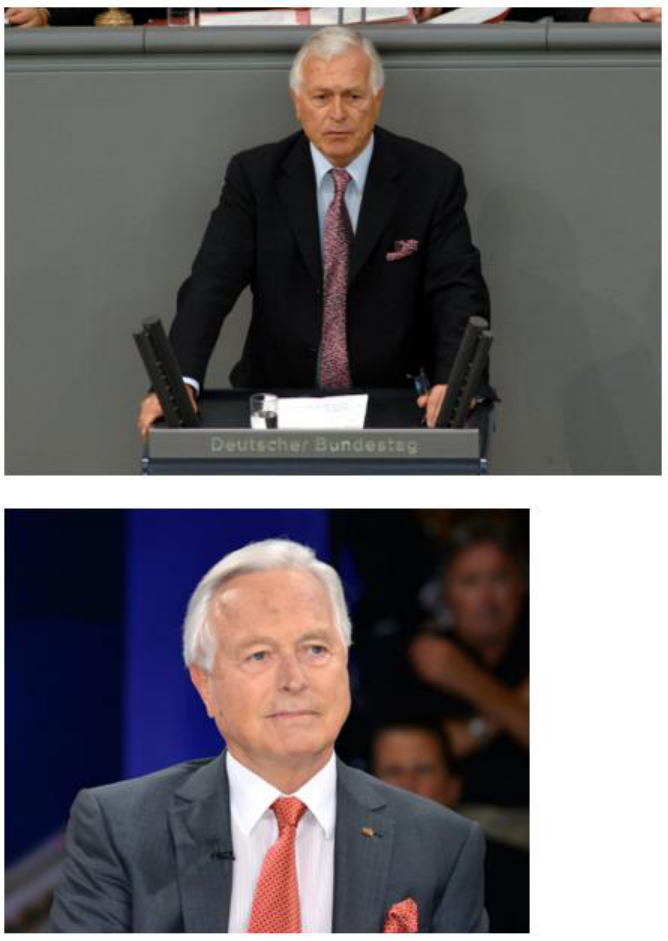
101
Mr. Bernd Schmidbauer (born May 29, 1939) is a former German politician (CDU). From Jan-
uary to December 1991, he served as Parliamentary State Secretary to the Federal Minister
for the Environment, Nature Conservation, and Nuclear Safety, and from 1991 to 1998, as
Minister of State to the Federal Chancellor and Commissioner for the Federal Intelligence
Services (Federal Intelligence Service, Federal Office for the Protection of the Constitution,
Military Counterintelligence Service). From 1983 to 2009, he was a member of the German
Bundestag. Because of his tendency to take a hands-on role in matters concerning the intel-
ligence services, Schmidbauer earned the nickname “008” - a reference to James Bond, alias
007. In 1992, for example, two German hostages were released in Lebanon; Schmidbauer
was involved in the tough negotiations. Following the Bundestag election on September 27,
1998, the Kohl era came to an end. Schmidbauer stepped down from office on October 26,
1998. From December 5, 2002, through 2005, he served as a full member, and from 2005
through 2009, as vice chair of the German Bundestag’s Parliamentary Control Panel for the
Oversight of Federal Intelligence Services.
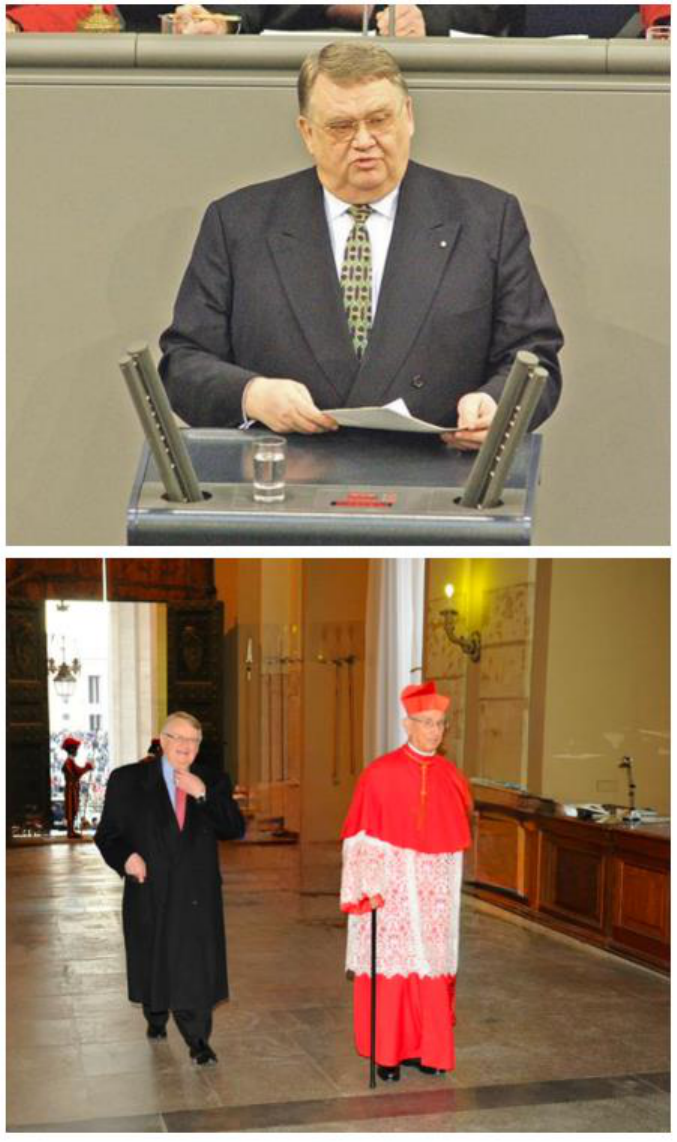
102
Rudolf Kraus (born February 27, 1941; died May 18, 2018) was a German politician (CSU -
Christian Social Union in Bavaria). From 1992 to 1998, he served as Parliamentary State
Secretary at the Federal Ministry of Labor and Social Affairs. From 1976 to 2005, he was a
member of the German Bundestag. There, he served as Parliamentary Secretary of the
CDU/CSU parliamentary group from 1989 to 1992, as a member of the Parliamentary Control
Commission for the control of the Federal Intelligence Services from February 21, 1991, to
1995, and as Chair of the Committee on Economic Cooperation and Development from No-
vember 1998 to October 2005. From 2005 to 2013, Rudolf Kraus served as an alternate mem-
ber of the G10 Commission.
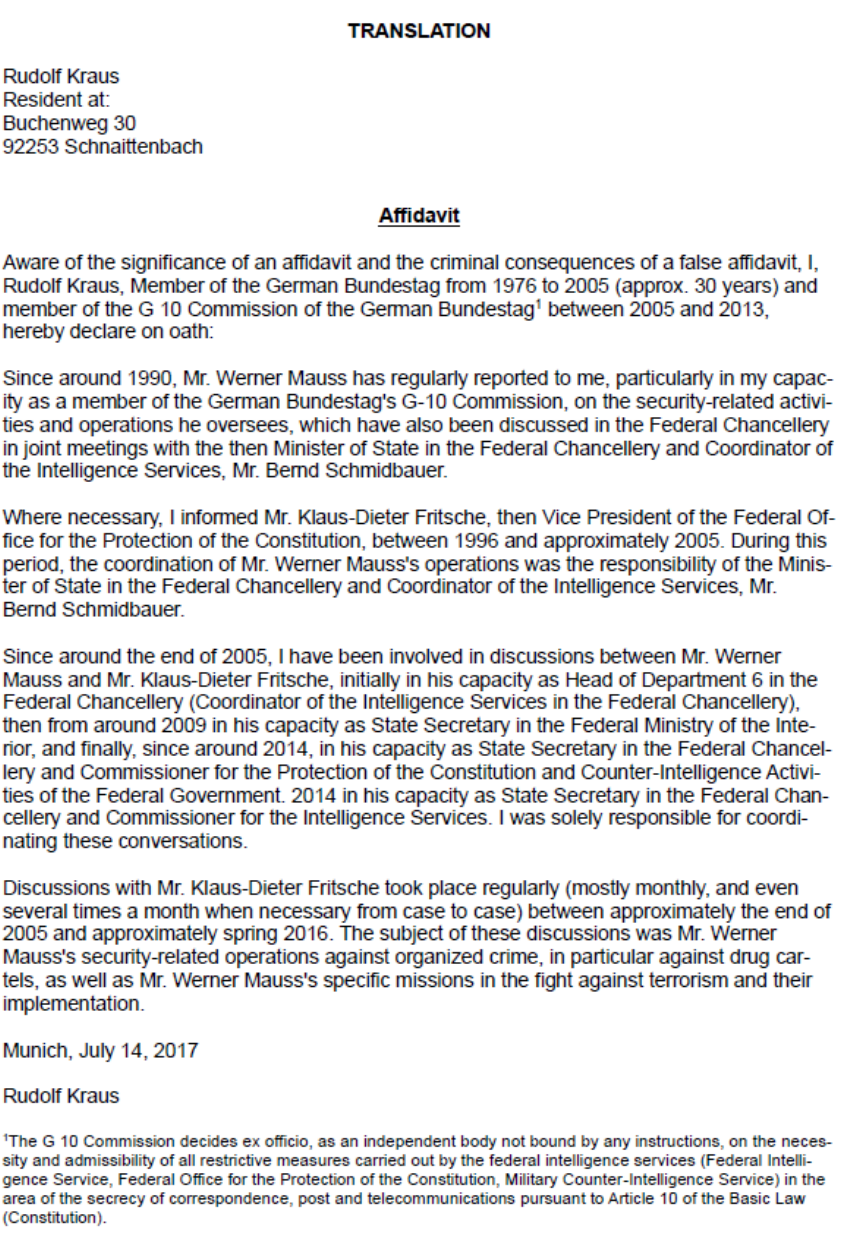
103
The G-10 Commission, acting ex officio as an independent body not bound by any instruc-
tions, decides on the necessity and admissibility of all restrictive measures (G-10 measures)
carried out by the federal intelligence services (Federal Intelligence Service, Federal Office
for the Protection of the Constitution, Military Counter-Intelligence Service) in the area of the
confidentiality of correspondence, mail, and telecommunications under Article 10 of the Con-
stitution (Grundgesetz – Basis Law).
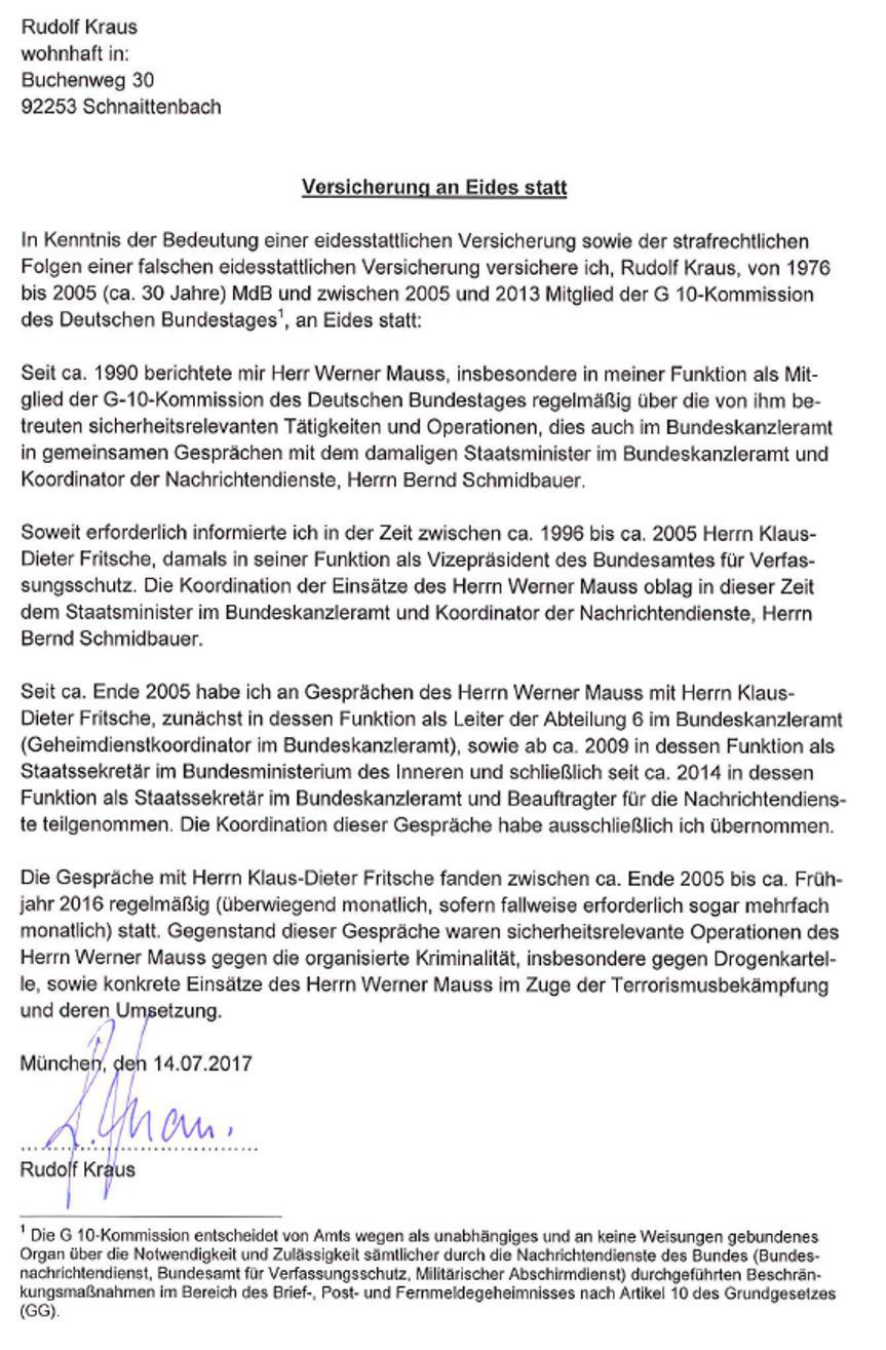
104

105
1991-1998 – Peace Process in Colombia
Information gathering for the Federal Government - coordination by the Federal Chan-
cellery - personal conversation between Mr. Werner Mauss and Federal Chancellor Kohl
- direct contact person and client: Bernd Schmidbauer, then Minister of State, head of
the Federal Intelligence Service (BND), and coordinator of the BfV and BKA
Mr. Werner Mauss, together with his then-wife and in coordination with the Chancellery, was
tasked with a special mission in Colombia, which, as described earlier, aimed, among other
things, to facilitate peace talks between the Colombian government and the ELN guerrilla or-
ganization.
In a secret operation, Mr. Werner Mauss brought the first four commanders of the ELN’s
Comando Central from the Colombian jungle to Bonn. In a personal meeting at the Chan-
cellery, the Federal Chancellery had explained to the ELN representatives - in the presence
of Mr. Werner Mauss - that Germany would actively support the peace process only if the ELN
in Colombia released all European hostages in its custody without demanding a ransom. The
ELN’s Comando Central subsequently decided to accept the proposal from the German Fed-
eral Chancellery and to release the hostages it was holding in accordance with the conditions.
Since the ELN is not centrally organized but operates on a confederal basis, Mr. Werner
Mauss had to bring about the release of the hostages with the regional leaders of the ELN in
Colombia - for each hostage individually - through arduous negotiations and under life-threat-
ening circumstances, whereas the release took place without any ransom payment.
Massacre by paramilitaries in opposition to the ELN Guerrillas
During all negotiations and rescue operations in Colombia, Mr. Werner Mauss worked under
extreme danger between guerrilla groups, paramilitaries, and common criminal organizations.
The greatest danger, however, came from the paramilitaries, who acted as “soldiers” and en-
forcers of criminal orders for internationally active criminal organizations. For example: At that
time, the paramilitaries would always invade the guerrilla-controlled outlying areas in groups
of 100 to 200 people or fewer, following the same pattern. Using lists of names that the syn-
dicates’ contacts had obtained illegally, civilians in the villages were dragged from their beds.
In most cases, they were lined up on a village square or sports field. Armed with chainsaws,
the executioners then approached the line of people resp. the victims from both sides and
severed their feet in a flash. The victims tried to run away on their stumps. Pregnant women
were tied to a stake and slashed open. A large number of people had their carotid arteries slit.
Children, women, and teenagers were shot in front of their families, and so on.
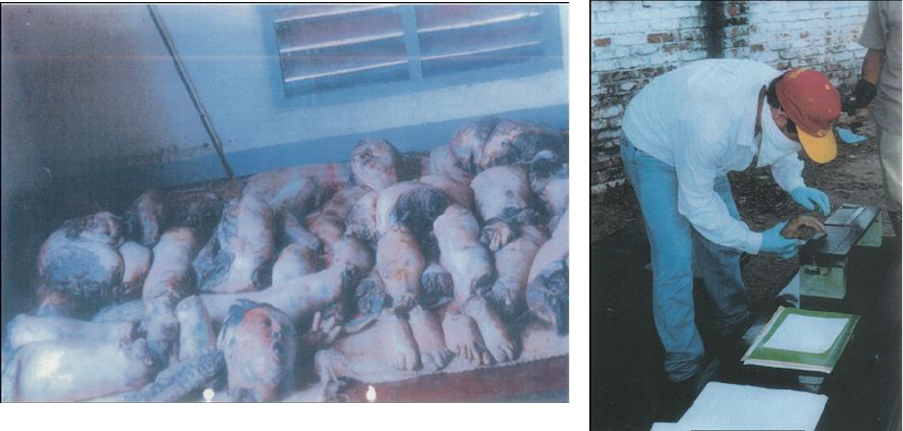
106
On his way to the ELN’s central camp, after a three-day ride, Mr. Werner Mauss happened to
witness the the consequences of this crime. He took photographs and also consulted with the
Colombian judicial authorities. The ELN guerrillas, who have joined forces against the criminal
organizations, are fighting the paramilitaries and their supporters. Western companies, as well
as the ten European hostages, had become caught up in this spiral of violence. This turned
the various on-site negotiations to rescue the hostages - conducted on behalf of the Federal
Chancellery - into a recurring, life-threatening operation for the Mauss couple.
Photos of the massacres carried out by the paramilitaries
Mr. Werner Mauss established a sufficient level of trust with the commanders to set up a
satellite telephone station at the ELN’s central camp in the Colombian jungle, through which
the Chancellery resp. Minister of State Schmidbauer, as the only person in the world, could
reach the commanders at any time in order to minimize the impact of sudden outbreaks of
conflict – see also the following letter from Mr. Schmidbauer:
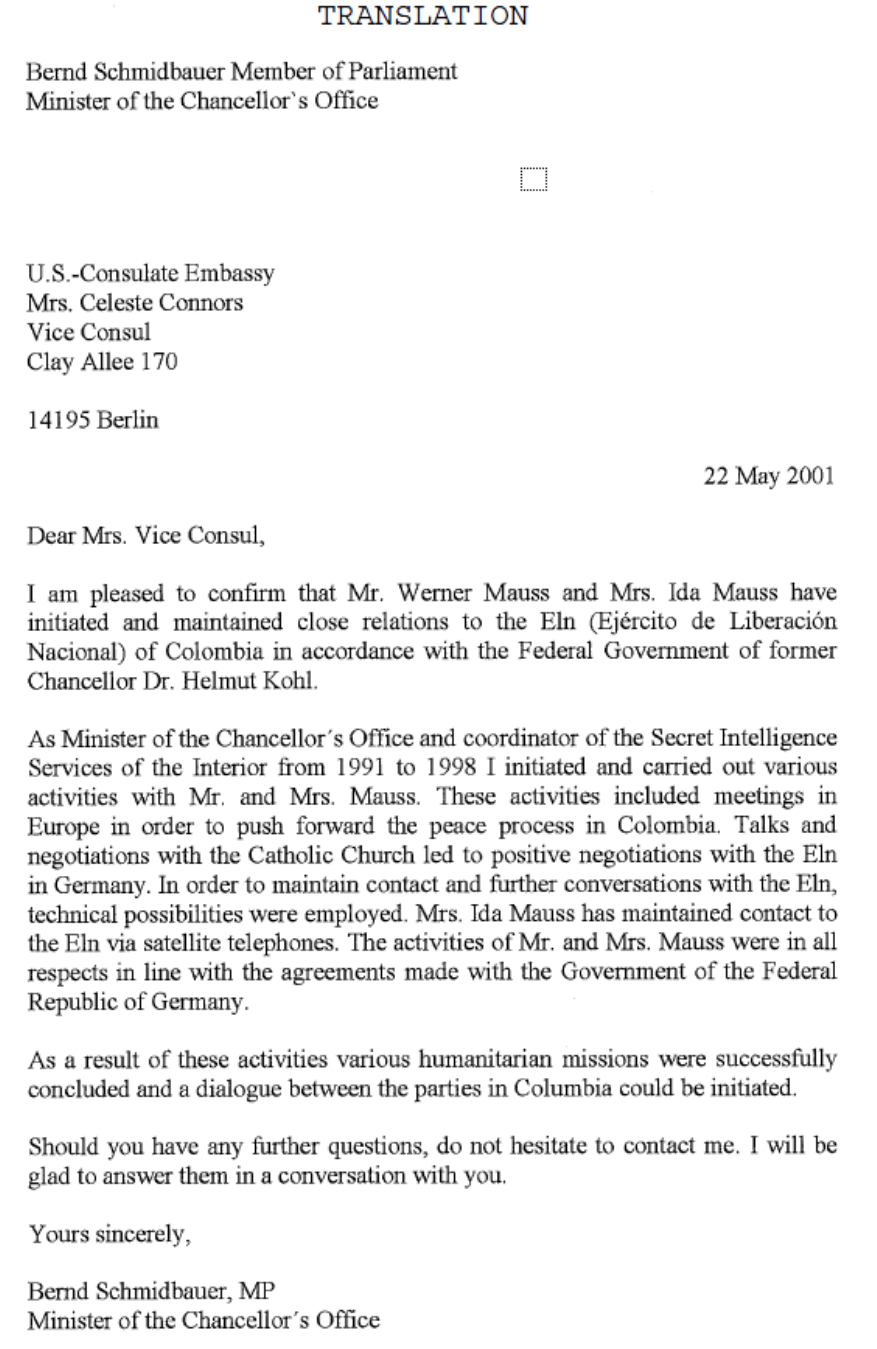
107
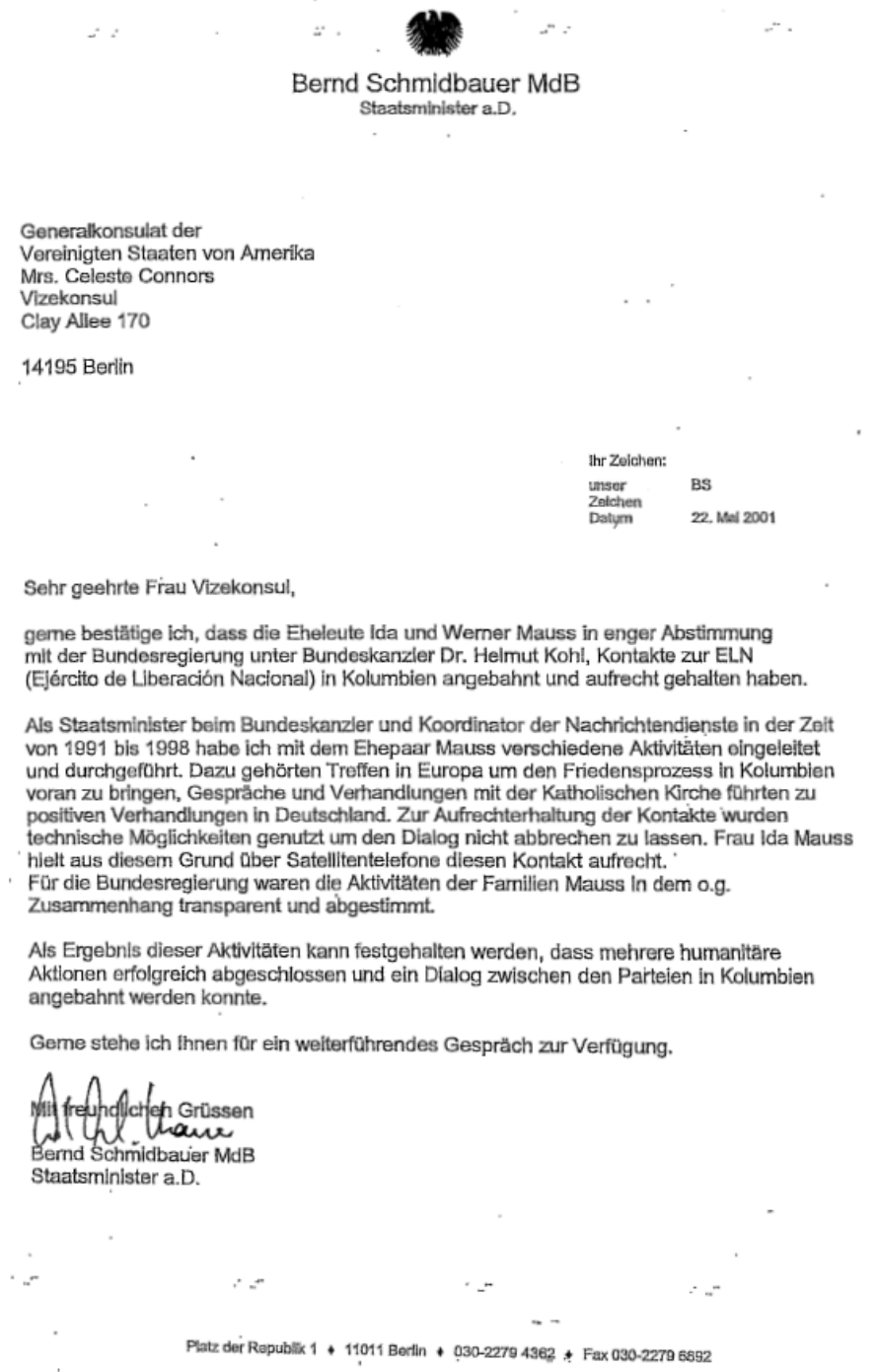
108
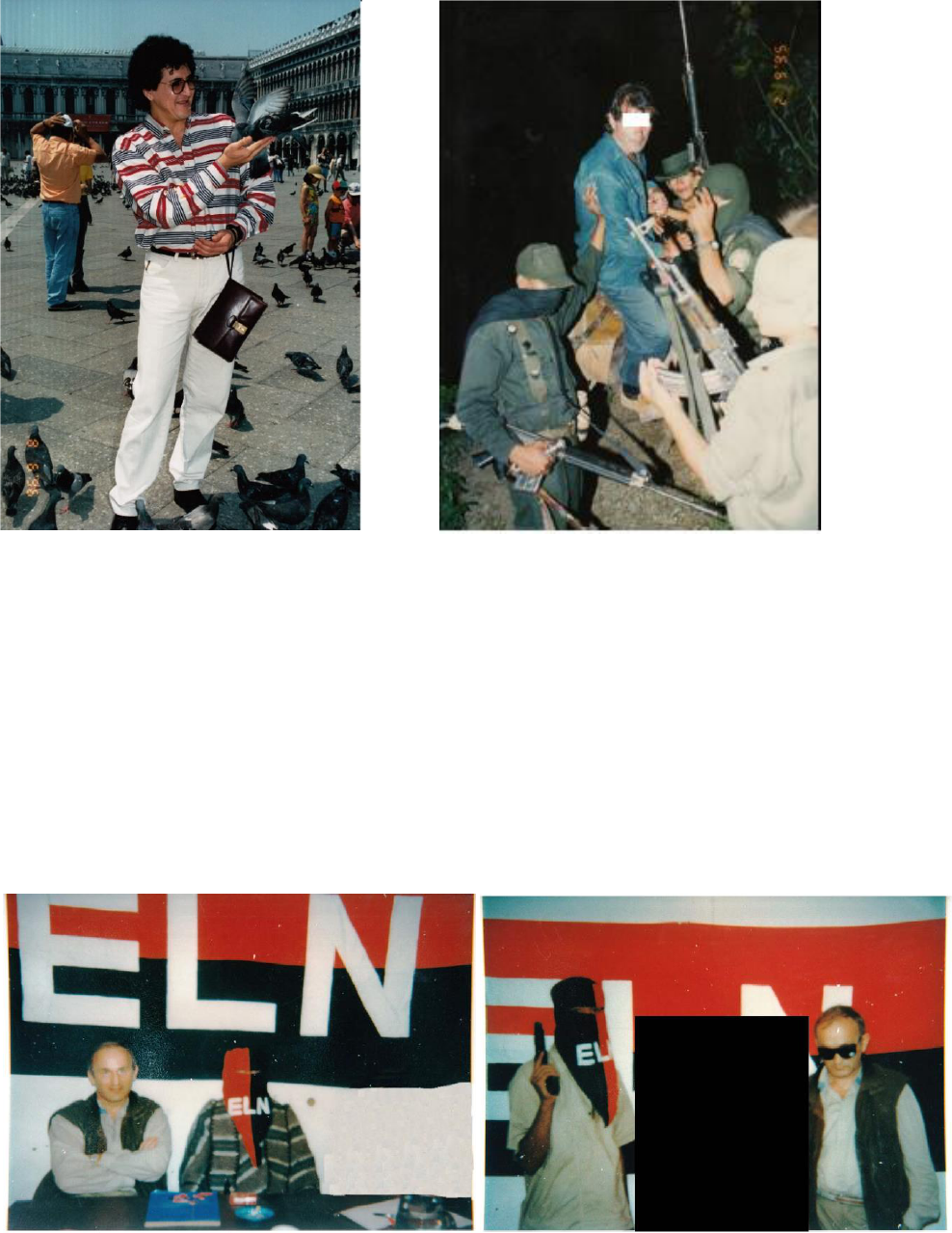
109
An ELN delegation, led by Commander “Antonio García,” is brought to Europe by Mr. Werner
Mauss for peace talks on behalf of the Federal Chancellery and the Bishops’ Conference,
headed by Bishop Lehmann of Mainz. Mr. Werner Mauss conducts psychological counseling
sessions with the ELN delegates in East Berlin, Venice, Rome, London, Berlin, and Bonn to
support the peace process – see photo of Antonio García in St. Mark’s Square in Venice. The
goal of these highly complex talks is to democratize resp. humanize the ELN, in the interest
of Colombia’s civilian population. This, too, was part of Mr. Werner Mauss’s tasks on behalf
of the German Federal Chancellery and the Bishops’ Conference.
Negotiations with the ELN – Comando Central ELN fighters
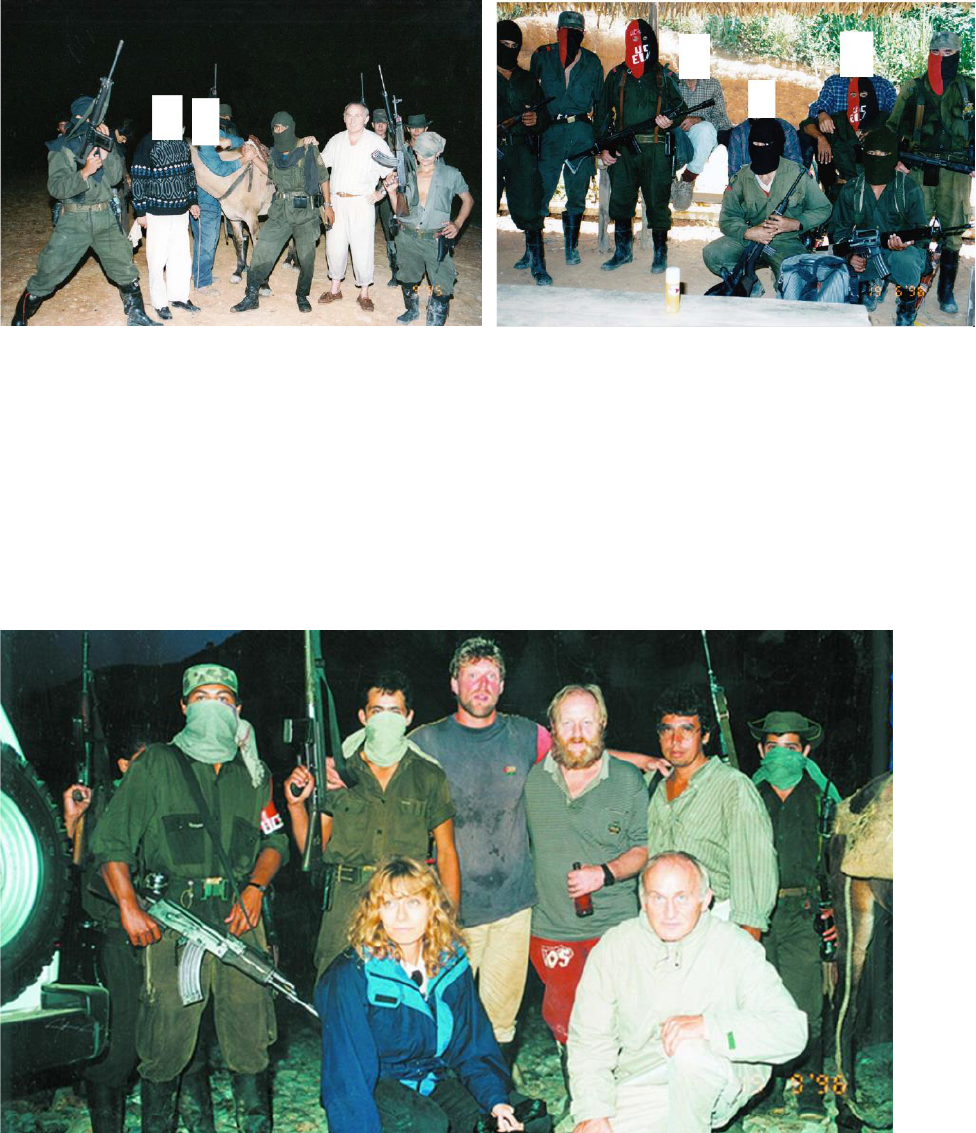
110
Rescue of a hostage
In 1993, Mr. Werner Mauss was tasked by the government - after having started the operation
in 1991 - to lead, as an undercover agent, a negotiation delegation of the ELN’s Central Com-
mand to Germany, with the aim of gathering information and initiating peace talks. The Ger-
man side’s condition for actively promoting the peace process was the release of all (nine)
hostages held by the ELN.
A tenth hostage, Ms. Brigitte Schöne, had been kidnapped by a group of criminals who had
no connection to the ELN. Through the peace table established in Germany at the initiative of
the Chancellery, the German government asked the ELN to free Ms. Schöne from the crimi-
nals. Ms. Schöne was then freed by the ELN and handed over to Mr. Werner Mauss in the
jungles of Antioquia, at great personal risk.
111
When Mr. Werner Mauss, acting on his instructions, wanted to fly out the last hostage, Ms.
Brigitte Schöne, in a private jet from the Medellín airport in accordance with his mandate - with
logistical support from the German federal government and equipped with a letter of protection
from the German Embassy - he was arrested by Colonel Santoyo, then the head of the Co-
lombian police unit Gaula and a corrupt and manipulated interlocutor of Control Risks (a British
insurance company). On the way from the airport to the police headquarters, the hostage freed
by the Mauss couple, Ms. Brigitte Schöne, was handed over by Colonel Santoyo to employees
of Control Risks at the Intercontinental Hotel at night, in the presence of Mr. Werner Mauss;
in contrast, Mr. Werner Mauss, who had been wrongfully arrested, and his then-wife were
presented to the national and international press the next morning as alleged hostage-takers.
Control Risks attempted to further criminalize Mr. Werner Mauss in the eyes of the Colombian
and international public by presenting negative press coverage about him that had appeared
in Germany from approximately 1983 to 1996 - material that had been prepared well in ad-
vance and translated into Spanish. The vast majority of the newspaper articles contained false
and discriminatory content, against which Mr. Werner Mauss had successfully filed injunctive
relief lawsuits in previous years.
The unlawful arrest of Mr. Werner Mauss and his then-wife marked the beginning of a schem-
ing preliminary investigation in 1996 against the Mauss couple by the relevant Colombian
prosecutor’s office. All charges brought against Mr. Werner Mauss in the preliminary investi-
gation were false; they were based primarily on false allegations made by employees of the
firm Control Risks in order to eliminate Mr. Werner Mauss as a supposed competitor who, as
explained, acted solely on behalf of the German Federal Chancellery and the Bishops’ Con-
ference responsible for the peace process under the leadership of Bishop Lehmann, and who
freed the European hostages and supported the peace process with the ELN without any
ransom ever having been paid.
On May 20, 1998, Mr. Werner Mauss and his then-wife were expressly and definitively acquit-
ted in the second-instance proceedings by the Attorney General’s Office of Antioquia, Colom-
bia, of all charges brought against them. The judgment states that the 1996 arrest of Mr. Wer-
ner Mauss and his then-wife was caused by employees of the firm Control Risks, acting in
illegal and criminal collusion with the police authorities involved, including Colonel Santoyo
and others.
112
In this context, it should be noted that, under Colombian law, the decision of the Attorney
General’s Office is equivalent to a judicial ruling in all respects. The decision further states
that the Mauss couple had not violated Colombian law at any time and that their detention was
unlawful. In addition, the decision found that the various identities provided to Mr. Werner
Mauss by the German Federal Government for the operation were genuine identification doc-
uments. They were therefore returned to the Mauss couple following the decision.
For the sake of completeness, it should be noted that investigations into the police officers
and prosecutors involved in the case led to the arrests of those officers and prosecutors fol-
lowing the acquittal of Mr. and Mrs. Mauss. It is telling that Colonel Santoyo, who served as
head of the Gaula police unit in Medellín, Colombia, from 1996 to 2001 - and who, on Novem-
ber 17, 1996, had carried out the arrest of the Mauss couple in Medellín, “organized” in crim-
inal collusion with Control Risks - was ultimately sentenced on July 5, 2012, in Alexandria, in
the U.S. state of Virginia, to 13 years in prison for his crimes committed in Colombia, including
those related to drug trafficking in the United States and serious human rights violations. The
charges included, among others:
• Assisting criminal organizations in drug trafficking
• Accepting massive bribes
• Leaking classified information to criminals, including information obtained through illegal
wiretapping
• On August 20, 2012, Santoyo pleaded guilty in a Virginia court to abuse of office.
• Forming an alliance with other corrupt police officers so that the “Envigado Office” and the
organization “United Self-Defense Forces of Colombia” (Autodefensas Unidas de Colom-
bia, AUC) could ship cocaine to the U.S., etc.
Notwithstanding all the intrigues and slander, the Mauss couple was definitively acquitted of
all charges by the Colombian judiciary on May 20, 1998, as explained above. Following an
18-month investigation by the Fiscal General de la Nación and the Procurador General (re-
sponsible for crimes committed by public officials), it was proven beyond a reasonable doubt
that the Mauss couple had not violated Colombian national law at any time during their mis-
sions or stays in Colombia since 1984. According to the acquittal ruling, their detention and
the nine-month period of pretrial detention, beginning in November 1996, were unlawful.
113
As proven by the investigation and the court ruling, the arrest of Mr. and Mrs. Mauss was
based on intrigues and false accusations by Control Risks and the Gaula police department
in Medellín. Among other things, the aforementioned agency had manipulated prisoners after
their arrest and coerced them into making false statements against the Mauss couple. This
fabricated evidence was later given its own legal assessment in the judgment.
The last of the 10 hostages freed by the Mauss couple, Ms. Brigitte Schöne, had - as shown
by a wealth of overwhelming evidence, including the perpetrators’ confessions - been kid-
napped by common criminals and held captive in the jungles of Antioquia. The German Chan-
cellery had asked the ELN for help. The leader of these criminals, Mariano Humberto Zea
Ospina, and his gang were subsequently exposed by the ELN, and the information leading to
their arrest was passed on to the Colombian law enforcement authorities. The ELN rescued
Ms. Schöne from the criminals and, following coordination with the German Chancellery,
handed her over to Mr. and Mrs. Mauss on November 17, 1996. Subsequently, with the ELN’s
assistance, the aforementioned Mariano Humberto Zea Ospina and his accomplices could be
arrested by the Colombian police and sentenced to lengthy prison terms.
Mr. Bernd Schmidbauer, Member of the German Bundestag and Minister of State in the Ger-
man Chancellery, responsible for the Mauss couple’s operation, stated in an affidavit he
drafted on July 10, 2000, among other things – excerpt:
“… I had been aware since early October 1996 that medical equipment had been delivered
for humanitarian reasons and was intended for use among the civilian population. I had
also been aware, at least since that time, that Ms. Schöne’s kidnappers were common
criminals. This was confirmed after these individuals were arrested in late 1996.”
The German federal government officially assumes responsibility for the aforementioned
peace mission carried out by Mr. and Mrs. Mauss from 1991 until their arrest in November
1996 in a government statement issued together with a verbal note (nota no.: 022/97), issued
on January 25, 1997, and delivered by the German ambassador in Bogotá to the Colombian
government, the Fiscal General de la Nación, and the Attorney General of Antioquia – see
below:
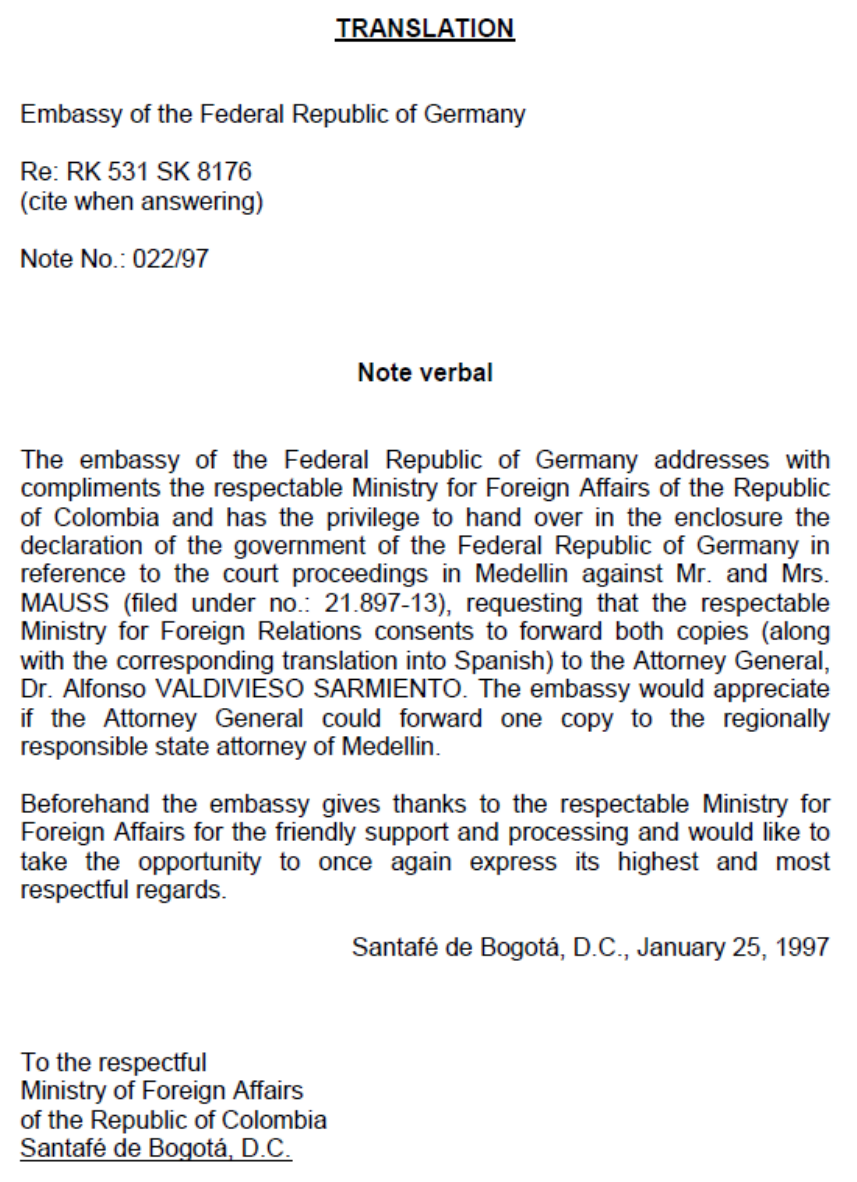
114
115
116
117
118
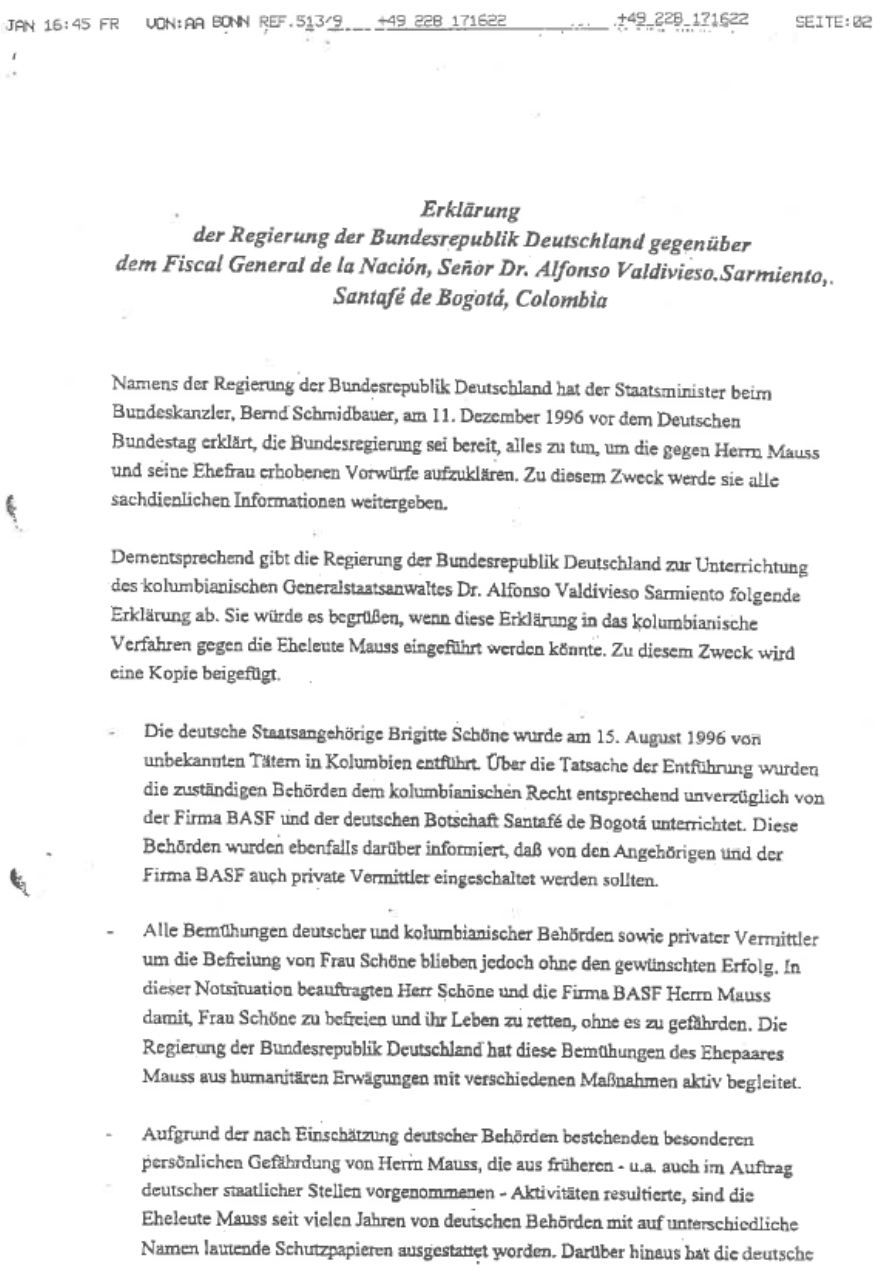
119
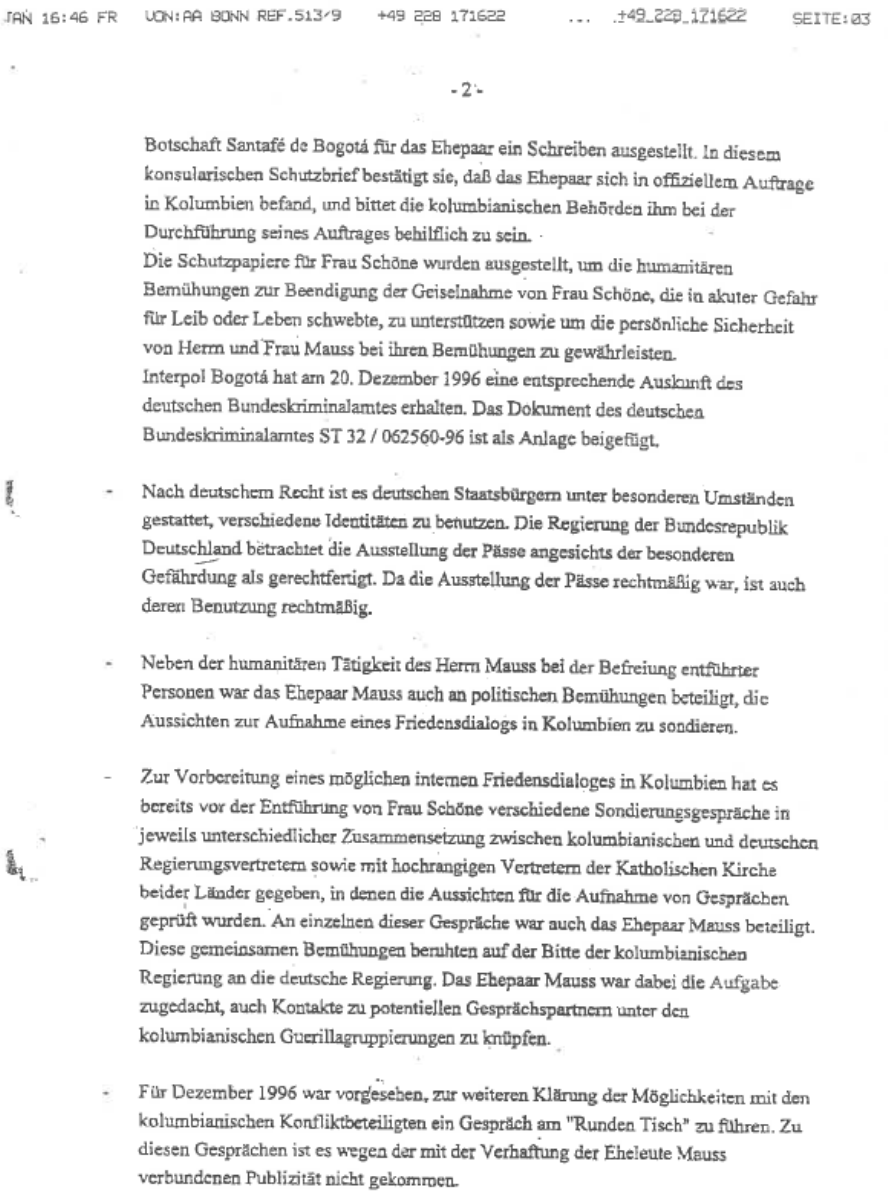
120
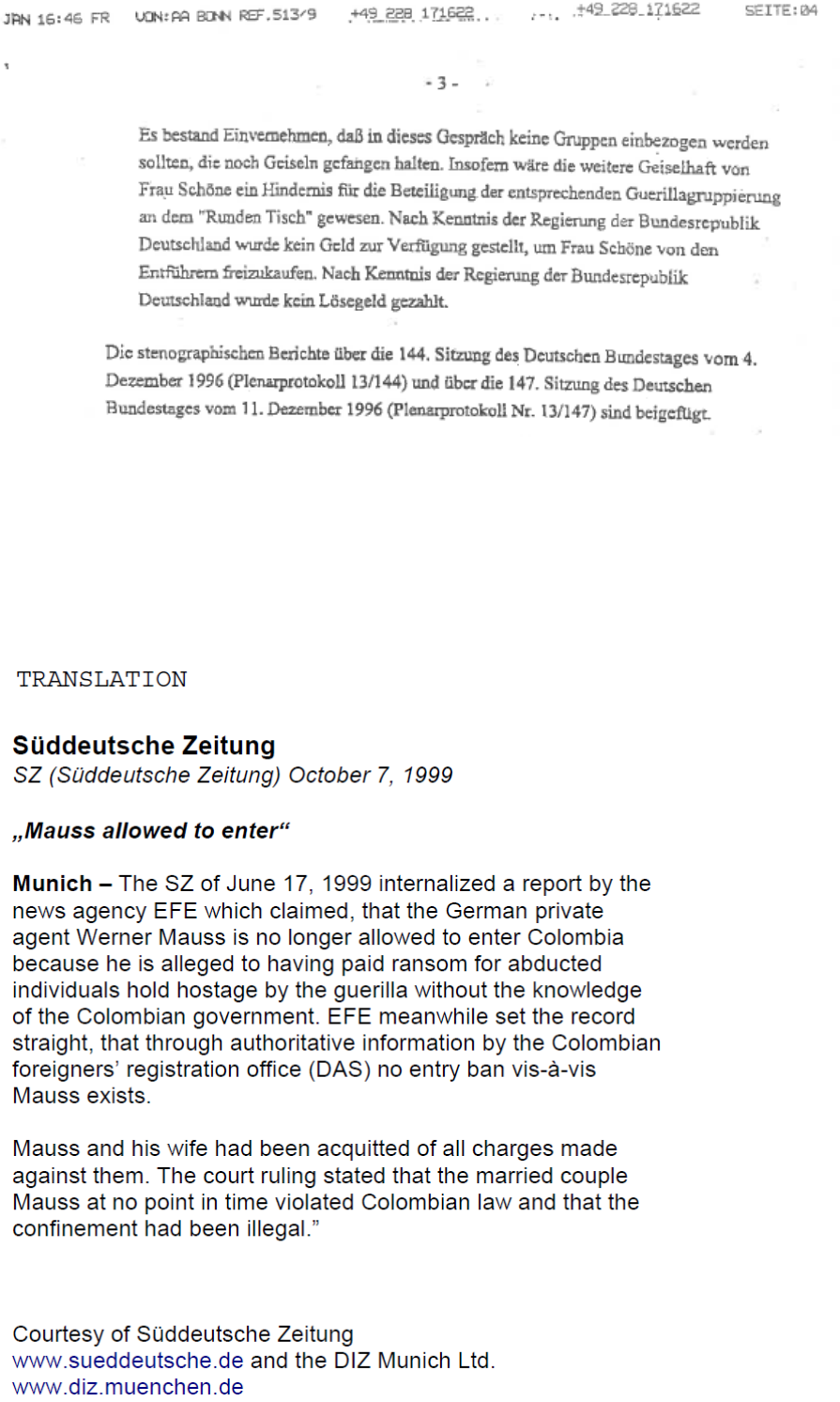
121
Despite all the intrigues and obstacles, Mr. Werner Mauss and his then-wife continued the
peace process on behalf of the governments of Colombia and Germany at the time following
the acquittal on May 20, 1998. Furthermore, it should be made clear that, following the acquit-
tal, there are no restrictions whatsoever against Mr. Werner Mauss in Colombia. As a citizen
with a clean record, he is free to enter Colombia at any time, as he has done.
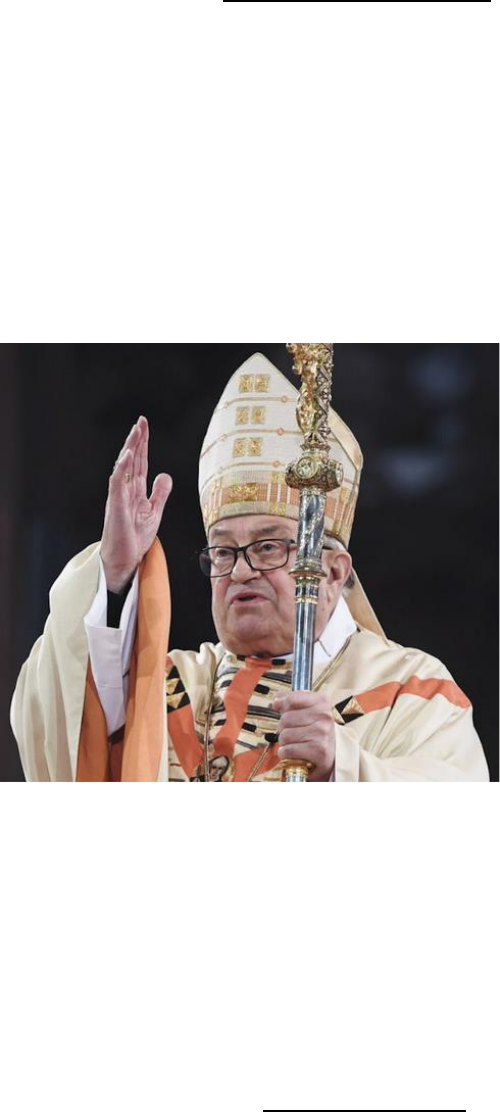
122
As previously arranged, following his acquittal on May 20, 1998, Mr. Werner Mauss was com-
missioned by the German Federal Chancellery, in agreement with the Colombian government
(then-President Samper) and the Colombian National Peace Commission - whose members
included former Colombian President and Nobel Peace Prize laureate Juan Manuel Santos -
to lead a negotiating delegation from the ELN’s Central Command out of the Colombian jungle
to Germany for peace talks. During the subsequent negotiations between the parties to the
conflict, under the auspices of the Bishops’ Conference, then Bishop Lehmann, at the Him-
melspforten Monastery, a first agreement promising peace between the parties to the Colom-
bian civil war was concluded there on July 15, 1998.
Opening Remarks by the Chairman of the German Bishops’ Conference at the
meeting of a peace initiative for Colombia on June 29, 1998, at the Himmel-
spforten Monastery in Würzburg
I am truly delighted to welcome you here this morning at the Bishop’s Residence in
Mainz. I would like to thank you - along with Archbishop Alberto Giraldo, Chairman of
the Colombian Bishops’ Conference, who unfortunately cannot be here today - for
coming. However, Monsignor Martínez, the Secretary General of the Colombian Bish-
ops’ Conference, is here on his behalf, so that, together with Father Dr. Langendörfer,
both the Colombian and German Bishops’ Conferences extend a very warm welcome
to you.
I am pleased that Bishop Emil Stehle, formerly a pastor in Bogotá and, since 1987,
bishop in Santo Domingo de los Colorados, Ecuador, is here with us as an experi-
enced advisor. I would also like to thank everyone else who has been involved in
these discussions for a long time, not least Mr. and Mrs. Mauss and their compan-
ion from the ELN’s Central Command.
However, my dear gentlemen from Colombia, I am even more delighted by your visit:
it reflects the willingness to discuss the peace that the people of your country so ea-
gerly await. You have come here to Germany to work with us to find a way out of the
crisis of your country.
123
I would like to extend a special welcome to you as representatives of the Consejo
Nacional para la Paz, and to you, gentlemen, representatives of the ELN. You have
decided to bring together the various sectors (distintos sectores) of the people in a
peace initiative and to engage in a dialogue that involves as many people as possible.
You deserve special thanks for having adopted the “Mainz Declaration” yesterday and
for presenting the program in four points. Archbishop Giraldo and I are grateful that
you were able to reach such a result in a relatively short time. If you would like to hold
these talks in Germany, we wish to facilitate them - given the external circumstances
- by taking on some of the organizational and coordination tasks (participación facil-
itadora). In this spirit, as bishops’ conferences, we would like to do everything we can
regarding the framework for these discussions to facilitate your negotiations and talks.
If we can contribute to this, we will gladly continue to provide this assistance - acting
as facilitators in the logistical preparations - to the best of our ability.
Also on behalf of the bishops of Colombia and Germany - and certainly in the spirit of
many people in Colombia - I thank you for this important first step you have taken.
With this in mind, I look forward to the discussions that will now follow and hope that
you will be able to continue these fruitful conversations here in my home as well.
I wish the gentlemen flying back to Colombia a safe flight. I wish the gentlemen staying
here in Germany until July 12 a pleasant and restful stay. It would be a very significant
next step if we could meet again here in Mainz on July 12 along with other men and
women from various sectors of your people.
(Signature)
Karl Lehmann
Agreement reached at Kloster Himmelspforten, July 15, 1998
The representatives of Colombian civil society, the ELN and the National Peace
Committee assembled here under the auspices of the German and Colombian Bish-
ops’ Conferences
Resolve:
1. To begin peace negotiations with the ELN.
Participation of civil society:
2. To recognise the permanent right of civil society to participate, and in so doing,
reach the ultimate objective of the peace process.
3. To invest more effort in appraisal of and proposals for peace-related topics,
through which structural or partial changes in the lives of the population can be
aimed at.
4. To organise meetings with the various sectors in order to consolidate progress in
the peace process.
5. To cultivate the projection of the spirit of this document to the government and the
continuation of peace measures with the support of the international community.
124
6. To organise meetings between the government and the commanders of the
E.L.N. and the E.P.L.. And, at the same time, to organise a meeting between the
signatories of this agreement with the commanders of the P.A.R.C.‚ the C.G.S.B and
other participants in the war. In this connection, the meeting between newly elected
president Andrés Pastrana and the commanders of the F.A.R.C. is welcomed as a
valuable step for the future of the peace initiative.
7. To place ourselves at the disposal of the large national movement inspired by the
Mandate for Peace which has appeared all over the country in the desire to see an
end to the war. This we do by supporting the strengthening and consolidation of
such developments as the Civil Society Permanent Assembly for Peace (Asamblea
Permanente de la Sociedad Civil por la Paz).
8. That civil society should become mediators and talk with the government, de-
manding adherence to political guarantees and civil liberties which are constitution-
ally protected in every part of the country.
The Humanisation of the War:
9. That the acts of war and massacres of the civil population that are financed by the
various sectors are to be condemned. These are increasing due to a readiness to
look away and through the actions of some state officials.
10. That the ELN will suspend the kidnapping or detaining of people for financial
gain to the extent to which they are able to gain by other means a sufficient availa-
bility of resources and on the condition that other means of making sufficient money
available to the ELN are found, provided that the realisation of the peace process by
such means does not result in their strategic weakening. In addition, from today, it
will refrain from detaining minors or persons of over 65 years of age, and in no case
will it deprive pregnant women of their freedom.
11. That moves to abolish the exemption from punishment for crimes against hu-
manity such as enforced disappearances, massacres, genocide and torture should
be supported in line with the international laws on these subjects.
12. That attention is to be given to making sure that, in line with UNO concepts, the
validity period of regional law does not extend beyond the end of the legislative pe-
riod. Moreover, it was stressed that the law must quickly recover its efficiency, swift-
ness, impartiality and procedural guarantees.
13. To support the organisation and intervention for the defence of their legitimate
interests and needs of those who have been forced into exile and we particularly
support the safe return, and, if necessary, the appropriate conveyancing of their
lands and property, their entire development and the development of their regions.
14. That in order to protect them from armed attacks, there is to be collaboration be-
tween the leaders of civil society, the coordination of the Procuradoría General de la
Nación and the ombudsman’s office on the identification and marking of all goods
protected by the international human rights experts (DIH), such as:
125
- Water pipelines and dams
- Schools
- Health centres for people and for animals
- Hospitals
- Medical supply centres for the civilian population
- Ambulances, fire fighting and first-aid vehicles
- Civilian vehicles, ships and planes not used for military purposes
- Hygiene campaigns for people and for animals, or social campaigns
- Centres for education, sport, culture, recreation and religion
- Infrastructure of the electricity supply for the civilian population
- Installations containing dangerous forces, e.g. water under pressure or nuclear
material.
15. The ELN again confirms its one-sided adherence to the recommendations for
guerrillas made by Amnesty International in its 1994 Annual Report on Colombia.
Confirmed adherence to recommendations, as follows:
A. Humane treatment of prisoners, the injured and those wishing to surrender; irre-
spective of whether they are civilians or members of the armed forces, their lives
must be spared.
B. Deliberate and arbitrary murder of non-combatants is forbidden under all circum-
stances.
C. Prisoners are not to be used as hostages. Prisoners are to be identified, they are
to be released unharmed and in good health.
D. No mines to be used for the killing or deliberate mutilation of civilians.
E. Cases of rape reputedly carried out by guerrilleros are to be investigated in order
to identify those responsible.
F. Guerrilleros suspected of committing, or of ordering the committing, of rape are to
be relieved of all authority and any duties which might enable them to repeat such
abuses.
16. Respect for the autonomy, religion, culture and the right to neutrality of the In-
dian communities and other ethnic groups and the areas where they live is to be
supported by all armed groups and other involved parties.
17. Civil society and the ELN once more affirm their promise to respect the rights of
children, and this organisation is to use no children under 18 years of age in its mili-
tary forces. In future, age at entry is to be 18.
18. Ratification by the Commission was prompted by the Ottawa agreement on the
banning of landmines. In addition, assurances have been given that no landmines
will be laid in places where civilians, and particularly children, could be endangered.
We also demand observance of the ban on the bombing of civilian property and ci-
vilian areas.
19. At the conference it was remarked that prisoners and detainees of the guerrillas
must be handled with humanity and respect for their dignity and rights as political
prisoners. Non-prosecution of social protest is supported.
126
Natural Resources:
20. The signatories to this agreement will promote the implementation of a broad fo-
rum within a National Convention in order to discuss the problem of the sovereignty
over natural resources, including oil, and with the purpose of proposing changes to
the Commission and to the government which would be politically and legislatively
advantageous for the people. This forum will take place in a region whose demilitari-
sation will be requested of the government in advance. During implementation, the
ELN will desist from sabotaging pipelines, acts for which the organisation has thus
far been solely responsible.
The National Convention:
In view of the positive results of this meeting we further agree to the convening of a
national Convention for the purpose of achieving peace and social justice, the
spread of democracy and the consolidation of national sovereignty within the follow-
ing parameters:
By National Convention we understand a process with various discussion phases,
and with the authority to make proposals granted to participating representatives of
state, society and guerrillas.
It is intended that the Convention lay the groundwork for a political agreement on re-
forms and social changes with regard to the democratisation of the state and soci-
ety. Its implementation will be carried out with the help of essential administrative or
legal mechanisms, and even via the organisation of a national constituent assembly.
The National Convention is to promote the participation of representatives of the
state and receive the guarantee of the national government, for which the National
Peace Council, in its role as government advisor, should act as mediator.
The F.A.R.C. and the entire Coordinadora Guerrillera are to be invited to participate
in the National Convention and to support its objectives.
The largest possible representation of participants is important though the current
group participating in the Mainz meeting will be taken as basis and constituted in the
preparatory committee for the National Convention. For this purpose an operations
Committee is to be formed.
Both regional and national preparations are required for this National Convention.
The preparatory committee must organise the National Convention by the 12th of
October 1998, at the latest.
The National Convention will then decide on decision-making procedures and other
aspects of its function.
On the agenda of the Convention will be topics such as the determination of basic
principles for the transformation of the necessary social, economic and political
structures by means of concerted action. Amongst other things, this must allow for
full observance of human rights, social and economic justice, political democratisa-
tion, the sovereignty of integration and internationalisation and the role of the armed
forces in a peaceful country.
The National Convention is to take place on Colombian state territory, in a zone
where a mutual ceasefire is observed and the necessary guarantees are to be given
to all participants.
127
During the progress of the National Convention, participants are called upon to seek
achievements of greater significance to the cause of peace, such as a ceasefire or
putting a stop to offensives by the conflicting parties on national territory.
21. The signatories to this agreement commit themselves to its planning, support,
evaluation and observance, as well as to involving other representative sectors of
Colombian society in this work. We would also like to express our very particular
thanks to the Bishops’ Conferences of Germany and Colombia for their hospitality
and the warmth and cordiality with which they have taken up this mission.
The following persons signed this agreement on July 15th 1998 in Würzburg, Ger-
many:
Order:
Family name of the father, family name of the mother, forename/s
AbeIlo, Aída – Chairperson of the “Union Patriótica” (Communist Party)
Alvarez Gardeazábal, Gustavo – Governor of the province Valle del Cauca
Angarita Figueredo, Hernado – National Peace Council
Beltrán, Pablo – Commander of the ELN
Bernal, Ana Teresa – Director of Redepaz
Bernal Cuellar, Jaime – Procurador General
Berrío, Nelson
Cabal, Jaime Alberto – President of Acopi
Caicedo, Jaime – Communist Party
Carillo, Cesar – Trade union leader
Castro, Msr. Luís A. – Archbishop of Tunja
Castro, José Fernando – Ombudsmann
Garzón, Luis Eduardo – Trade union leader
Gaviria, Carlos – Constitutional Court judge
Gómez, Ana Mercedes - Director of “EI Colombiano” newspaper, Medellín
Gómez Mario - Veeduria Ciudadan
González Posso, Camillo – Mandate for Peace
Hernández, Milton – Commander of the ELN
Hernández, Hernándo – President of the USO (trade union federation)
Izquierdo, P. Gabriel – Ex-director of Cinep
Martínez, Father Jorge – Colombian Bishops’ Conference
Marulanda, Eugenio – President of Colfecar
Molano, Alfredo – Sociologist
Moncayo, Victor – Rector of the Universidad Nacional
Moreno´, Samuel – Senator
Picón Antonio - Fenalco Antioquia
Pretelt de la Vega, Sabas – Chairman of Fenalco
Ramirez Ocampo, Augusto – Conciliatory Commission
Restrepo, Javier Dario – Journalist
Rias, José Noé – Government advisor
Rueda, Maria Isabel - Journalist
Rufz, Carlos Alberto
Santos, Francisco – from the daily newspapers El Tiempo and País Libre, Bogotá
Santos, Juan Manuel – Political leader
Umaña Luna, Eduardo – University Professor
Valencia, León – from “Socialist Renewal” movement (renovación socialista)
Vargas, Alejo – Vice Rector of the Universidad Nacional
Vasquez, Juan – Commander of the ELN
Villegas, Luís Carlos – President of ANDI (business association)
Visbal, Jorge – President of Fedegan (cattle breeders association)
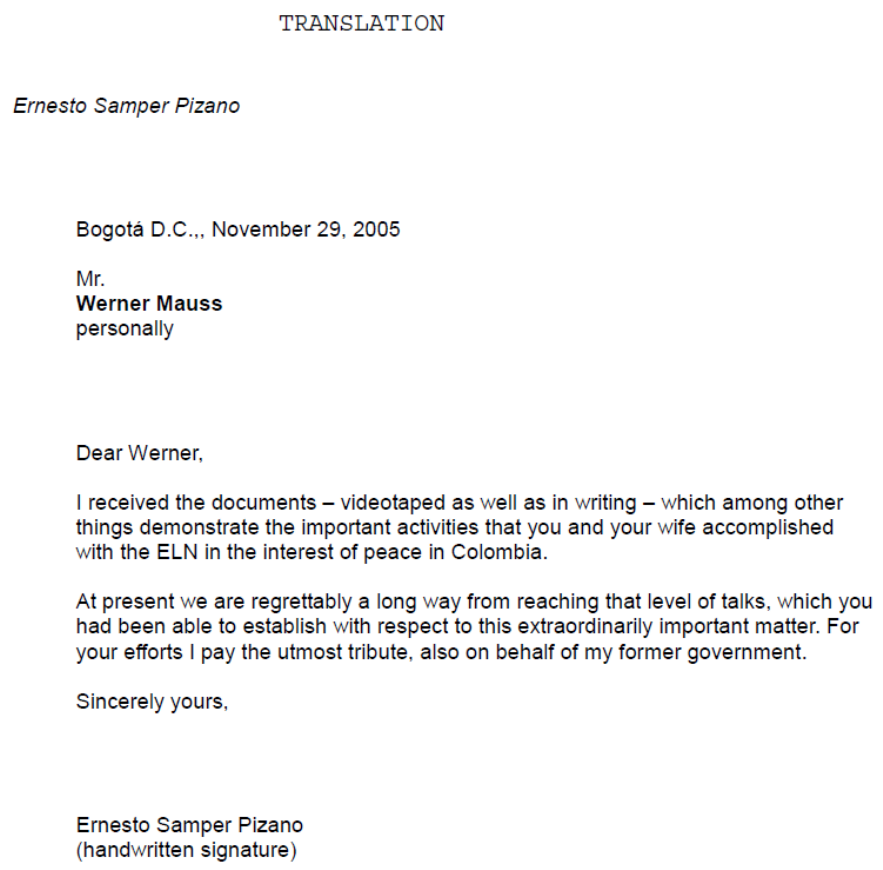
128
1998 – In a letter of recognition, Ernesto Samper Pizano, who served as president until
1998, informed Mr. Werner Mauss of the following:
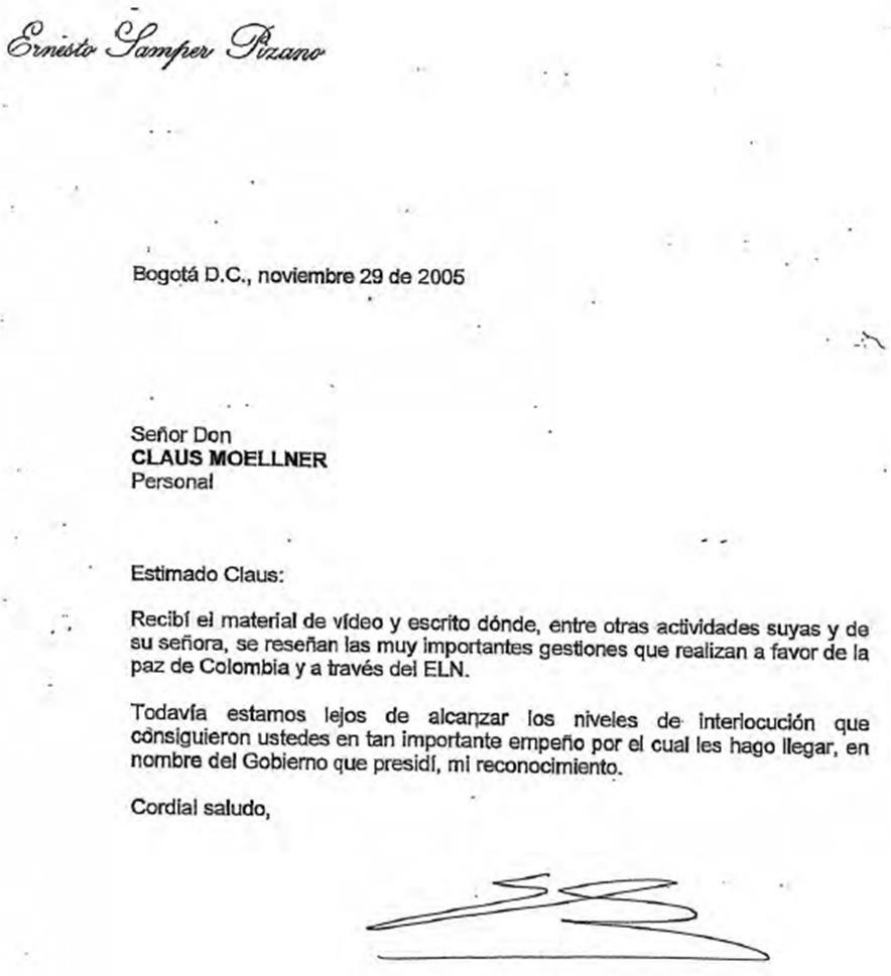
129
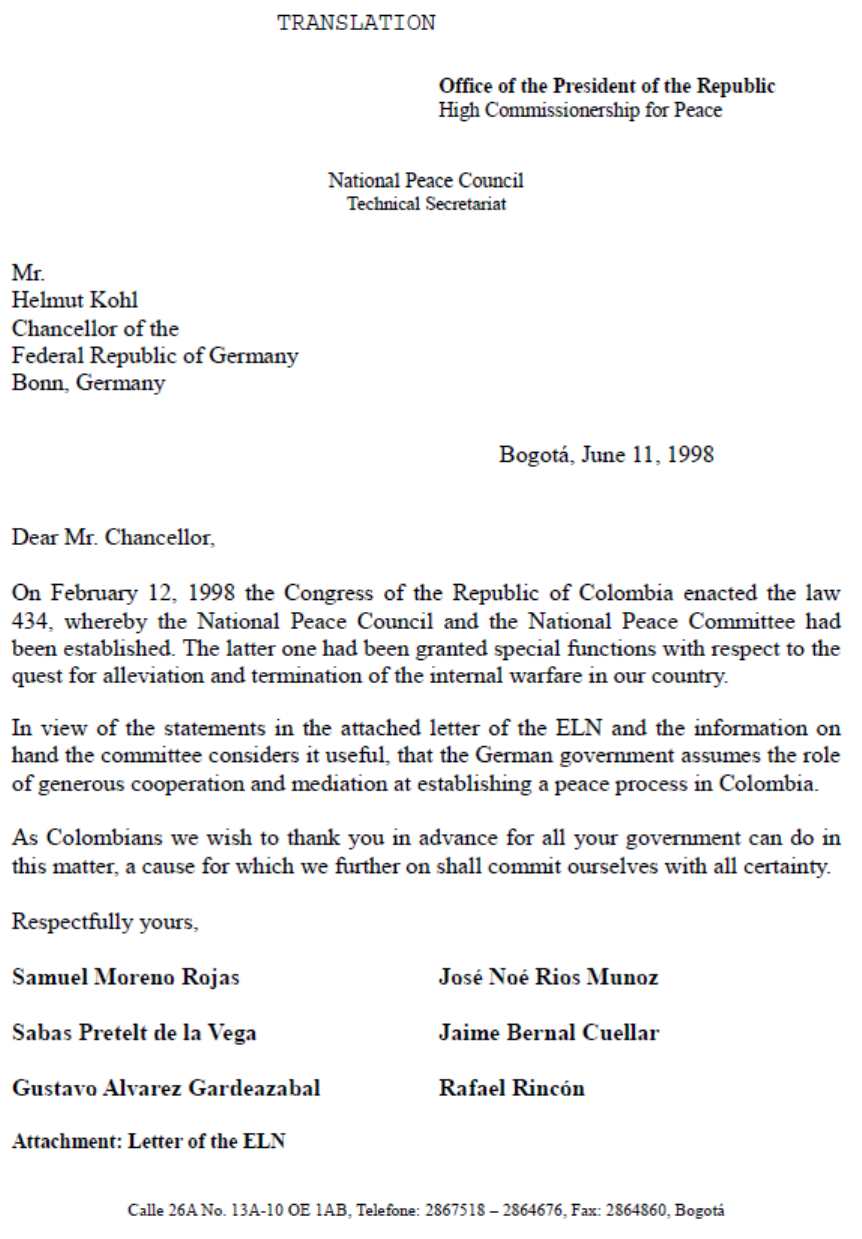
130
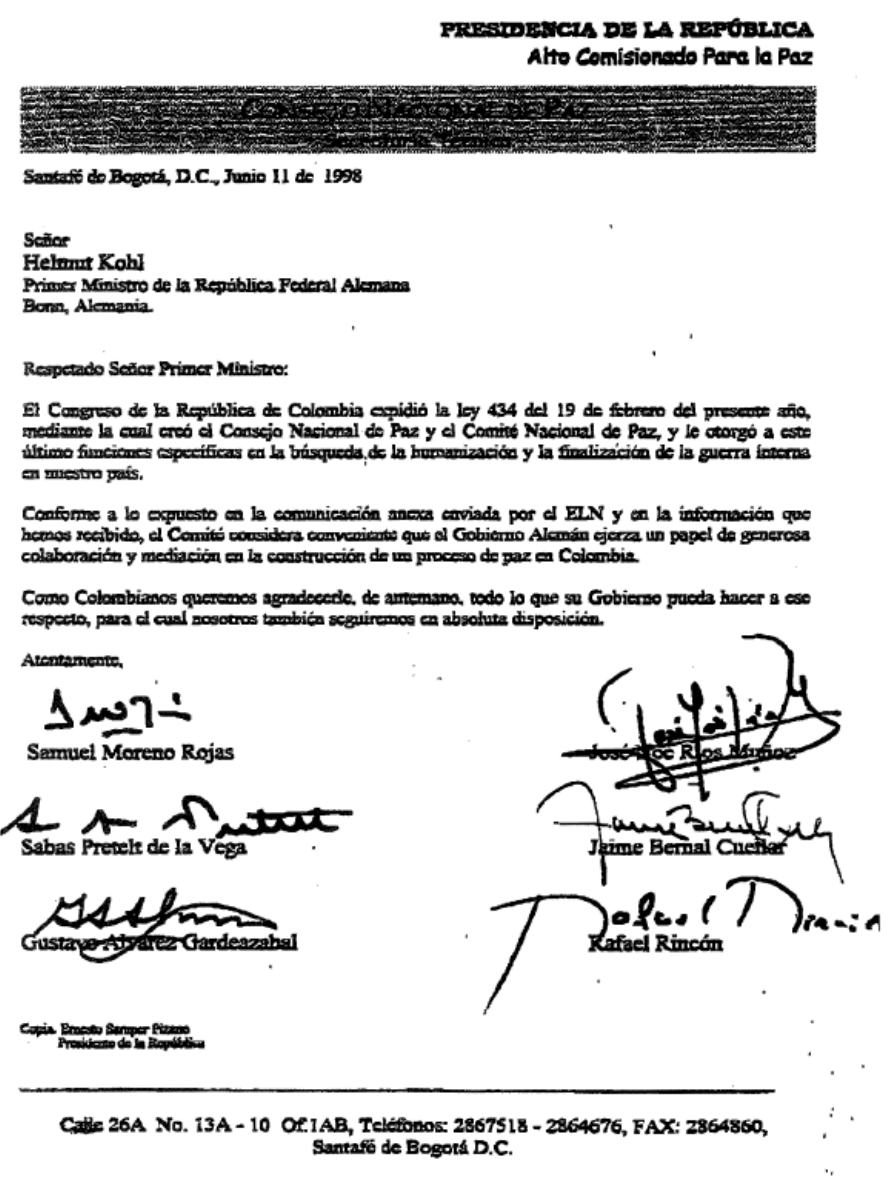
131
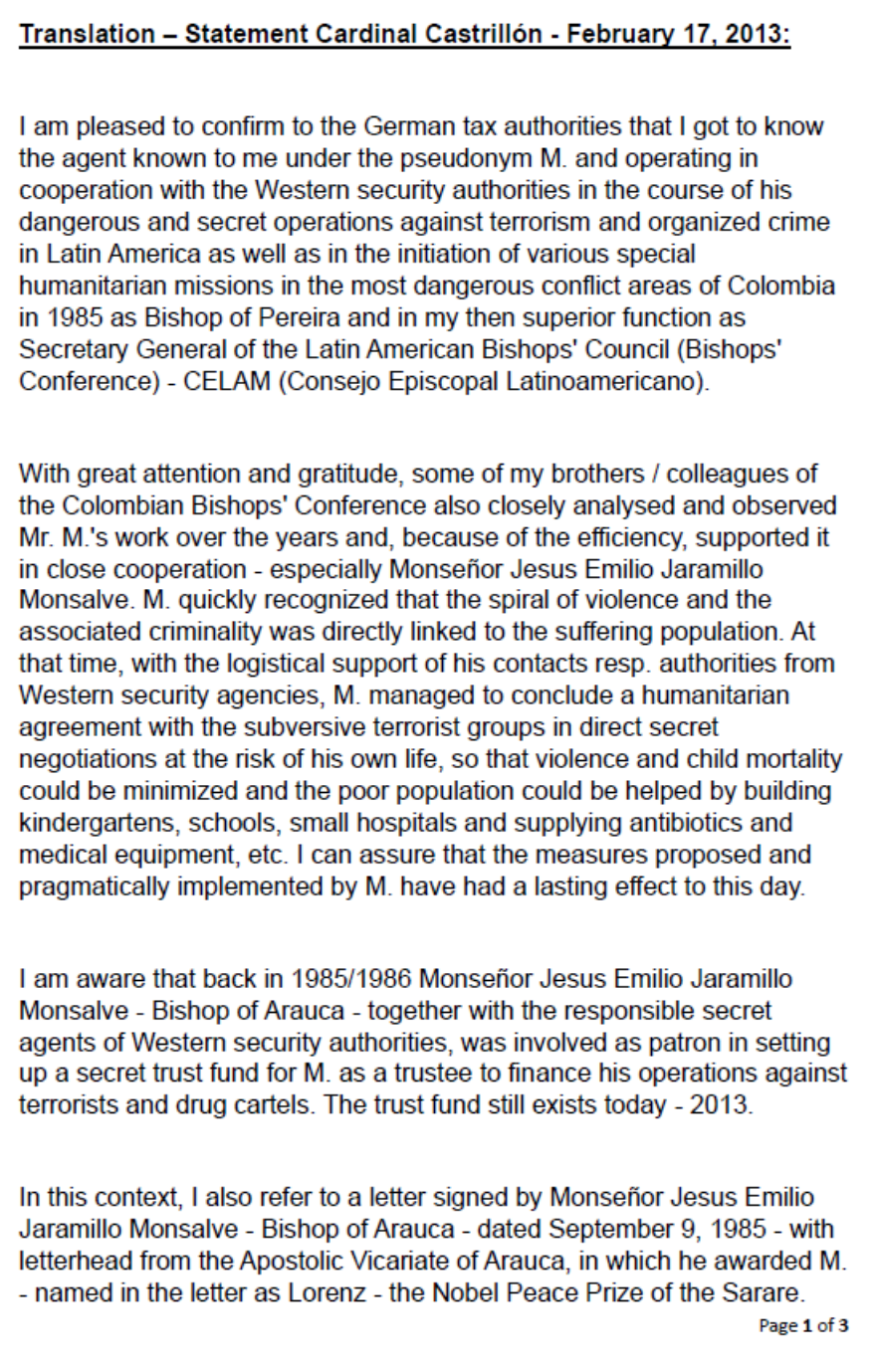
132
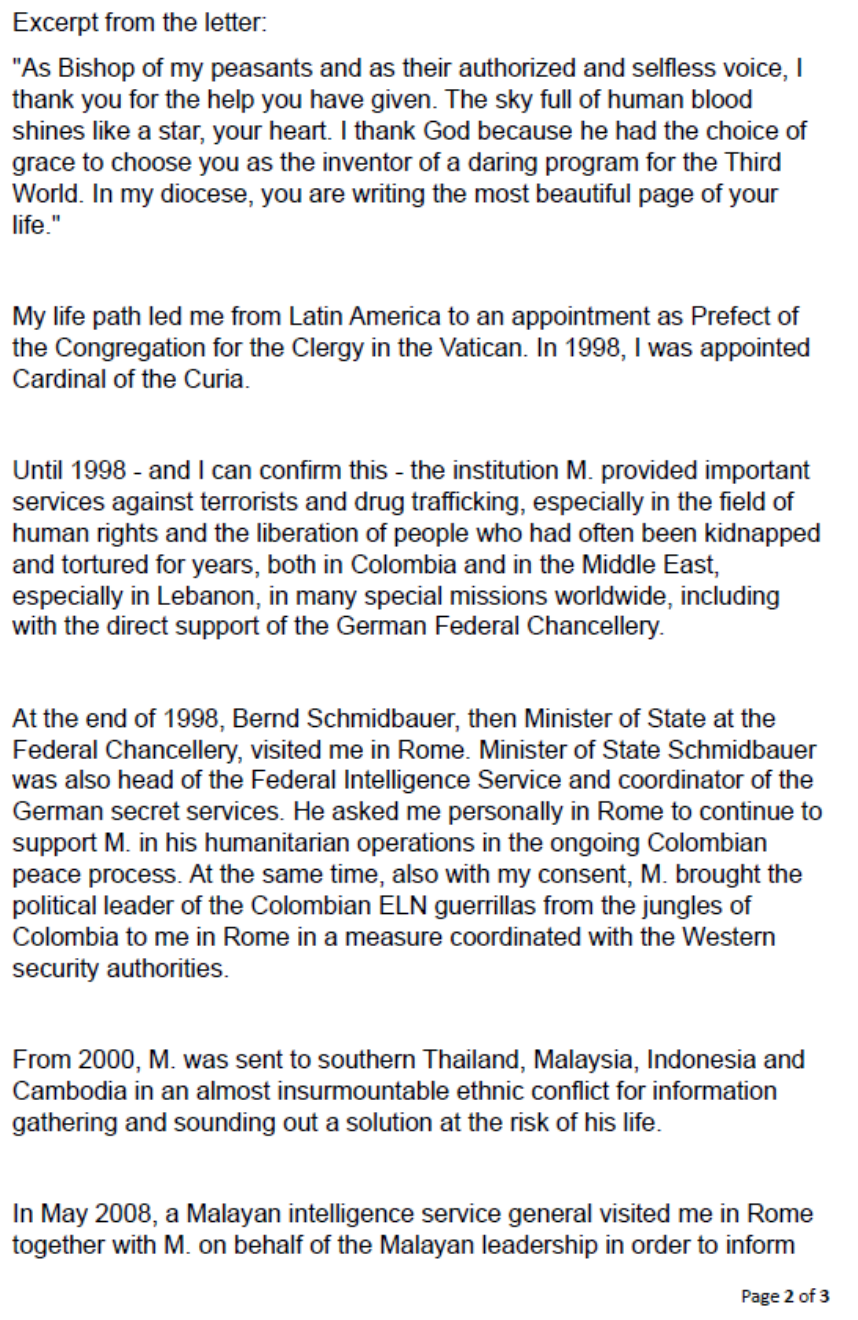
133
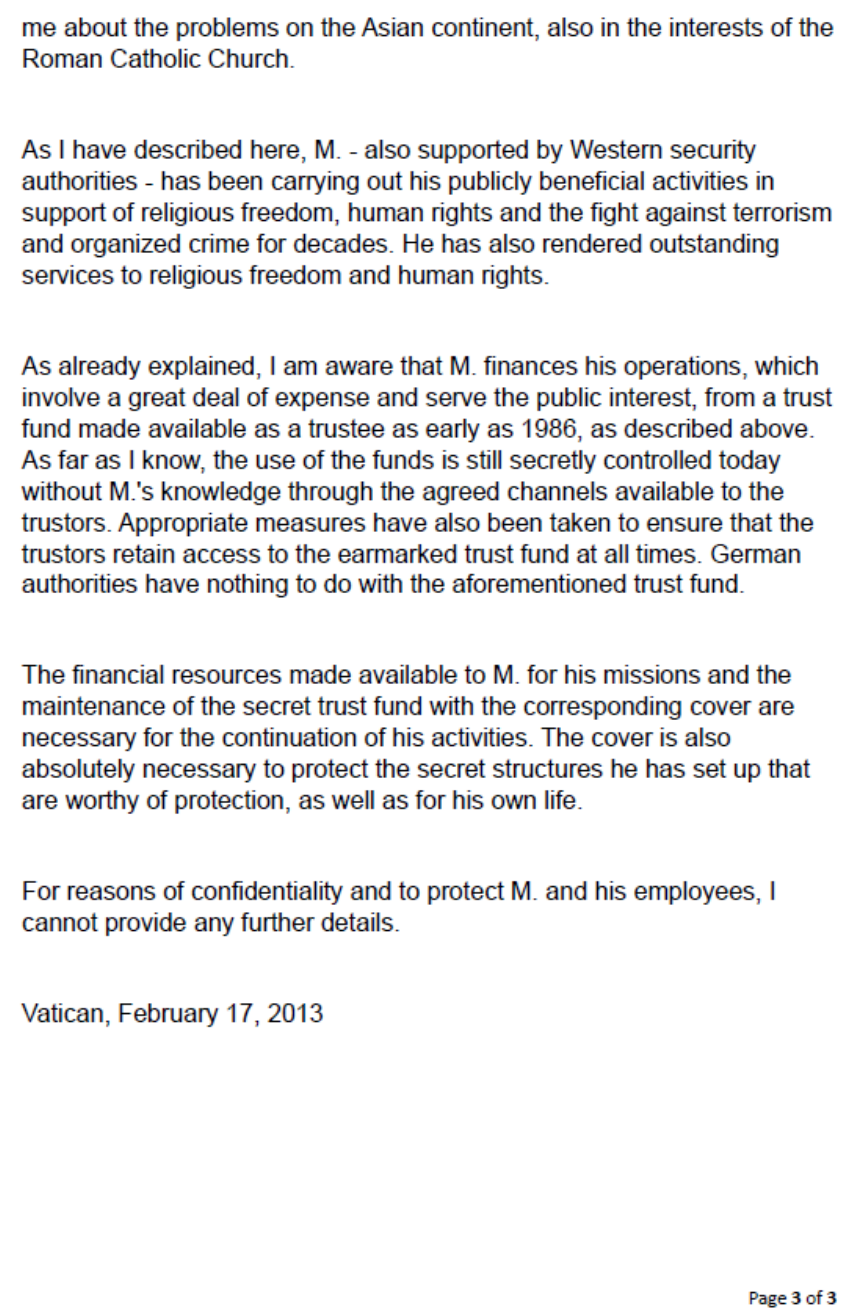
134
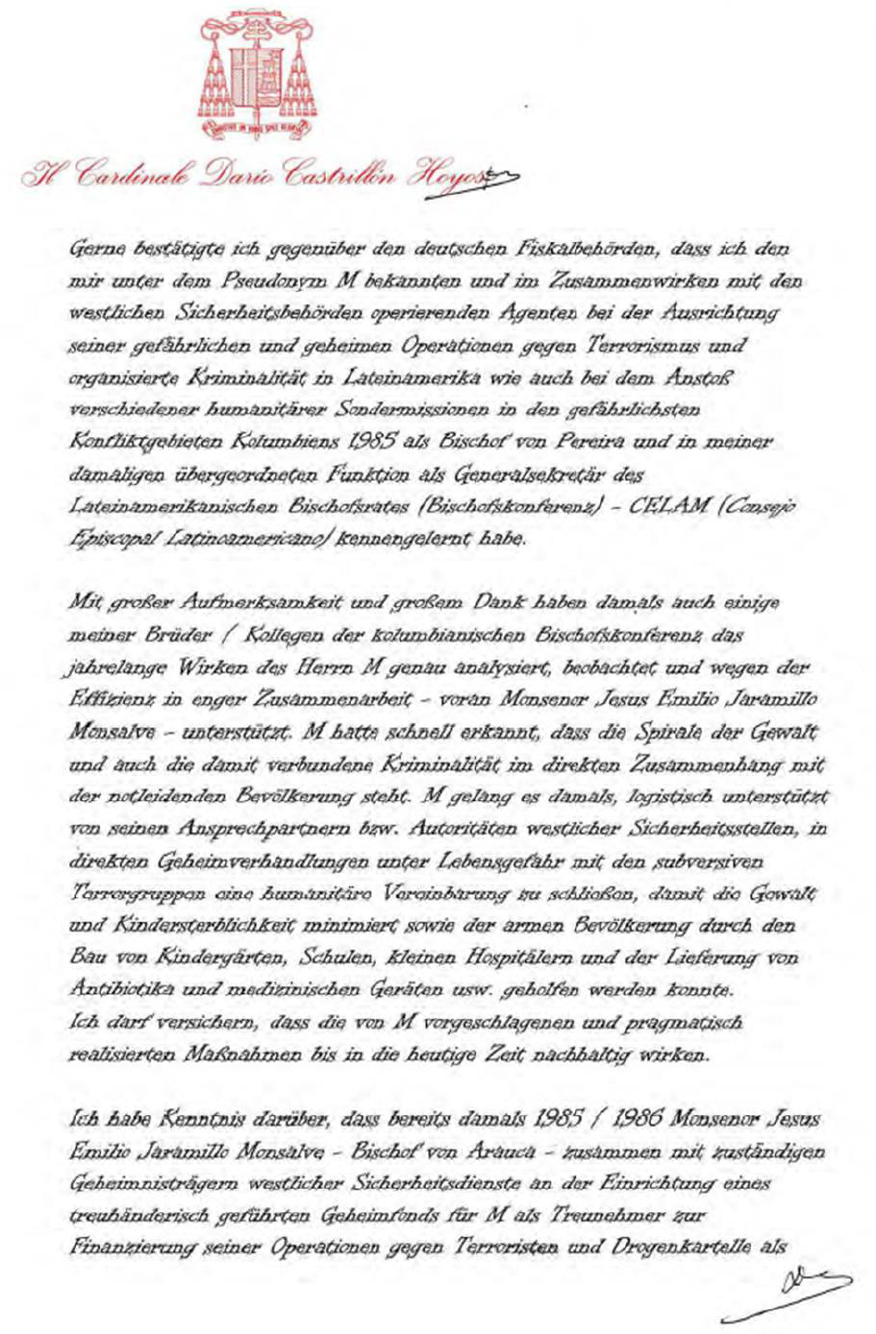
135
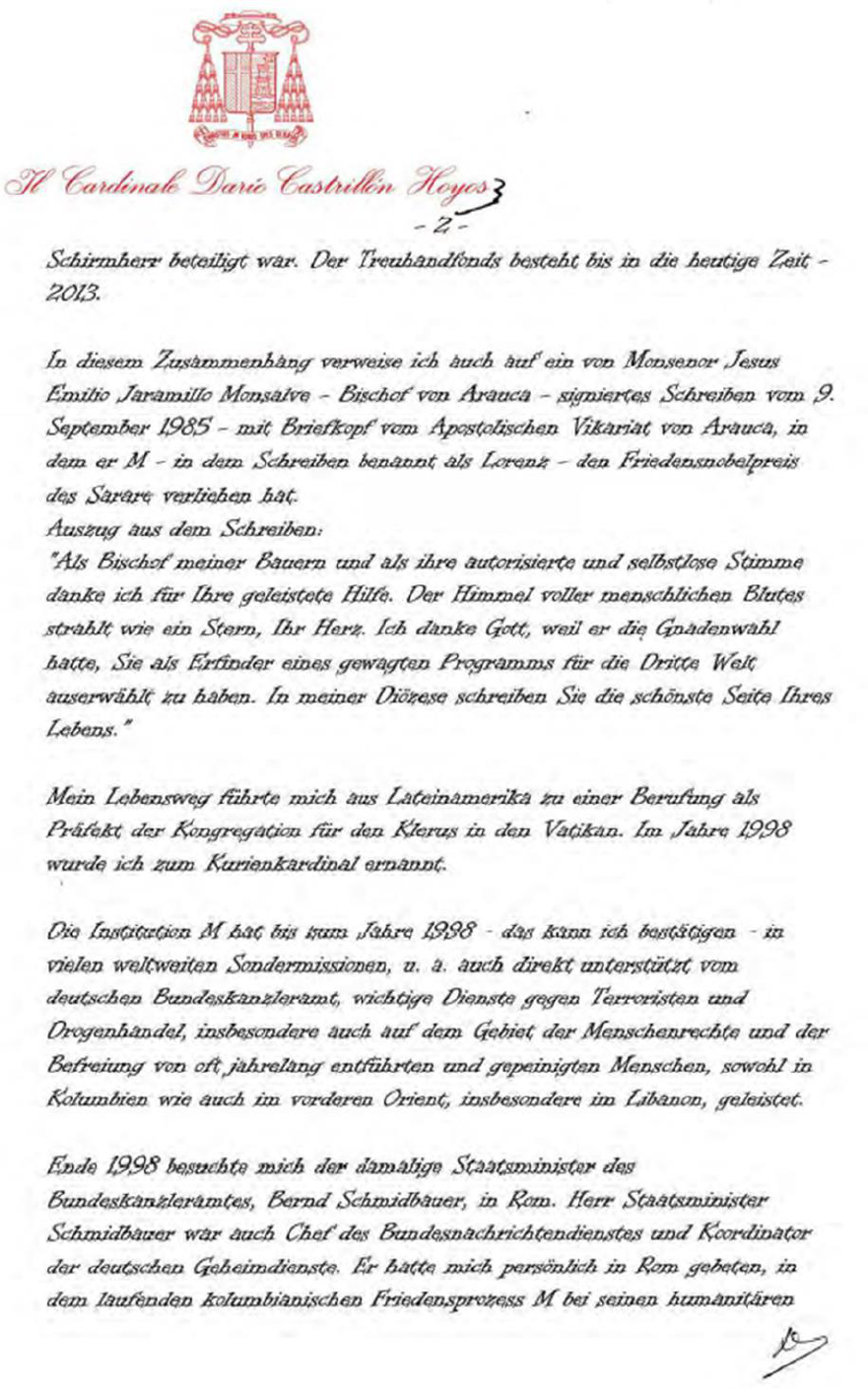
136
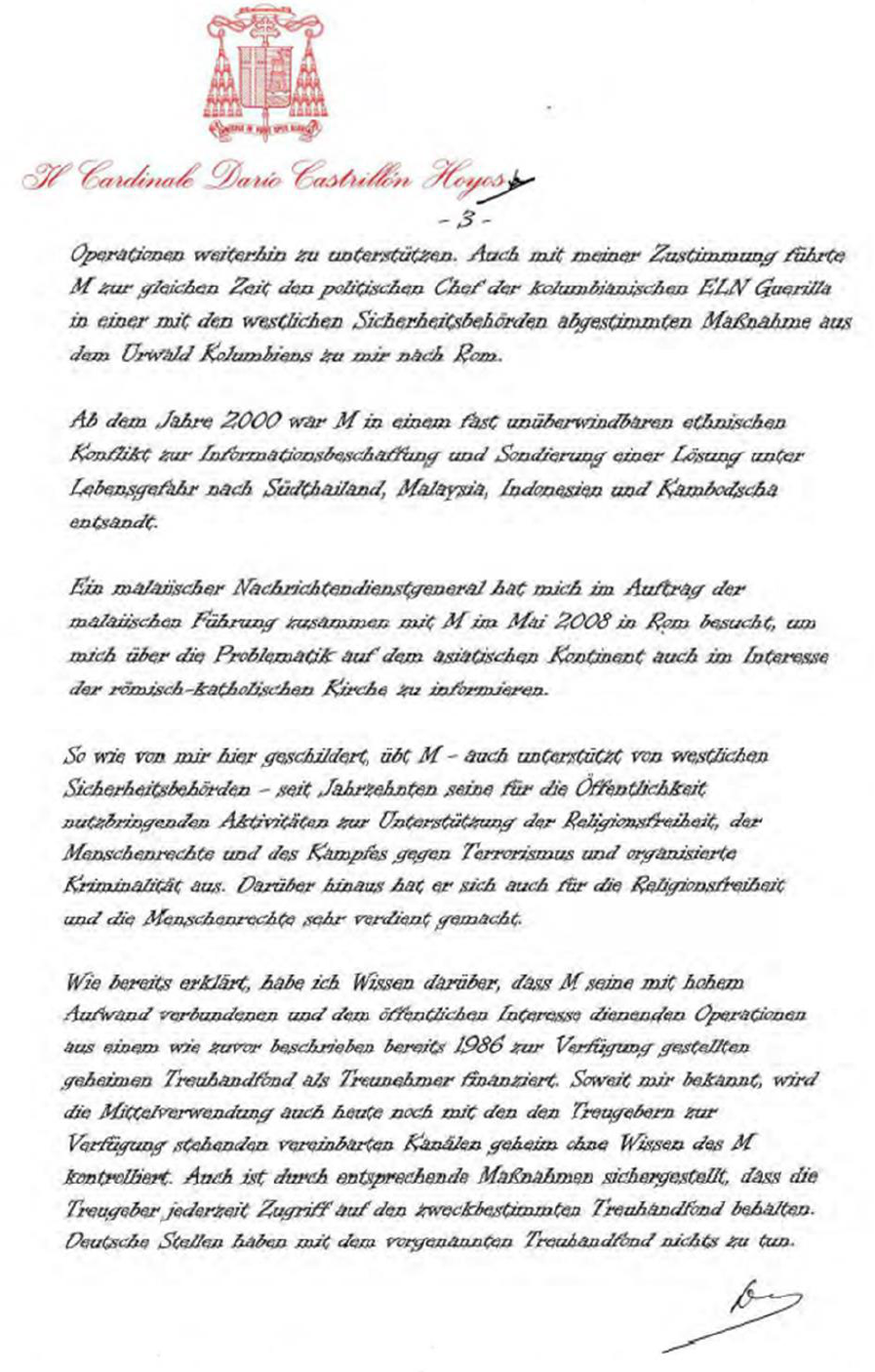
137
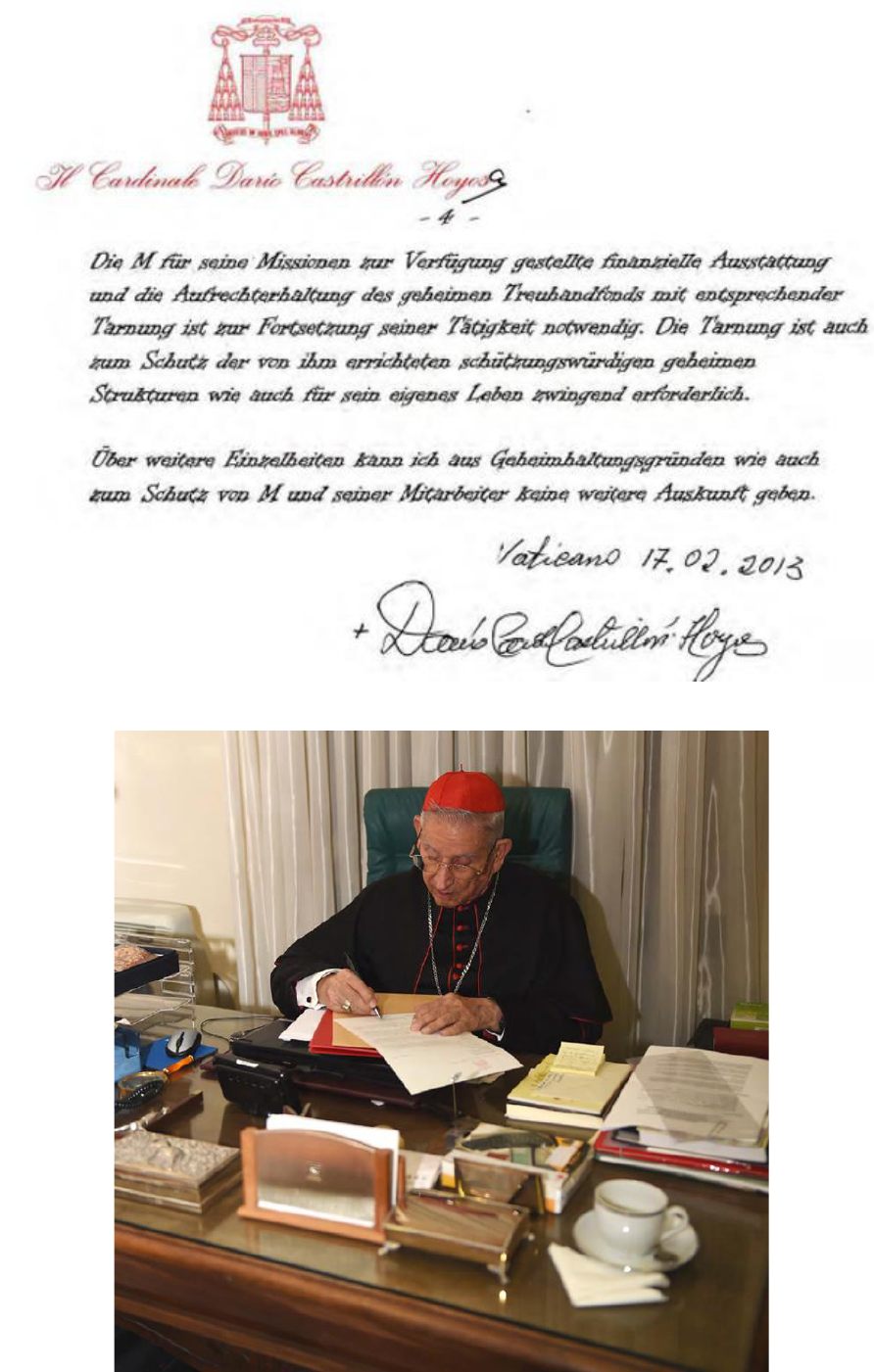
138
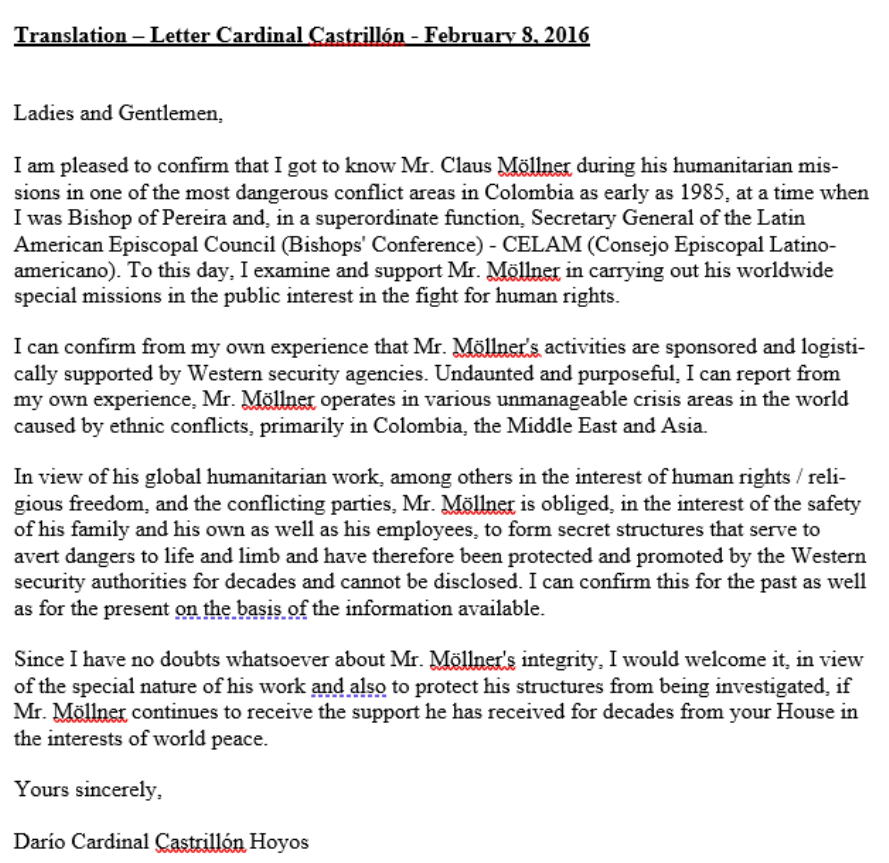
139
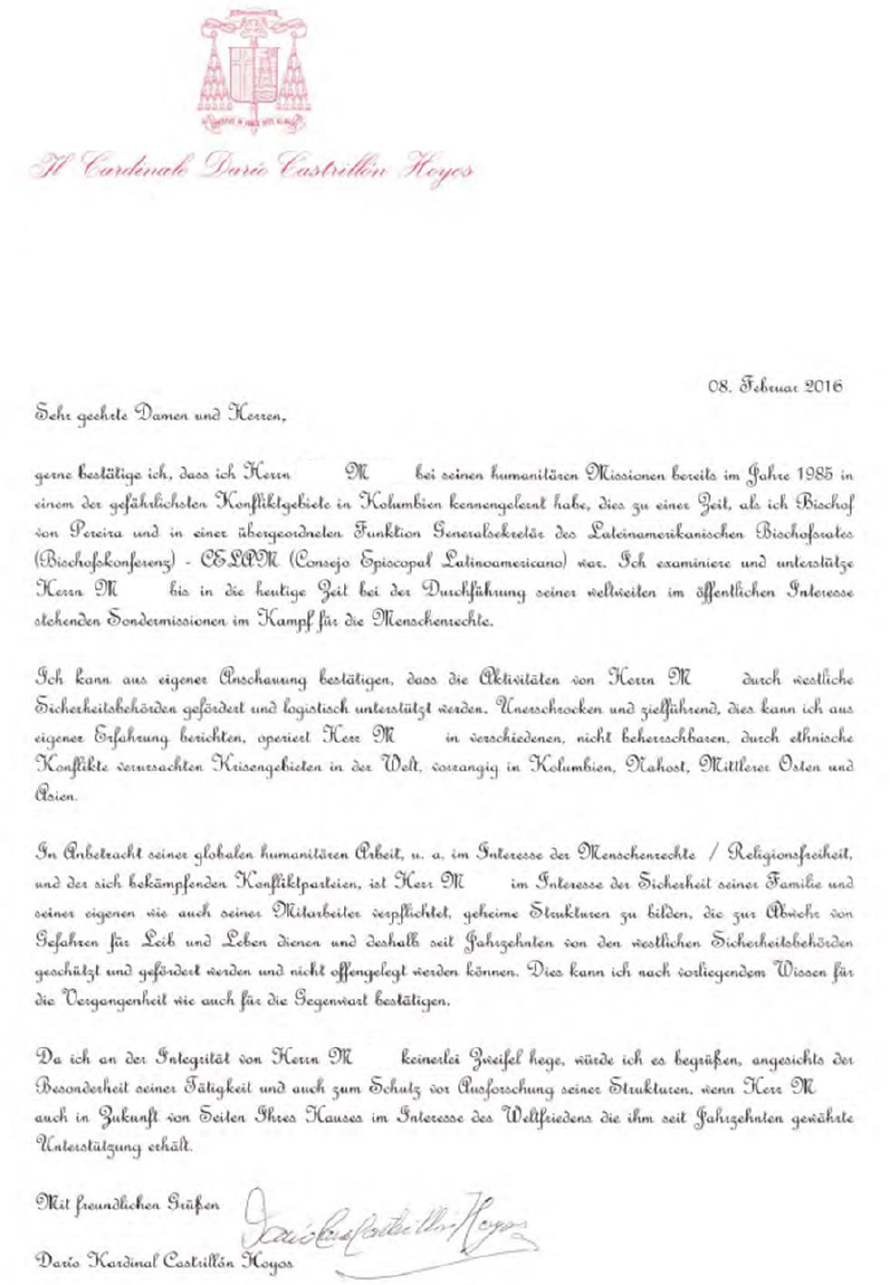
140
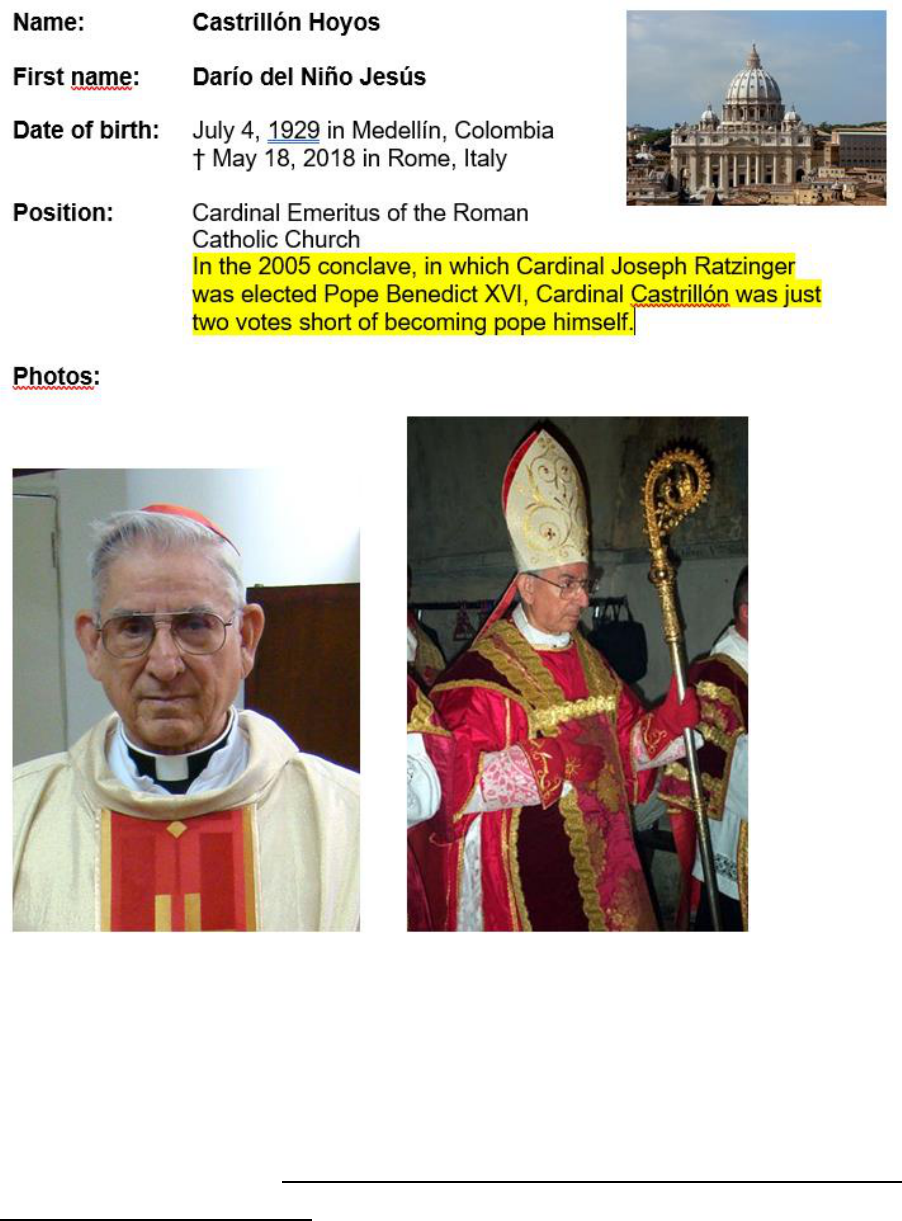
141
1994-1998 – UCA operation in Colombia in coordination with the Fed-
eral Chancellery - intelligence gathering
To investigate serious crimes such as kidnappings and bomb attacks, and to gather infor-
mation on the procurement of explosives and other activities of Colombian drug cartels and
their international networks. Uncovering an ETA cell in Central America that was procuring
explosives for the ETA in Spain.

142
July 2000 – Abu Sayyaf, Philippines, Islamic terrorist organization –
Kidnapping of journalist Andreas Lorenz from the German news
magazine “Der Spiegel”. Secret mission from “Der Spiegel”’s man-
agement dated July 18, 2000, for the release of the journalist – he
was released on July 27, 2000. The kidnappers had threatened to
amputate both of Mr. Lorenz’s hands. The operation was also fully
approved by the trustors.
On Easter Sunday, April 23, 2000, the Wallert family, along with 19 other people of various
nationalities, and, on July 2, 2000, “Der Spiegel” journalist Andreas Lorenz were kidnapped in
the Philippines by the Muslim Abu Sayyaf rebels, i.e., the militant MILF (Moro Islamic Libera-
tion Front).
Originally, starting in 1968, the Libyan intelligence service under Muammar al-Gaddafi had
covertly and subversively built up the Muslim terrorist organization MNLF (Moro National Lib-
eration Front), led by Nur Misuari, in the Philippines with substantial financial support. Further
logistical support and influence from Afghanistan and Pakistan had already been identified at
that time, also coordinated by Gaddafi. Later, particularly radicalized members broke away
from the MNLF and, under their leader Salamat Hashim, formed a military wing, the MILF
(Moro Islamic Liberation Front), which became an independently operating terrorist organiza-
tion. MILF leadership cadres were trained as terrorists in Libya. Both the MNLF and the MILF
- also supported by other terrorist organizations from South Asia and the Arab countries -
declared war on the Philippine government. Base camps were established in the regions of
Mindanao, Basilan, Jolo, and Lanao del Norte, again equipped with substantial financial and
logistical support from Muammar al-Gaddafi.
On July 18, 2000, Mr. Werner Mauss was instructed by the editor-in-chief, Mr. Aust, on behalf
of “Der Spiegel”’s management, Mr. Augstein, to immediately take steps to secure the release
of journalist Andreas Lorenz, who had been kidnapped on July 2, 2000, and who, like the
Wallert family, had been abducted by the MILF, the Abu Sayyaf Group.
The Spiegel management was under immense pressure because the terrorists had threatened
to amputate both of the Spiegel journalist's hands.
Excerpts from the secret contract issued by “Der Spiegel”'s management on July 18, 2000:
.....
"The management of ”Der Spiegel” would like to thank you for the constructive discussion
we had yesterday evening, July 17, 2000, at Frankfurt Airport.
143
With this letter, we authorize you to conduct negotiations with the aim of securing the re-
lease of our employee, who was kidnapped in the Philippines this month, as soon as pos-
sible.
We support and welcome your cooperation with the Malaysian National Security Council
Committee in your negotiations for the release. The Committee is tasked with finding a
political solution - through social and economic measures – to the problem of hostage res-
cue and the political problem on the Yolo Islands. The Committee intends to take appropri-
ate measures to prevent future hostage-takings. We also welcome the fact that cooperation
with the committee is taking place through direct contacts, particularly with the commander-
in-chief of the Malaysian Military Intelligence Service.
You informed us that our employee’s release will proceed as usual through the Philippines,
and that the Malaysian committee is coordinating this release with the Philippine govern-
ment discreetly, in conjunction with the Commission for Economic Development in the
Southern Philippines.
Yesterday evening, the management of “Der Spiegel” assured you the strictest confidence.
Should an agreement be reached - or even if no agreement is reached - no information
regarding the structures and channels of the contacts and arrangements you revealed, as
described here, will be disclosed to third parties. This also incluedes that no information
regarding this matter will be published at a later date.
“The management of “Der Spiegel” assures you that any expenses incurred by you or your
employees - provided they were agreed upon with us in advance, either verbally or in writ-
ing, after the authorization was granted - will be reimbursed without delay.”
The trustors responsible for Mr. Werner Mauss had fully approved the special operation and
given approval that Mr. Werner Mauss was authorized to cover all costs of the operation
through the secret trust fund. Furthermore, the trustors viewed the mission as an effort to
gather intelligence against the Islamic Abu Sayyaf group. Mr. Werner Mauss was prohibited
from claiming either expenses or fees from Der Spiegel. Mr. Werner Mauss guarantees that
he strictly adhered to this instruction and did not receive any money from Der Spiegel.
144
With the help of the network that Mr. Werner Mauss had been passively maintaining for dec-
ades, he was able to determine within just 48 hours that Mr. Lorenz had been abducted and
was being held on the island of Jolo, in the Patikul and Maimbung area, by the military wing
of the MILF (Moro Islamic Liberation Front) under the leadership of Abu Sabaya, alias Aldam.
Aldam was later shot and killed by Philippine marines on June 21, 2002. Mr. Aust had informed
Mr. Werner Mauss in Frankfurt on July 18, 2000, that the kidnappers had threatened to am-
putate both hands of their hostage, Mr. Lorenz. Through an emergency operation in Malaysia,
supported by the Malaysian military intelligence service, Mr. Werner Mauss succeeded in in-
fluencing the Abu Sayyaf command and stopping the amputation at the last minute.
After assessing the difficult situation in the Philippines regarding corruption and mismanage-
ment linked to the terrorist organization MILF, Mr. Werner Mauss developed a strategic plan
and, due to the negative results, flew immediately to Malaysia. There, in accordance with his
plan, Mr. Werner Mauss met with General X, the head of military intelligence, with whom he
had been cooperating for more than a decade. At Mr. Werner Mauss’s request and with the
approval of his political leadership, General X immediately convened an officially authorized
committee for the release of Andreas Lorenz in Malaysia resp. for the economic development
of the southern Philippines.
Malaysia’s military intelligence agency, in cooperation with Mr. Werner Mauss, identified a
company in eastern Malaysia, in the state of Sabah, through which rice, sugar, etc., as well
as pharmaceutical products, were being supplied to the southern Philippines, to Jolo - but
particularly to the Abu Sayyaf and the MILF. Following Mr. Werner Mauss’s targeted interven-
tion on the ground, the Chinese employees of this company were successfully recruited as
informants - secret collaborators in exchange for financial incentives.
The secret collaborators deployed from that point on were able to exert pressure com-
pletely unnoticed in their capacity as logistical supporters of Abu Sayyaf and obtained
a “last-minute” assurance from the leader of the kidnappers, Abu Sabaya, alias Aldam,
that Andreas Lorenz would not have any body parts amputated and would be spared
any form of repression. Subsequently, on July 21, 2000, the secret collaborators
handed over to the kidnappers seven “proof-of-life” questions that Mr. Aust had previ-
ously forwarded to Mr. Werner Mauss, as well as a satellite phone provided by Mr. Wer-
ner Mauss.

145
On July 22, 2000, Mr. Werner Mauss received two preliminary answers via satellite phone
from the Chinese secret collaborators, who were on their way back from Jolo - the kidnappers’
camp - to Malaysia, in response to the questions posed by Mr. Aust, noting that the answers
to the remaining five questions, accompanied by photographs, would be sent later via satellite
fax.
Submitted responses:
1. Mr. Lorenz gave his last interview before the kidnapping with “former Singaporean Prime
Minister Lee Kuan Yew”
2. The last country he visited before his abduction was Thailand
Mr. Aust confirmed the accuracy of the aforementioned answers.
Mr. Lorenz had filled out the questionnaire with the remaining five questions by hand at the
kidnappers’ camp. While doing so, he was photographed by the secret collaborators. Mr.
Werner Mauss received the photos and the completed questionnaire from the Malaysian
military intelligence service, as promised, on July 23, 2000, via satellite fax – see below:
1. The reporter Lorenz has an editor in chief. What is the name of the editor in chief’s
girlfriend in Indonesia? JULIA
2. What is the name of the country in which the reporter was before he went to Bang-
kok? We want to know as well the month and the year. POLAND OCT. 91 - DEC. 95
3. The reporter Lorenz has a chronic illness. What is the name of this chronic illness?
PSORIASIS
4. In which countries Mister Lorenz has been living
as correspondent? SOVIET UNION - CHINA - POLAND - THAILAND – CHINA
5. Whom did he interview together with his editor in chief?
LEE KUAN YEW/SINGAPUR
Immediately after receiving the responses to the 5-point questionnaire, Mr. Aust informed Mr.
Werner Mauss that this information was also entirely accurate.
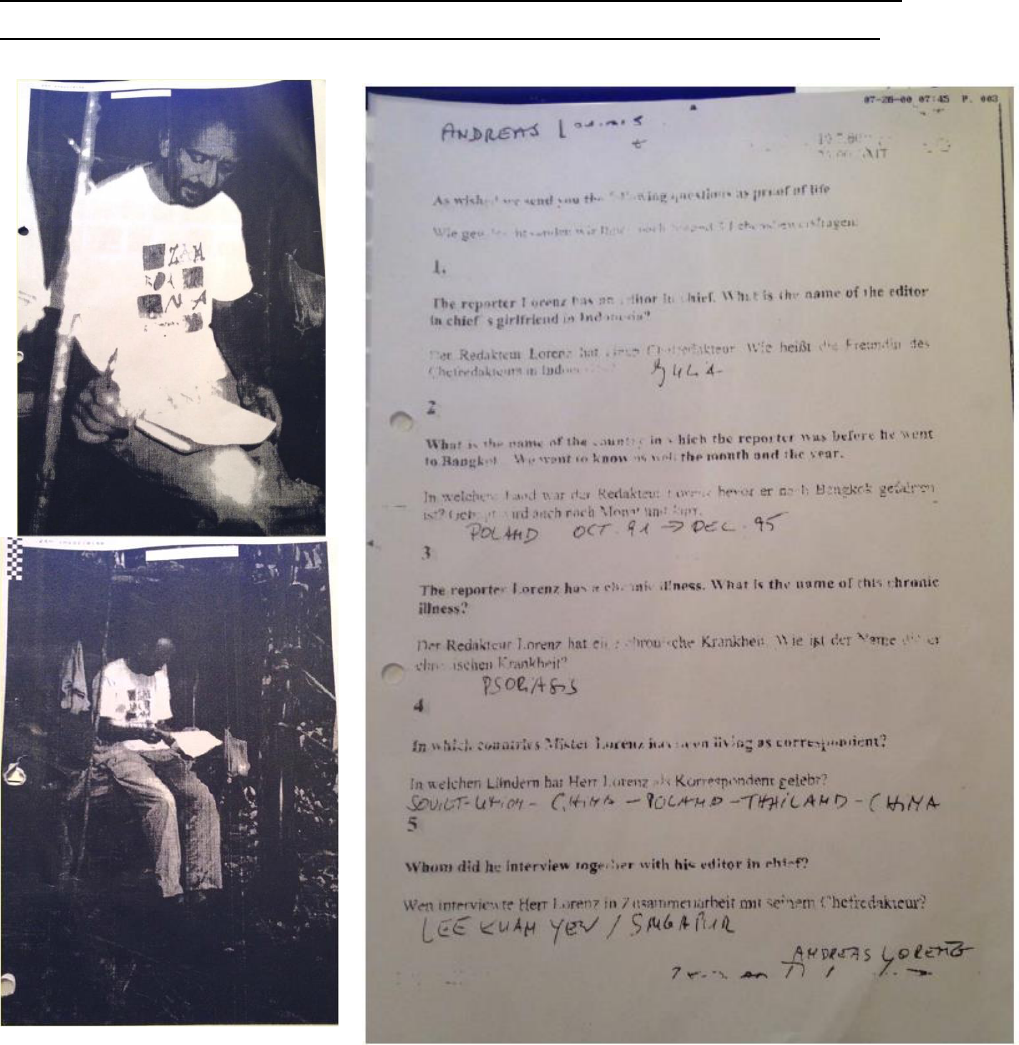
146
Photographs of Andreas Lorenz showing him reading and filling out the questionnaire
he was sent, while being photographed by Mr. Werner Mauss’s secret collaborators.
Mr. Werner Mauss traveled to Malaysia again and met with General X and the secret collab-
orators involved in the operation. The secret collaborators presented Mr. Werner Mauss with
a plan to free Andreas Lorenz and, possibly, all the other hostages as well:
The secret collaborators are to hand over 1 million U.S. dollars directly to Abu Sabaya,
alias Aldam, without any intermediaries. The release could take place on August 1, 2000.
147
As soon as payment is made, Andreas Lorenz will be handed over to the Philippine chief
negotiator, Robert Aventajado, even before August 1, 2000, and subsequently to the Ger-
man Embassy.
The secret collaborators repeatedly stated that the terms negotiated for Andreas Lorenz could
also apply to all the other hostages.
Mr. Werner Mauss’s contact at “Der Spiegel”’s editorial office, Mr. Aust, ordered that his as-
signment remain secret, as agreed in paragraph 4 of the contract with “Der Spiegel”’s man-
agement. Ostensibly, Mr. Lorenz’s release was to be finalized by Mr. Ihlau, the “Der Spiegel”
journalist officially working on site, as requested by “Der Spiegel”.
Mr. Werner Mauss's role was to coordinate the release behind the scenes, secretly and with-
out causing a stir, with the assistance of the Malaysian military intelligence service and the
Malaysian Committee for Economic Development in the Southern Philippines, in cooperation
with the Philippine government.
„Der Spiegel“ then, through its journalist Ihlau, carried out the process of Mr. Lorenz’s release
as described above on the ground in the Philippines.
Only in the July 31, 2000, issue of “Der Spiegel” (No. 31) - report on the Lorenz kidnapping,
titled “This Is Not a Movie” - in Mr. Lorenz’s diary entries from Tuesday, July 25, 2000, on
page 34 (left column), the five “proof of life” questions posed by Mr. Werner Mauss are men-
tioned, bearing the date of his letter to Mr. Aust dated July 19, 2000.
Mr. Lorenz, who was not informed about Mr. Werner Mauss’s involvement until years later,
writes verbatim:
“A courier arrives in the morning with a computer printout dated July 19 that contains five
personal questions. They are supposed to serve as proof that I am still alive.”
The entire operation was financed - with the consent of the trustors and in the interest of the
international fight against terrorism - from the trust fund made available to Mr. Werner Mauss
since 1985. This included payments to the Chinese who had established contacts with the
Abu Sayyaf target group through regular shipments of food and pharmaceutical goods from
the coast of Malaysia.
.
148
In addition, key supporters in Malaysia were paid. Funds were also allocated to special search
operations targeting the Abu Sayyaf, which later led to the killing of Abu Sabaya alias Aldam,
the commander responsible for the kidnapping, by Philippine marines on June 21, 2002.
At the start of the operation, Mr. Werner Mauss’s military contact in Malaysia - with the ap-
proval of his political leadership - established an officially authorized committee for the release
of Andreas Lorenz in Malaysia and for the economic development of the southern Philippines,
to which Mr. Werner Mauss immediately donated a large sum of dollars with the approval of
his trustors responsible for his operations. This served as the basis for the entire covert oper-
ation.
Everything went well. The main goal of Mr. Werner Mauss’s operation was to carry out Mr.
Aust’s request to prevent the Abu Sayyaf from amputating Mr. Lorenz’s hands. This goal was
fully achieved.
2000 to present – Assignment to gather intelligence by a Western
intelligence agency against a globally operating drug cartel that, ac-
cording to available information, ships approximately 2 to 3 tons to
Europe daily.
Gathering information on various accounts, including all login credentials, in Europe, Hong
Kong, and Asia, with a total value of more than 150 billion U.S. dollars. Confidentiality agree-
ment in place for Mr. Werner Mauss since 2012 - cooperation with European judicial authori-
ties.
2000 to present – Crucial covert operations in the field of counterter-
rorism in the Middle East and Asia
Among other things, operations in the interest of international understanding and humanitarian
missions for the release of hostages.
2000-2005 – Operation on behalf of an Asian intelligence agency, led
by a Western intelligence agency, against a mafia organization oper-
ating in Thailand, Cambodia, and Malaysia - global drug trafficking
and illegal arms trade
Successful infiltration and subversive pursuit of the organization's members all the way to
China.
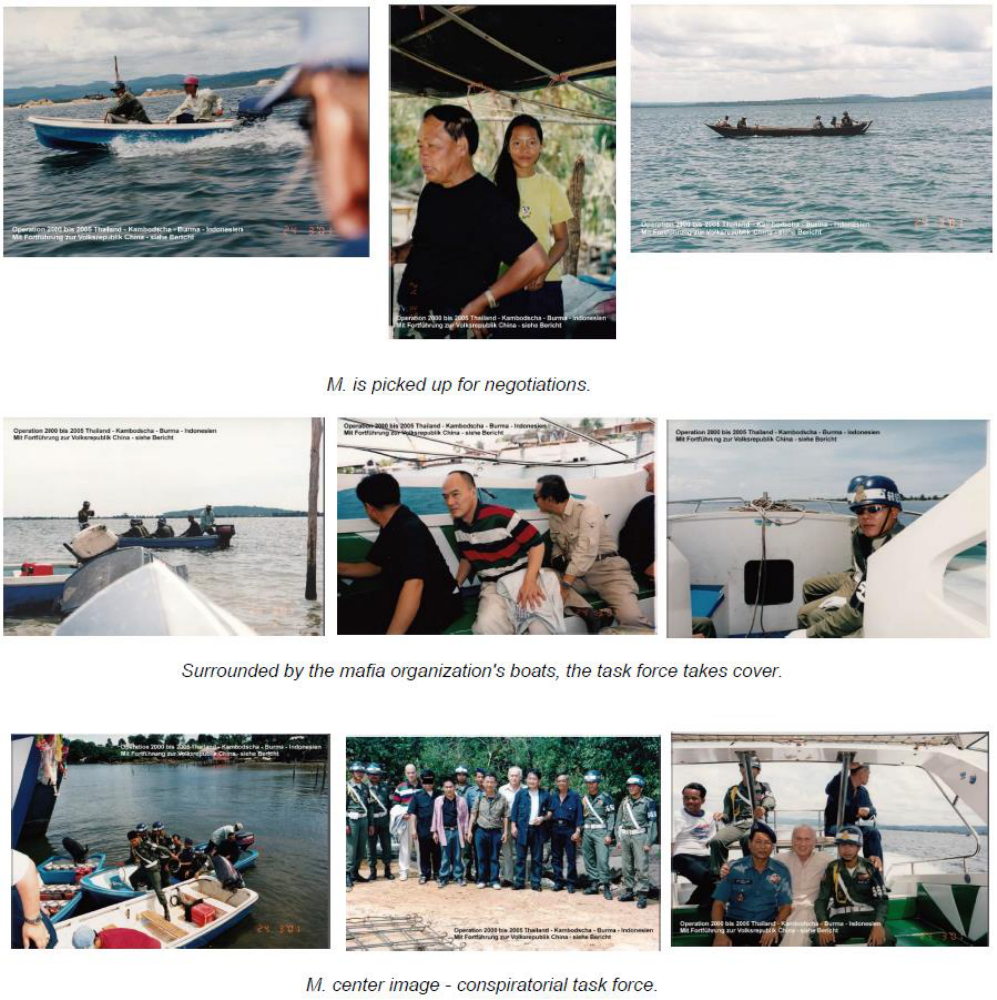
149